Preservation stories
Behind the scenes: Second Floor Living Hall

Posted 8/9/13
Updated 7/29/26
A dramatic restoration of Second Floor Living Hall was completed in 2013, restoring the room’s appearance to the era in which when George Vanderbilt opened Biltmore House in 1895.
For some years, the Second Floor Living Hall was used as an exhibition space; prior to that, it was interpreted as a sitting area. An early 1950s photo offered a glimpse of the original furnishings of this space—gilded sconces, paintings and a suite of oversized Baroque furniture placed around the perimeter of the room. Additional research led curators to determine that the room’s primary function was intended as a picture gallery and formal hallway.
Restoring Second Floor Living Hall
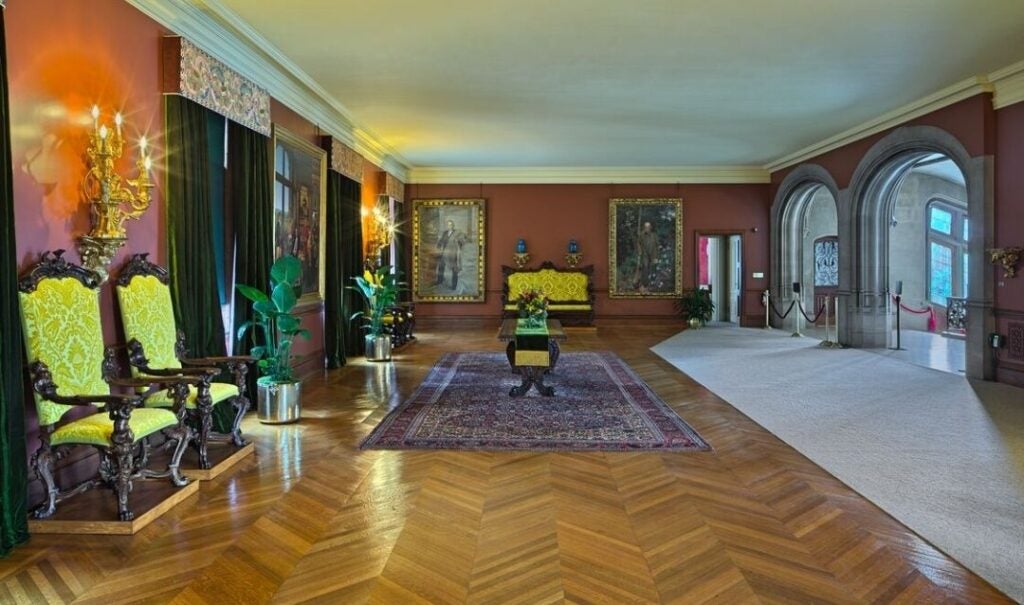
“We’re constantly striving to interpret the house authentically as it appeared during the Vanderbilts’ time,” said Darren Poupore, Chief Curator.
Bringing the room back to its original state includes conserving all the furnishings, recreating elaborate window treatments, and making structural changes.
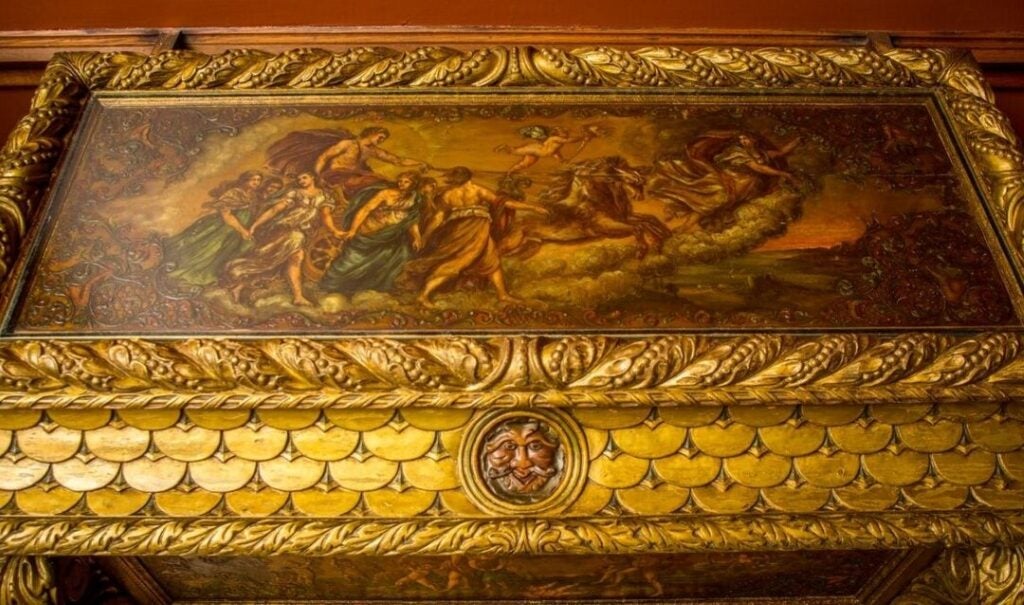
“We discovered that the original upholstery was a gauffraged fabric—a rich wool velvet with a pattern pressed into it—in a striking gold color,” said Darren. “We had it reproduced in France by Prelle, the same company that made many of our historic fabrics for the Louis XV Suite project.”
Green velvet draperies adorn windows featuring exact reproductions of four pelmets (or valances). For two years, local textile artist Heather Allen Swarttouw painstakingly embroidered and appliquéd each pelmet to match the originals.
Returning portraits to their original locations
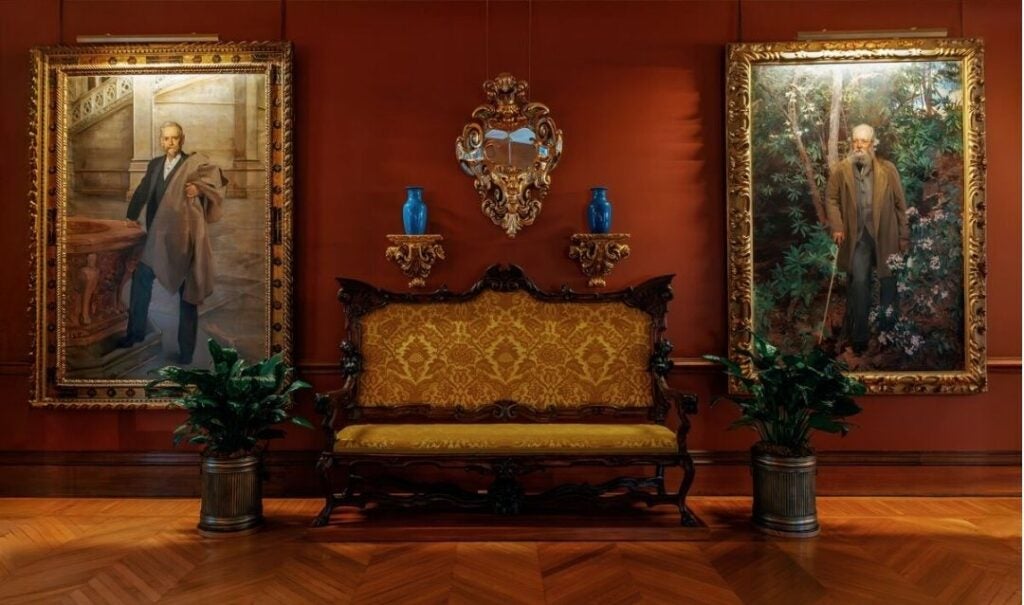
As appropriate for such a prominent space, several notable paintings were returned to their original locations. John Singer Sargent’s portraits of Richard Morris Hunt and Frederick Law Olmsted and Anders Zorn’s painting The Waltz, which were temporarily displayed in the Salon, were once again placed where George Vanderbilt intended. The restoration was completed and Second Floor Living Hall re-opened September 1, 2013.
Salon restoration
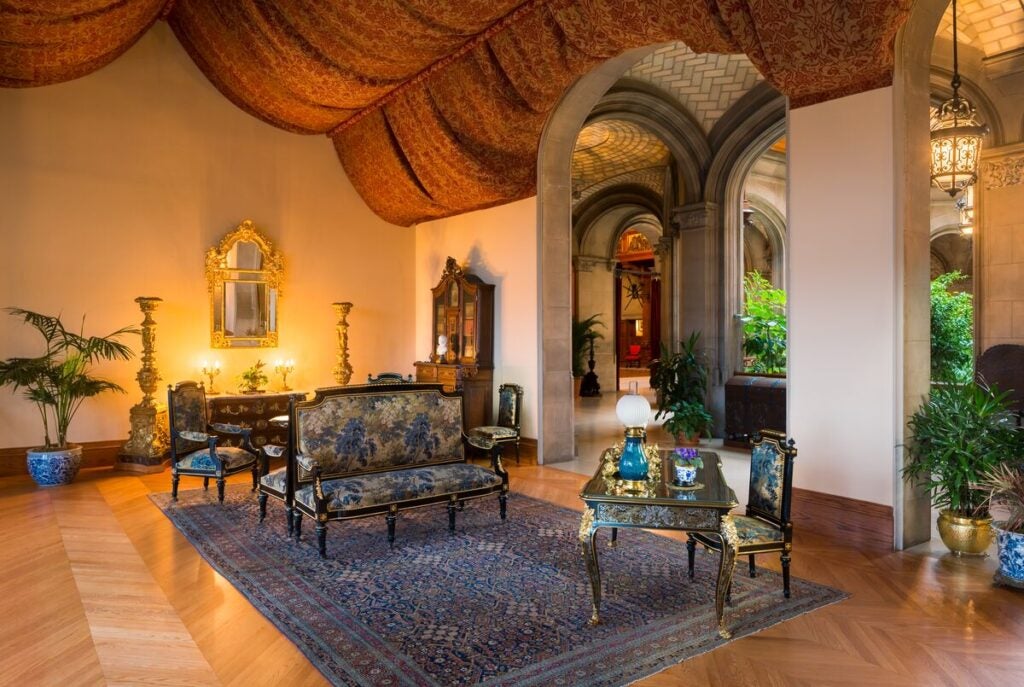
Relocating the paintings from the Salon led to its reinterpretation, centered on the fact that the Salon was one of the few first floor rooms not completed during Vanderbilt’s lifetime.
“Draperies were placed in the archways to prevent the Vanderbilts’ guests from seeing inside the room,” Darren said. “It had bare brick walls, a rough subfloor and a structural tiled ceiling without its finished treatment. In the 1920s, Edith Vanderbilt turned it into a Turkish sitting room, but in 1930 everything except the 1920s ceiling treatment was removed and it became a space to display special objects.”
Today’s guests can admire two paintings by Impressionist artist Claude Monet that are now displayed in the Salon. One is a landscape entitled Strada Romana à Bordighera from 1884; the other is a seascape entitled Belle-Île, le chenal de Port-Goulphar from 1886.
Plan your Biltmore visit today
Experience Biltmore House, as magnificent today as it was more than a century ago. Your self-guided house visit spans three floors and the basement of the luxurious family home of George and Edith Vanderbilt. Explore the stories of the Vanderbilt family, their guests, and employees through displays of vintage clothing, accessories, art, furniture, and more.


