Stable Café Pot Roast Recipe

With this delicious, slow-simmered pot roast featuring our award-winning Biltmore Estate Winery™ Cabernet Sauvignon and a hint of Biltmore® Grown honey, the culinary team at Stable Café defines what we think of as comfort food. Perfect for a cozy meal that chases the chill in the air, it’s even more satisfying when served with mashed potatoes and gravy. Pair it with the bold depths of our barrel-aged Cabernet Sauvignon or any of our dry red wines.


Ingredients

  • 4–5 pounds boneless beef chuck roast
  • 4 large carrots, trimmed and cut into chunks
  • 4 celery stalks, trimmed and cut into chunks
  • 3 large onions, peeled and quartered
  • 1 thyme bundle, tied with butcher’s twine
  • 2 cups Biltmore Estate Winery™ Cabernet Sauvignon
  • ¼ cup balsamic vinegar
  • ¼ cup Biltmore® Grown honey
  • 1 tablespoon salt
  • 1 teaspoon pepper
  • 16 ounces unsalted beef broth
  • Olive oil
  • Kosher salt and freshly ground pepper to taste
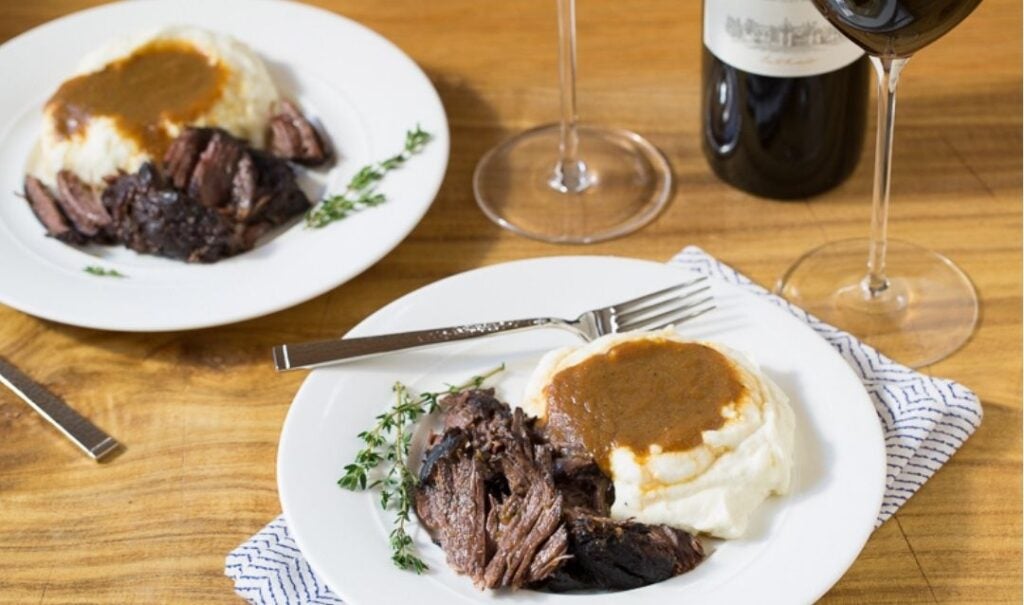
Stable Café pot roast served with Biltmore Estate Winery Cabernet Sauvignon
Enjoy the cozy comfort of Stable Café pot roast with award-winning Biltmore Estate Winery Cabernet Sauvignon

Directions
Place the beef roast, vegetables, and thyme in a large dutch oven (deep enough to submerge the roast in liquid). Pour the wine, vinegar, and honey over the top and season with 1 tablespoon salt and 1 teaspoon pepper. Marinate for at least 3 hours, and overnight if possible.

Preheat the oven to 350 degrees. Remove the roast from the marinade and reserve marinade. Pat the roast dry and season meat liberally with salt and fresh black pepper.

Place a large skillet over medium-high heat with a little olive oil. Pan-sear the roast to brown on all sides. Put the roast back in the dutch oven with the marinade. Remove the vegetables and pan-sear the carrots, celery, and onions until golden brown and return to the dutch oven.

Add beef broth, ensuring the entire roast is submerged in liquid. Place the dutch oven over high heat and bring the liquid to a simmer. Cover and quickly move the dutch oven to the oven. Braise for 2–3 hours until meat is tender enough to pierce with a fork.

Remove the cooked meat from the braising liquid and set aside. Remove thyme bundle from liquid and discard. Puree the liquid and the vegetables and strain through a fine mesh colander.

Return liquid to pot and simmer, reducing until gravy consistency is achieved. Return meat to liquid and break into portion-size pieces with a fork. Serve pot roast and gravy hot with mashed potatoes.
Biltmore Test Vineyard Offers a Grape Escape

Our test vineyard, located below The Inn on Biltmore Estate®, offers an easy “grape escape!”

Biltmore’s main vineyards are planted on the west side of the estate in an area not normally seen by guests. Opportunities to visit them are limited, but you can get a sneak peek at growing grapes by visiting our test vineyard.

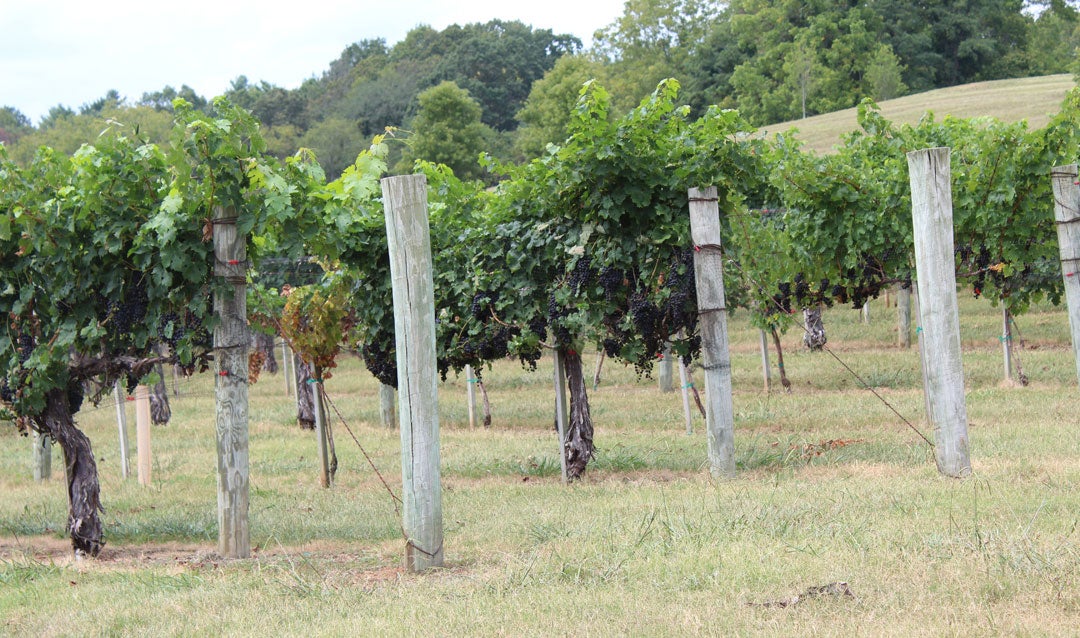
Plantings in the test vineyard

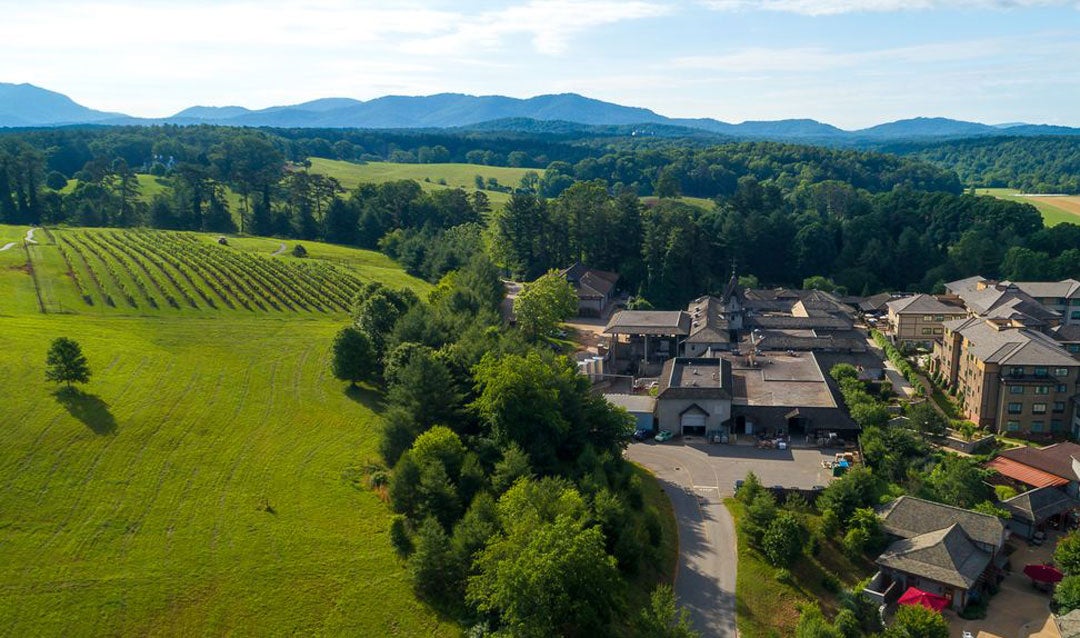
Test vineyard above the Winery at Biltmore
Rows of vines (far left) show the location of the test vineyard between The Inn and the Winery.

According to Philip Oglesby, Vineyard Supervisor, this small display area was planted by the Vineyard team in 2000 to offer guests at the Winery and The Inn an opportunity to see first-hand how Biltmore wine grapes are grown.

There were two acres of plantings originally, but a small portion was removed to make room for the walking path between The Inn and Winery once The Inn was finished in 2001.

“Cabernet Sauvignon is the grape of choice for the test vineyard because that varietal had already proved hardy in our main vineyards,” said Philip. “We have experimented with other varietals like Sauvignon Blanc and Syrah at times to see how a particular grape performed in our climate, but Cabernet Sauvignon is still the primary variety you’ll find in this little vineyard.”

Discover each season in the test vineyard

Biltmore test vineyard offers a grape escape
The test vineyard gives guests an opportunity to see how grapes are grown at Biltmore.

Since the test vineyard was developed, guests have been able to see a small-scale version of the grape-growing process in each season, from caring for the vines in winter to bud break in spring and ripening fruit during the summer.

Each fall, the grapes in this small vineyard are harvested for use in Biltmore wines. It typically takes Philip’s harvest crew of approximately 30 people one full day to pick the grapes by hand and bring them down to the crush dock behind the Winery.

Protection from predators

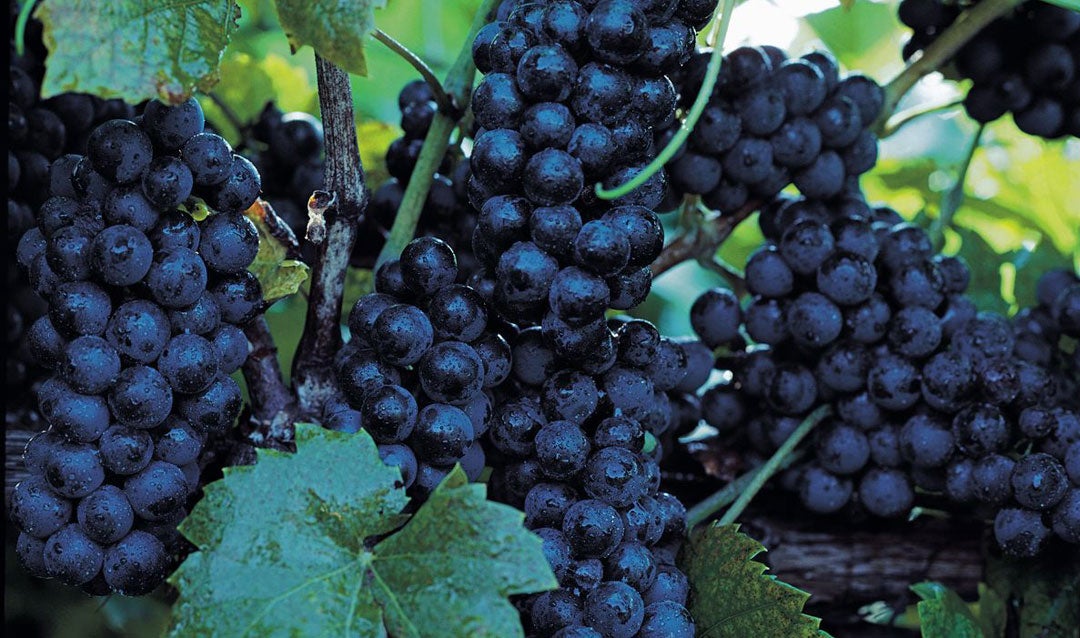
Clusters of ripe red grapes in Biltmore's vineyard
As the grapes ripen in our vineyards, the fruit must be protected from uninvited guests such as robins, geese, and turkeys.

Today’s visitors will notice a fence around the vineyard—it was added to keep deer from damaging the plants and fruit. In addition to keeping the deer out, Philip’s crew places netting on the vines in August every year to prevent bird damage.

“We have to keep birds—especially robins—out of the vineyard or else we would have nothing left there,” said Philip. “Birds aren’t usually a big deal for the west side vineyards during most years, and I honestly do not know why they like to pick on the little Test Vineyard so much!”

For the main vineyards on the west side, Philip’s team has to contend with damage by geese (and turkeys, to a lesser extent), which can lead to fairly significant crop loss.

“During years when there are fewer wild berries and seeds, I have noticed that smaller birds will also seek out grapes as an alternate food source on the west side, but this is not a frequent problem,” said Philip.

Plan your own grape escape now!

Couple drinking Biltmore wine
Enjoy Biltmore wine on the estate and at home.

Visit Biltmore Estate in Asheville, NC, and see the test vineyard for yourself. Make it a real “grape escape” with overnight accommodations at The Inn, Village Hotel on Biltmore Estate, or one of our private historic Cottages on Biltmore Estate™.

Featured image: The Inn on Biltmore Estate above the test vineyard