A Birthday for Edith Vanderbilt

In honor of the 141st anniversary of Edith Vanderbilt’s birthday, we have been reflecting back on the festive days surrounding her arrival at Biltmore in 1898. Since George Vanderbilt had mainly courted Edith Stuyvesant Dresser abroad, estate managers and employees were filled with curiosity about the future Mrs. Vanderbilt. The Vanderbilts were married in a relatively simple ceremony in Paris in June.  While George and Edith were on an extended honeymoon in Europe, the estate made preparations for a celebration befitting a queen.

What would their first impressions be? No one was quite sure what to expect. When the newlyweds’ train arrived at the passenger depot in Biltmore Village, curious onlookers, civil authorities, and hordes of media watched on as Mr. and Mrs. Vanderbilt boarded a carriage bound for their future home.  Biltmore’s Chief Forester, Dr. Carl Alwin Schenck, shared a vivid description of this momentous occasion in his book Birth of Forestry in America:

“The young couple, our lord and his lady, arrived on a gorgeous afternoon and were welcomed by the officials of the estate at a huge horseshoe of flowers overarching the approach road to Biltmore House. All was cheers and smiles and happiness! Mrs. Vanderbilt! One could not help but love her! Her face…was sparkling with kindness, sweetness, lovability, grace, and womanliness.”

After passing under this emblem of good luck, the Vanderbilts were greeted by estate employees and their families lining both sides of the road. Following an English baronial tradition, each worker held a symbol of his trade and the children joined in welcoming Edith to her new home.  The sheer number of estate employees must have been overwhelming, but there were still many more surprises in store for Mrs. Vanderbilt. A lengthy article from the Asheville Daily Citizen detailed the celebrations once the party had reached Biltmore House:

At night the employees continued the festivities… Shortly after 9 o’clock the men met north of the esplanade and Mr. and Mrs. Vanderbilt viewed the scene from the roof balcony over the main entrance to Biltmore House.

The Biltmore band, stationed in the tea garden at the top of the vista began an inspiring march, and the men with torches moved in converging lines…to the winding steps of the rampe douce, where the march continued in crossing belts of fire…Suddenly their appeared a glow of light on the ridges of the deer park and within a brief period there was a brilliant illumination of the grounds by colored arc, extending to the lake and through the shrubbery of the winding roads and walks.

The finale of the illumination came in showers of flaming stars from fireworks that exploded in different points surrounding the mansion.  On Pisgah and other prominent peaks of the estate huge bonfires were lighted and beamed their welcome. Mr. and Mrs. Vanderbilt evinced great interest in the event of the evening and frequently applauded the hearty endeavors of the men who were showing their good will to the bride. At the conclusion of the illumination and until past midnight the employees enjoyed refreshments in the open before the conservatory. 

Dr. Schenck’s memoir makes it clear that the employees offered Edith a grand welcome not only onto estate, but into their lives. Schenck wrote:

“…Mrs. Vanderbilt took a personal interest in every man and woman connected with the estate. … she went to every humble cabin of a forest worker in Pisgah Forest when she was near it; she encouraged the small home industries… at Christmas she had a small gift for every child of every employee of the estate; and  whatever she did or said, she did or said so gracefully that she put at ease whomever she met.”

Mrs. Vanderbilt’s long legacy of grace and heartfelt hospitality is still very much alive at Biltmore. What fun it has been to look back at first impressions, grand celebrations, and the cherished memories of such a special woman who helped to shape and preserve the estate.  Happy Birthday, Edith!
A Vanderbilt Christmas

Biltmore’s archives are full of letters and documents detailing the lives of George and Edith Vanderbilt, their daughter, Cornelia, and many of their friends and family members who visited them at Biltmore.  Below are some of the Vanderbilts’ yuletide traditions…and even a glimpse of the food they enjoyed during the holidays.

How did our Christmas tradition begin?

Although George Vanderbilt moved into Biltmore House in October 1895, the house did not officially open to guests until Christmas Eve of that year.  Great efforts were made to ensure all (or most!) would be ready by this special day.  Mr. Vanderbilt was still a bachelor during the first Biltmore Christmas and his mother, Maria Louisa, presided as hostess. 

Correspondence between Mr. Vanderbilt and his staff indicates that planning was intensive and no detail was left unattended.  Managers debated which nearby county had the best holly and the most desirable mistletoe, while staff scouted for the perfect candidate for the Banquet Hall Christmas tree.

Mr. Chauncey Beadle, estate horticulturalist, writes estate manager, Mr. Charles McNamee:

“I quite agree with you that we should have a very large tree for this occasion; in fact, I think a twenty foot tree in that large Banquet Hall would be rather dwarfed.”

When Mr. Vanderbilt’s mother, several of his brothers and sisters and their spouses, and assorted nieces and nephews arrived, they were greeted in the Banquet Hall by a splendidly tall tree laden with gifts for estate workers.  At the foot of the tree was a table piled high with family gifts.  Because of this, the Banquet Hall has always been the focal point for Christmas celebrations in Biltmore House.  

A Family Gathering

The family and guests gathered around the 40-foot Banquet Hall table for elaborate dinners served both evenings.  Mr. Vanderbilt’s niece Gertrude kept a series of Dinner Books in which she recorded the seating arrangements of all of the parties and dinners she attended as a young woman, and she was one of the guests at the first Christmas dinner in Biltmore House. Gertrude kept two Dinner Books in 1895, and the Christmas meal at Biltmore House was the 193rd formal dinner that she attended that year.  In her diagram of the dinner, she listed 27 Vanderbilt family members.  It was said to be the largest gathering of the family since the death of William Henry Vanderbilt, George’s father, in 1885.

In addition to the grand meals and festive décor, stockings hung on mantles, plum puddings and mince pies were served, and George’s mother read “‘Twas the Night Before Christmas” to the children.  It must have been a grand time — one article even stated that the family exchanged gilded and jeweled Christmas cards!

Christmas and New Year’s meals in Biltmore House, 1904

In 1904, George and Edith Vanderbilt were raising their 4-year-old daughter, Cornelia, in Biltmore House.  The 1904 Menu Book, kept by cook Esther Anderson, contains luncheon and dinner menus for Christmas Day and New Years Day.  Surprisingly, they are not the most elaborate meals included in the book.  The 1904 Christmas Day luncheon featured a fairly light menu that began with clear broth, followed by broiled oysters.

The Christmas Day luncheon entrée consisted of venison steak (very likely from the estate deer herd), served with string beans, potatoes and cauliflower.  The salad course consisted of roast partridge and salad.  Luncheon dessert consisted of apple tart, not surprising, since estate orchards produced over twenty varieties of apples. Coffee followed dessert and served as a separated course.

Christmas dinner began with Consommé Royale, a clear chicken broth thickened with tapioca and served with a savory garnish made from bullion, egg and herbs, poached in buttered molds, floating in the broth. A fish course of broiled Spanish mackerel accompanied by cucumber salad came next. 

The main course featured roast turkey and cranberries, served with potatoes, peas and celery.  The Vanderbilts ate turkey in one form or another on average every three days.  Mrs. Doris Johnson, whose daughter-in-law, Ellen, was a Biltmore House cook at the turn of the century, recalled that turkey and dressing were Mr. Vanderbilt’s favorite of all the things Ellen cooked, and it is very likely that turkey was indeed one of Mr. Vanderbilt’s favorite foods.  A salad of Virginia ham and spinach followed. Christmas dessert consisted of plum pudding, ice cream and cake.

The New Years Eve luncheon began with fish cutlets, followed by braised rabbits and lamb chops served with potatoes, beets and stuffed tomatoes. Chicken salad followed, and dessert consisted of apple tapioca pudding, followed by coffee.  New Years Eve dinner began with either purée of chickens or consommé, followed by the fish course consisting of mousse of bass. The mousse was followed by an entrée of mushroom patties, and a relevé consisting of filets of beef with potatoes, spinach and baked macaroni. Roast partridge accompanied the salad. 

New Years Eve dessert was Fanchonette, an “old-fashioned French cake, somewhat like a pie made with rough puff pastry and a pastry cream filling baked in a slow oven. After cooling, it is piped with meringue, sprinkled with sugar and baked until brown.   Coffee followed dessert, and midnight toasts no doubt welcomed the New Year!

Eugenia and Her Ornaments

We are fortunate to have treasured stories from people who lived, worked or visited Biltmore throughout our history. These colorful recollections give us real clues to what life was like at the estate. They also serve as the foundation of stories we share with guests who visit us today. Eugenia Hallyburton Chandler shared one recollection of being a child on the estate at Christmas. Her story illustrates both her love of the beautiful holiday decorations and the candor of her youth!

For the youngest members of the estate, treats like special sweets, clothing, games and toys were standard gifts. Eugenia recalled the Christmas parties in the Banquet Hall; where there were “mounds of oranges . . . and this beautiful Christmas tree and I know they had gifts for all the kids.” One year Eugenia was given paper dolls as a gift from Edith Vanderbilt. And as children sometimes will do, she honestly replied that she didn’t like them and asked Edith to give them to someone else.

We have all wondered if that comment caught Edith by surprise, but Eugenia recalls she said “Well, Eugenia, what would you like?”  Eugenia replied, “That ball, right up there.” Pointing to the tree, she had her eyes set on a colorful, shiny glass ball hanging from the tree branches. Quotes like this next one tell us so much about the personality of Edith Vanderbilt. Eugenia remembered, “she called in Donohue [the butler] and she stripped that tree and gave those balls to the children. She knew what they liked.  Every time she went on a trip and came back after that, she would bring me some Christmas balls.”

Our design team enjoys remembering Eugenia and her beloved Christmas ornaments when they decorate the Banquet Hall tree each year. The team hangs hundreds of colorful balls on trees in the house, some inspired by the ones that Edith may have presented to the children. When she became an adult, Eugenia displayed her beloved collection in her home every year until an accident one holiday season. “I had some of the prettiest ones you ever saw until my cat pulled the tree over in the foyer and broke them all,” she shared.  While her story has a bit of a sad ending, we so enjoyed hearing about Eugenia’s fond Christmas memories of Biltmore and her ornaments.

The Making of Christmas at Biltmore

Each year at this time, signs of Christmas start to show up around the estate.  A tree here, a beautiful wreath there….all magically appear for guests to enjoy.   But behind all of this magic is a dedicated team of creative designers who are hard at work.  Every ornament, arrangement and yard of fabric is selected precisely for its intended location and specifically for that year.  The imagination and expertise of this team seems endless and their enthusiasm knows no bounds.


With that endless creativity comes a long list of supplies required to decorate America’s largest home and surrounding buildings on the estate.  From trees to bows, and countless ornaments in between, below are the Biltmore-sized trimmings for this holiday season.

Trees

A combination of fresh cut Fraser fir and artificial trees are used inside Biltmore House for fire safety and the protection of the collection. Designers also use potted holly trees, deciduous and evergreen trees and shrubs as decoration, both inside and outside. 

  • The 2013 celebration boasts 56 decorated Christmas trees inside Biltmore House.
  • The largest tree inside Biltmore House is the Vanderbilt traditional 35-foot-tall Fraser fir in the Banquet Hall.
  • A lighted 55-foot-tall Norway spruce with other evergreens decorates the front lawn of Biltmore House.
  • A total of 58 additional decorated Christmas trees are at other estate locations, including the Winery, Inn on Biltmore Estate, Antler Hill Village and restaurants.

Lights and Candles

There are around 30,000 lights and 150 candles inside Biltmore House. Over 130,000 LED and mini lights are found around the estate.  The Front Lawn tree features 45,000 lights and lighting accents are placed at the base of the poplar trees lining the front lawn.  Three hundred luminaries line the driveway and Esplanade in front of Biltmore House.

Ornaments

Five hundred gift boxes, 500 ornaments and 500 electric lights decorate the Banquet Hall Tree. There are 12,000 ornaments used on the other trees inside Biltmore House, and another 10,000 used around the estate.

Poinsettias and Other Blooming Plants

There are traditional red poinsettias, along with amaryllis, Christmas cactus, orchids, peace lilies, cyclamen, begonias, and kalanchoe in the displays.  Around 1,000 blooming plants are used during the season inside Biltmore House, along with several hundred more in the other estate facilities.

Wreaths

Wreaths are made of fresh white pine and Fraser fir, ornamented with golden arborvitae, holly, or other natural materials such as twigs and cones.  Artificial bases are decorated with ornaments, berries, silk flowers and ribbon.  Over 360 fresh wreaths and sprays along with 130 permanent botanicals are found around the estate during the season.

Kissing Balls

Guests will find 130 orbs made of fresh white pine and Fraser fir, or made of dried and faux materials are found all across the estate.

Garlands

Each season, designers use 5,000 feet of fresh evergreen garlanding of mixed white pine and Fraser fir. The garlands are replaced weekly to maintain a fresh look and fragrance for our guests.  Silk garlands add another 1,200 feet in Biltmore House and around 1,500 feet in other areas.

Ribbons and Bows

Biltmore House features 500 ribbons, while another 500 are used at other estate venues.  Bows are made from narrow cording to 8-inch-wide ribbons of velvets, metallics, satins, burlap and printed cottons.

A Shared History of Wine

A Shared History of Wine

The muscadine grape is native to North Carolina, thriving all across the region’s geography and climate, from the mountains to the piedmont to the coast. Scuppernong, a variety of muscadine, is designated as the official state grape and has long been a favorite ingredient in jams and jellies and wines.

Vitis vinifera, the type of grape associated primarily with winemaking, is not native to North Carolina. It prefers a classic Mediterranean climate of hot days, cooler nights, dry breezes, well-drained soil, and limited rainfall.

Taking Root

How then, did vitis vinifera get started in North Carolina?

It began with Biltmore, America’s largest home and the private estate of George Vanderbilt. More than 100 years ago, Vanderbilt envisioned his estate as a large-scale working farm that would generate produce and revenue to support and sustain itself. Original initiatives included a market garden, a nursery that shipped estate-raised plants around the world, and a dairy operation that eventually became one of the largest in the Southeast. From the Great Depression through the end of World War II, the Biltmore Dairy provided vital economic support for the estate.

In 1960, George Vanderbilt’s grandson William Cecil took over management of Biltmore. As an astute businessman, he immediately looked for diversification opportunities in harmony with the Biltmore brand to help sustain the property. In keeping with his grandfather’s vision of a working agricultural property, he realized that nothing was more appropriate for a French chateau than a vineyard.

Mr. Cecil went to the agricultural extension experts at NC State for assistance with his vineyard project in 1971. He was advised to work with native muscadines that were already growing in the Walled Garden.

After producing wine from these grapes, he was unsatisfied with the results and turned to Cornell University for assistance. They advised that he experiment with French-American hybrid grapes since some American growers in less-favorable climates were having success with them. After harvesting and wine production, however, Mr. Cecil was unsatisfied with the results.

Still convinced that a vineyard was the right move for Biltmore, Mr. Cecil went to the Department of Vitaculture and Enology at the University of California at Davis. Although experts there initially told him that vinifera cultivation was not possible in Western North Carolina, he pushed on, planting the first vinifera grapes on the west side of the estate in 1978. In his book Lady On The Hill, Mr. Cecil notes that“Asheville was about the same latitude as Gibraltar in the Mediterranean, and with an altitude between 2,100 and 2,500 feet, the fields of the estate would enjoy warm days and cool nights in the summer.”

At last, Mr. Cecil was satisfied with the type and quality of the grapes, and the winemaking venture moved ahead. In 1983, the Biltmore Estate Wine Company established and renovation began on the original Dairy structure to convert it into a state-of-the-art winery, which opened to the public in 1985.

Present and Future

In the past three decades, the Biltmore Winery has emerged as the most-visited winery in the nation, winning numerous prestigious awards and points rankings in competition with the finest wines in the world.

In that same time, North Carolina grape growers and winemakers have benefitted from the wine industry knowledge and expertise that developed around Mr. Cecil’s vision for his family’s home. There are now more than 400 vineyards and 100 wineries across the state, and the numbers continue to rise. Some agricultural forecasters have suggested that growing grapes may eventually provide a viable economic alternative to traditional tobacco farming.

In celebration of North Carolina Wine Month, we are also celebrating William Cecil’s determination and dedication to his own dreams of making Biltmore Wines a reality that would support the mission of preserving Biltmore as a privately owned working estate.

Learn more about our wine story.

Ted’s Favorite Places

Ted Katsigianis has experienced a lot during his three decades at Biltmore. As Vice President of Agriculture and Environmental Sciences, he directs a staff that works in traditional agriculture such as forage and field crops, and livestock including cattle, sheep, goats, and poultry. He also works with the Equestrian Center programs. As if that’s not a fulltime job, he’s also in charge of environmental initiatives and sustainability!

The Farmyard in Antler Hill Village is one of his favorite locations at Biltmore because of his personal connection to the area.

“I was heavily involved with the restoration of the Antler Hill Village Barn project and creation of the Farmyard. It’s a pleasure to see guests young and old enjoy interacting with our animals. The children are especially thrilled,” he says. “I enjoy admiring the sheep and cattle in the production pastures, and watching the poultry and baby goats in the Farmyard.”

His other favorite view is found on the estate’s West Side, located across the French Broad River from Biltmore House. The rolling pastures give way to Long Valley Vineyard—one of Biltmore’s earliest vineyards—with Long Valley Lake in the distance. Ted was a member of the team that helped create Long Valley Vineyard, and he’s proud to be a part of estate history in that regard.

“We were breaking new ground for a specialty crop grown in Western North Carolina, and we didn’t have anything to go by,” he explains. “I was in charge of the vineyard for 17 years, and some of our best harvests occurred during this time.”

If you would like to experience the views from the vineyards, we recommend the new Vine to Wine Tour offered on Saturdays and Sundays now through fall. This exclusive guided tour incorporates tastings of our best Biltmore wines while taking you to the vineyards and behind-the-scenes Winery production and bottling locales, finishing with a premium grand tasting and gourmet nibbles. You must have a Biltmore admission ticket or Annual Pass to participate.

Call us at 800-543-2961 to make reservations.

Behind the Scenes: Big Reveal Set For Fall

Two rooms inside the 250-room Biltmore House – the Second Floor Living Hall and the Salon – will re-open this fall after the estate’s Museum Services team restores them to their appearances as they were when George Vanderbilt opened the home in 1895.

In recent years, the Second Floor Living Hall has been used as an exhibition space; prior to that, it was interpreted as a sitting area. An early 1950s photo offered a glimpse of the original furnishings of this space—gilded sconces, paintings and a suite of oversized Baroque furniture placed around the perimeter of the room. Additional research led curators to determine that the room’s primary function was intended as a picture gallery and formal hallway.

“We’re constantly striving to interpret the house authentically as it appeared during the Vanderbilts’ time,” said Darren Poupore, Chief Curator.

Bringing the room back to its original state includes conserving all the furnishings, recreating elaborate window treatments and making structural changes.

“We discovered that the original upholstery was a gauffraged fabric—a rich wool velvet with a pattern pressed into it—in a striking gold color,” said Poupore. “We had it reproduced in France by Prelle, the same company that made many of our historic fabrics for the Louis XV Suite project.”

Green velvet draperies will adorn windows featuring exact reproductions of four pelmets (or valances). For two years, local textile artist Heather Allen Swarttouw painstakingly embroidered and appliquéd each pelmet to match the originals.

As appropriate for such a prominent space, several notable paintings are being returned to their original locations. John Singer Sargent’s portraits of Richard Morris Hunt and Frederick Law Olmsted and Anders Zorn’s painting “The Waltz,” which have been hanging temporarily in the Salon, will once again hang where George Vanderbilt intended. The restored room will be completed and re-opened September 1st, 2013.

Relocating the paintings from the Salon has led to its reinterpretation, centered on the fact that the Salon was one of the few first floor rooms not completed during Vanderbilt’s lifetime.

“Draperies were placed in the archways to prevent the Vanderbilts’ guests from seeing inside the room,” Poupore said. “It had bare brick walls, a rough subfloor and a structural tiled ceiling without its finished treatment. In the 1920s, Edith Vanderbilt turned it into a Turkish sitting room, but in 1930 everything except the 1920s ceiling treatment was removed and it became a space to display special objects.”

Curators decided to tell the story of how the room has changed through the years. Removal of a wall revealed an original firebox and brick walls. A section of the fabric ceiling treatment is being removed to show the terra cotta tiled ceiling above. Information panels will explain the new interpretation of the room when it re-opens October 1st, 2013.

Learn more about the Biltmore house.

Finding Summer Beauty in the Italian Garden

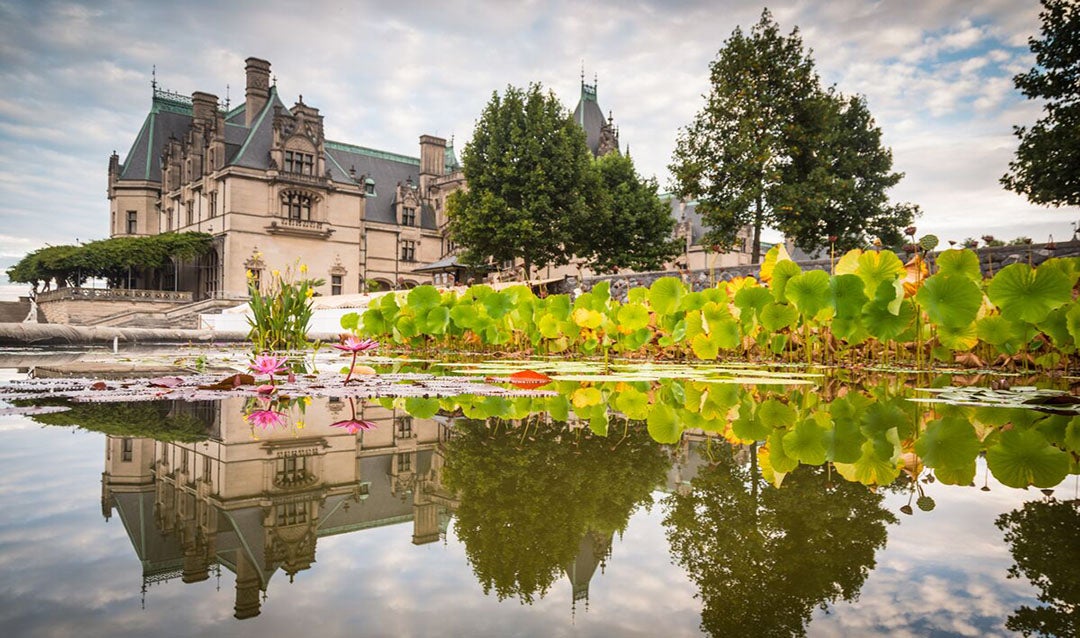
If you’re visiting Biltmore soon, make a beeline for the Italian Garden. Located adjacent to Biltmore House, this formal garden is in its prime late summer.

View of the Italian Garden and Biltmore House
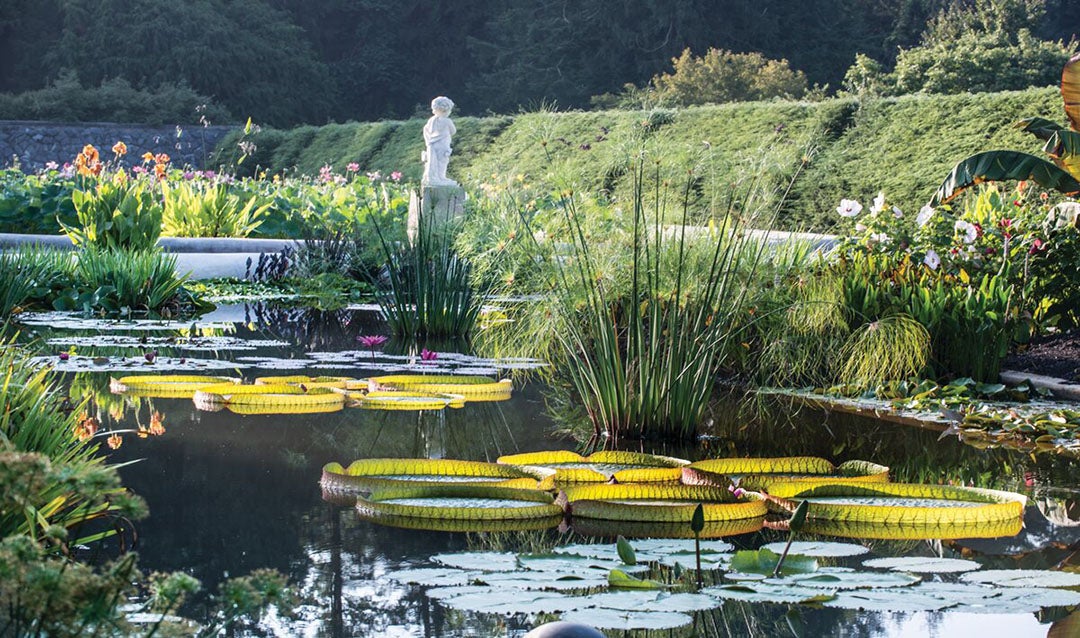
Filled with numerous varieties of exotic water lilies, tropical bananas, papyrus, and koi fish, the Italian Garden is a sight to behold.

Magical Lilies

Biltmore gardeners Chuck Cissell and Steven Ayers have been hard at work all year ensuring all the elements are in place for spectacular summer blooms. The Italian Garden gets better every year. This year, it is over the top again and this is probably the best year yet for seeing our water lilies.

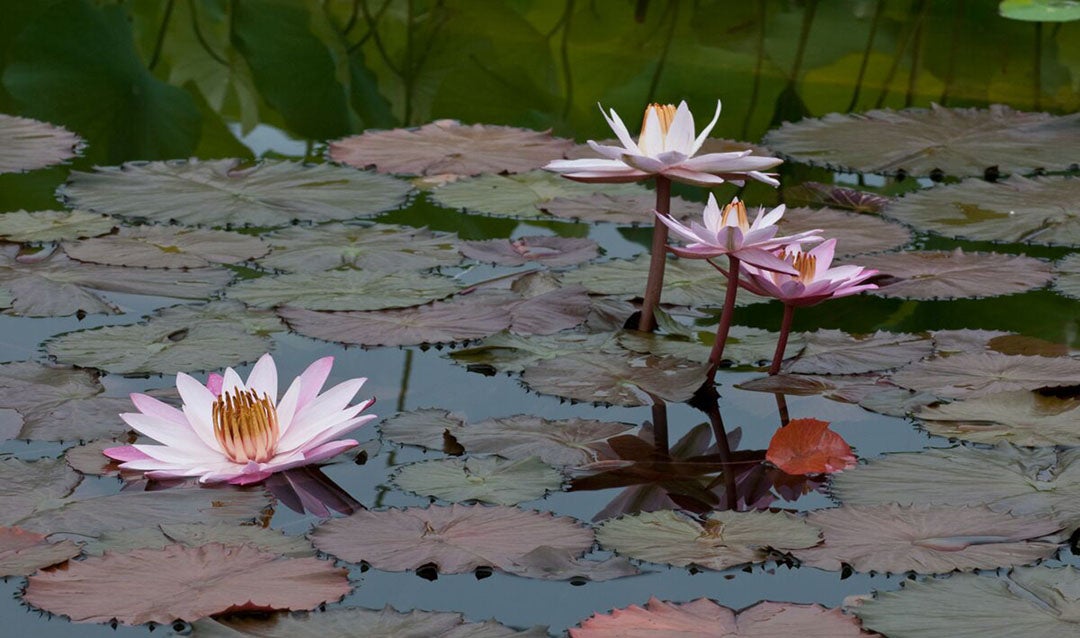
All three pools feature different water lilies including hardy and tropical varieties. We’re especially fond of our tropical water lilies that open up in the evening and bloom until mid-morning. If you’re an early morning guest or an overnight guest, sneak down to the Italian Garden to enjoy this unique display.

Water lilies in the pools of Biltmore's Italian Garden
Many guests don’t realize that lily blooms only last for three days. Many refer to the bloom process as being “sort of magical.”

The blooms from the tropical lilies sit above the water and feature bright white, pink, red and even blue blossoms. It’s a marvelous sight to see and just another amazing example of nature’s beauty.

If you miss the tropical night blooms, don’t worry. We have planted different varieties, so guests visiting during the day can still enjoy flowers from day blooming tropical and hardy lilies as well. Look for the blooms through the first cold snap, which can be as early as September or as late as October.

Full view of flowers blooming at the Italian Garden Pools at Biltmore
The Italian Garden closely resembles the original blueprint by Olmsted, with the only main difference being the center bed display.

Blooming Blueprint

While the lilies are the one the highlights of the Italian Garden, the pools include an array of other plants. Lotus, Victoria water platters, canna lilies, papyrus, water snowflakes, and purple leaf rice are all in bloom right now.

Perhaps one of the most rewarding aspects of visiting the Italian Garden is the fact that the design intent has remained unchanged since Vanderbilt’s time. Two of the pools have been refurbished, and the Hemlock hedges have recently been replaced with American Holly hedges to stay true to Olmsted’s vision for the garden. The plants used pay homage to gardening notes and plant orders found in estate archives. We don’t do anything different in the Italian Garden than what they did back in George Vanderbilt’s day.

Bring Home the Beauty of the Italian Garden

Water Gardening is easier than you think. Below are some quick tips for creating a backyard water garden:

  • Select a sturdy, large ceramic container that can hold water.
  • Find a location that receives at least eight hours of sunlight, and use pavers or bricks to form a level base for the container.
  • Start with a fool-proof water plant such as tropical water lilies.
  • Plant the water lily in a small plastic container filled with topsoil and plunge the pot into the larger container filled with water. Cover the soil with pebbles or sand to prevent muddy water.
  • The top of the lily’s pot should be eight inches below the surface of the water. If necessary, add bricks or blocks to form a base within the water container. Finish off the water garden by adding water lettuce or other floating plants.
  • Maintain your water garden by cutting spent blooms on the lily and pushing a fertilizer tablet into the lily’s soil every few weeks.

Learn more about our gardens and grounds.

The Royal Bundle Revives a Biltmore Memory

This week’s arrival of William and Kate’s baby – His Royal Highness Prince George of Cambridge – has us thinking back to the summer of 1996 when the child’s grandfather, Prince Charles, visited Biltmore.

The occasion? To launch the first American Summer School of the Prince of Wales’ Institute of Architecture.  Biltmore House hosted the school’s students for a week that summer. They studied drawing while immersing themselves in the works of the estate’s designers Richard Morris Hunt and Frederic Law Olmsted.

The idea for hosting the school came after William A.V. Cecil Sr., George Vanderbilt’s grandson, attended a dinner party at the Prince’s Gloucestershire estate in 1995. The Asheville Citizen-Times reported Mr. Cecil said the Prince was interested in supporting good architecture in the aftermath of World War II. The war devastated many historic structures in London, and the city’s reconstruction wasn’t to everyone’s liking. That sentiment, he said, inspired Prince Charles to start the school.

While the Prince was at Biltmore, William and Mimi Cecil hosted a reception for him and his staff on the Loggia of Biltmore House. As the photo shows, the Prince’s visit caught the attention of lots of news photographers and of course, Biltmore guests!

Planning for such a visit during Biltmore’s high season was no small task, having started many months ahead of the June visit. Countless phone calls between Biltmore and Buckingham Palace took place, says Debbie Robinson, who works in Biltmore’s Marketing Department.

Bill Alexander, Biltmore’s Landscape and Forest Historian, was part of the welcome party that day, and with Bill Cecil, Jr., toured the Prince and his party through the gardens and Conservatory. So impressed with the gardens and Bill Alexander’s knowledge about the history of Biltmore and gardening in general, the Prince offered a special invitation.

“He said that I was welcome to visit Highgrove, his country estate in Gloucestershire,” says Bill, noting he’d shared his upcoming plan to lead a tour group through the English countryside with stops at notable gardens along the way. Bill made an immediate change to the group’s itinerary and later that fall, he and his tour group were welcomed by the Prince’s staff at his home. Unfortunately, an emergency took the Prince away from home that day, but his staff received Bill and the group like honored guests, treating them to an elaborate tea held in the Prince’s dining room after a grand tour by the head gardener.

It’s a lovely footnote in Biltmore’s recent history. We hope that Prince Charles is enjoying his new grandson. And our most heart-felt congratulations to William and Kate!

About the Photos

Main photo: William A.V. Cecil Sr. greets Prince Charles at the front door of Biltmore House, Summer 1996. Photo courtesy of the Asheville Citizen-Times, by Debbie Chase-Jennings.

Greg’s Favorite Places

As head instructor for the Land Rover Experience Driving School at Biltmore, Greg Nikolas has what many people consider an ideal job. Greg drives luxurious and highly capable Land Rovers to rarely seen places on the estate while instructing guests on how to improve their off-road driving skills. The experiences range from 1 or 2-hour lessons on obstacle courses with steep descents, side-tilts, and rock crawls to full-day training in off-road techniques and recovery.

He doesn’t deny that it’s fun—he’s worked for Land Rover for 15 years, including the past 9 years at Biltmore’s program. And while he enjoys the time he spends navigating and instructing guests as they pilot Land Rovers through woods and fields, there are two locations on the estate he considers his favorites.

The first spot is the statue of Diana, located at the top of the Vista that faces Biltmore House.

“The view of Biltmore House from Diana is spectacular. Every time I’m there I think about how George Vanderbilt must have felt seeing his home from this vantage point. This particular view really puts the house’s size and splendor into perspective,” Greg says.

His other favorite is less well-known but just as scenic. Picnic Hill is located on the estate’s west side, across the French Broad River from Biltmore House and Antler Hill Village. There is limited access to this spot; it’s primarily visited by guests participating in a Land Rover activity. Picnic Hill overlooks Long Valley Lake, the vineyards, and provides a unique glimpse of the Inn on Biltmore Estate.

“It is so peaceful and serene there that you could be miles from anywhere. In reality, you’re only minutes from Asheville and the rest of the estate,” Greg says.

“As its name suggests, we use it for picnics on our full-day adventures. And it’s been the scene for more than one marriage proposal!”