Few things in life are as relaxing as a visit to a luxurious spa.
How can you get create the same feeling in your own home? We asked the experts at The Spa, located in the Inn on Biltmore Estate, for some do-it-yourself ideas that anyone can enjoy.
Soak it up
A long soak in a hot tub can work miracles for tired muscles and a stressed mind. Treat yourself—or someone special—to a soothing experience with our Biltmore Bath & Body products. The clean, refreshing fragrances of this collection offer peace of mind and help relax your senses while moisturizing your skin. Try our Foaming Shower Gel for your home spa soak (or shower, if your time is limited). Follow up with Shea Butter Body Lotion and Hand Lotion to make the experience last even longer.
Indulge in the entire paraben-free Biltmore Bath & Body collection crafted with exceptional ingredients and featuring alluring scents such as Blood Orange, Black Orchid, The Gardens, Blackberries and Cream, and more.
Shop the complete Biltmore Bath & Body Collection at Belk.
Spa Tip: to stay hydrated, be sure to drink plenty of tepid water while you are soaking.
Throw in the towel
While enjoying your home-spa soak, you may want to roll up a towel to place behind your neck. This will cushion you from the harder surface of the tub and help keep your face dry.
Ready to unlock spa secrets to lush locks? While soaking or showering, apply a moisturizing treatment to your hair (try salon recommendations or make your own home-based version). Wrap hair in a towel and relax while the treatment does its work.
Enjoy our luxurious Biltmore For Your Home towels, available at Belk in four collections: Legacy, Century, Chateau, and Everyday Luxury.
Shop all Biltmore For Your Home Towels at Belk.
Spa Tip: to enhance your home spa experience, use towels in calming colors such as greens and blues.
Wrap it up
Whether you’re opting for a luxurious spa soak, a rejuvenating shower, or simply trying to carve out a bit of time for yourself, go ahead and schedule those precious minutes each week. Otherwise, it’s easy to forego the time you need to relax your mind, recharge your spirits, and refresh your body!
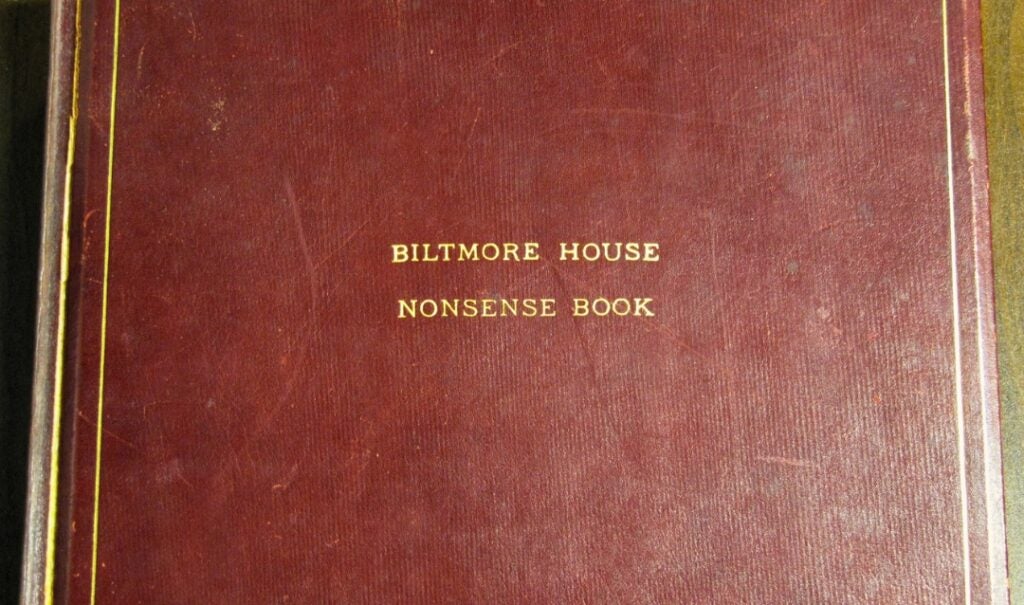
The “Nonsense Book” of Biltmore House is filled with handwritten poems and limericks, along with illustrations, telegrams, and photographs. This unique book was a way for guests of the Vanderbilts to commemorate their stay. It also captures the personalities of those who visited, while simultaneously offering a glimpse into their experiences while at Biltmore.
Continue reading for a look inside this charming—and perhaps unexpected—Gilded Age guest book from our archival collection.
A look at the original “Nonsense Book” in Biltmore’s archival collection.
New Year, New Nonsense
To mark the turning of 1901 into 1902, George and Edith Vanderbilt hosted a house party for 20 of the movers and shakers of Boston and New York society. Among the revelers that year were Larz Anderson, an American diplomat who had served in Rome and London, and his wife Isabel, an author of children’s books and travelogues.
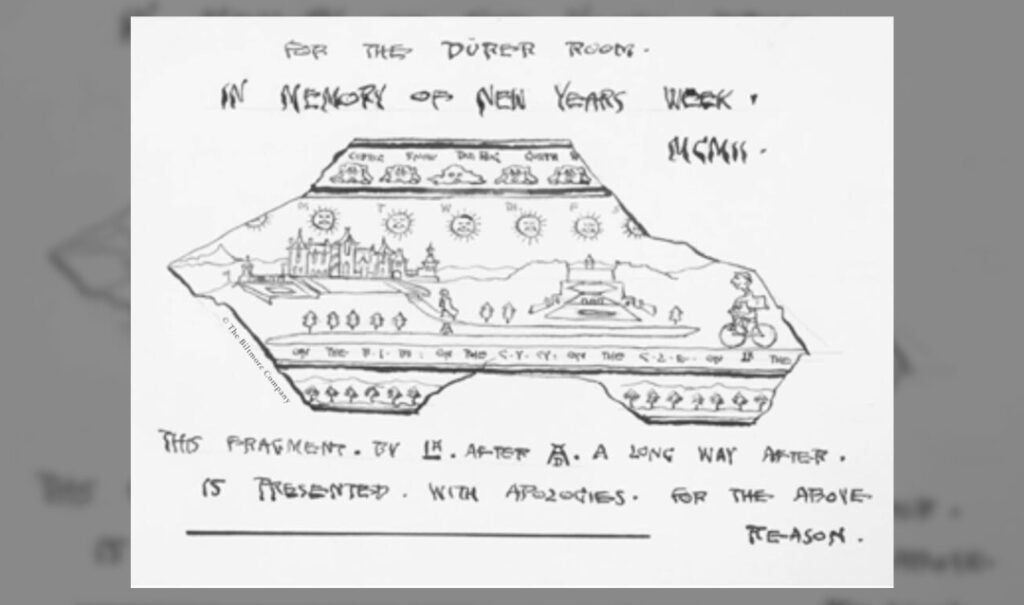
To commemorate the week-long festivities, Larz left an illustration in the Vanderbilts’ “Nonsense Book,” a bound leather volume full of notes and scribbles, rhymes and limericks inspired by one of George Vanderbilt’s favorite authors, Edward Lear.
With entries from many of the Vanderbilts’ guests, the Nonsense Book gives us a glimpse into the various entertainment activities held at Biltmore.
Larz Anderson left his amusing mark in the Vanderbilt “Nonsense Book,” detailing his frequent bicycle rides around the estate.
Drawn as if it were a scrap from George’s print collection, the top of Larz’s entry reads: “For the Dürer Room – In Memory of New Years Week MCMII.” The “Dürer Room” refers to a den off of the Library where George Vanderbilt displayed many of his prints by the famed artist Albrecht Dürer, a brilliant German virtuoso of the late 1400 and early 1500s. Dürer’s prints, including The Triumphal Arch of Maximilian,which now hangs in the Music Room, are museum-quality masterpieces that one wouldn’t expect to find in a private home.
Larz was impressed with Vanderbilt’s collection of engravings and was struck by the design and layout of Biltmore House, reporting to his mother by letter that “well, we all agree it is the finest thing in America – and one of the finest in the world….” Their week started off with several days of bad weather, but a few days into their stay, Larz wrote, “today is beautiful… the air is magnificent and yesterday I had a ten-mile climb over the mountains.”
Apparently, Larz also got in a good bit of bicycling during his stay. Echoing Dürer’s artistic style, Anderson draws himself astride a bike peddling across the estate and past the Esplanade. A small figure labeled “AD” for Albrecht Dürer follows a path toward the eastern façade of Biltmore House. Anderson labeled the cartoon of himself with his initials, “LA,” in the same distinctive script that Dürer used to sign his works. Larz’s doodle documents the mountainous scenery he enjoyed firsthand and the fine weather that finished out the first week of their new year. And, quite amusingly, he references several of the Vanderbilt family’s St. Bernards, including Cedric and his mate Snow, who presumably could often be found flopped down on Biltmore’s gleaming herringbone floors in a manner resembling a polar bear rug.
Join in on the Nonsense
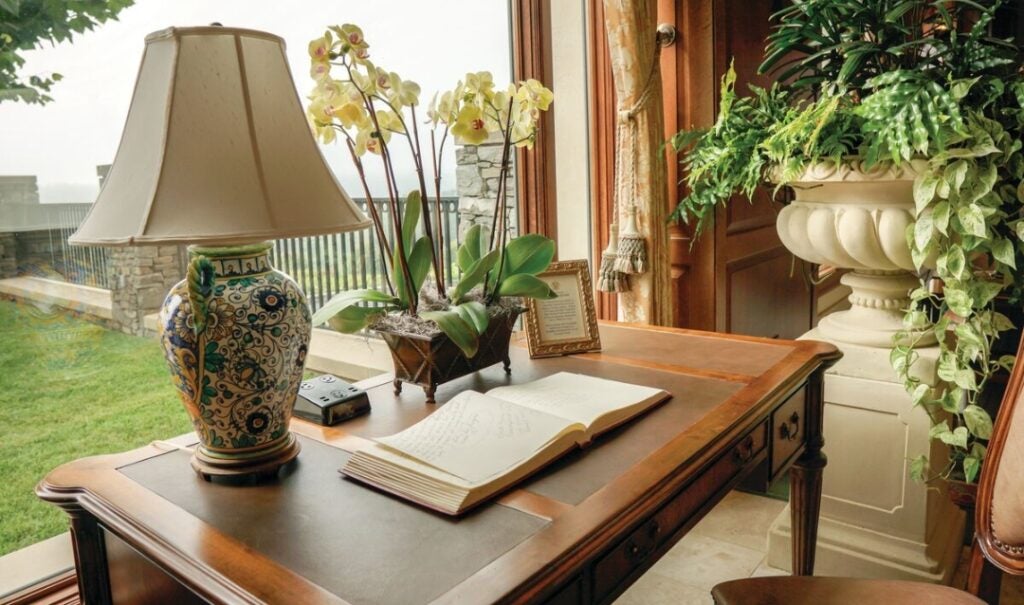
An iteration of the original “Nonsense Book” is still in use today. It resides in the lobby of the Inn on Biltmore Estate, and our guests are welcome to sign it and describe their adventures during their stay.
During your next overnight stay at Biltmore, be sure to sign and join in on the nonsense!
Looking for a thoughtful gift that will be used all the time? Our Biltmore chefs have partnered with Belk to create quality cookware to delight the culinarians in your life. From novice to experienced cook, this 13-piece set of cookware will help ensure professional quality results from the kitchen!
So…wine is made from grapes and grapes are sweet, right? What else is there to know?
Plenty! If you think that wine is nothing more than grape juice that sits in a barrel for a while, let me help you understand the process:
Grapes produce natural sugar, and depending on the varietal—and the growing season—the level can vary quite a bit. The yeast produced during fermentation converts the sugar in the grapes into alcohol. If we let this process continue until its natural end, it results in a dryer wine with a lower sugar level, like a Chardonnay.
To create sweeter wines, we must either add sugar to the dryer wine or interrupt the fermentation process before all the sugar is converted. There are several ways to do this:
Get the yeast out of the wine so that more residual sugar remains
Kill the yeast within the fermenting wine
Start with a high-sugar grape so that the yeast can’t convert all the sweetness before it dies. (Yeast is a living organism.)
Unexpected pairing suggestions
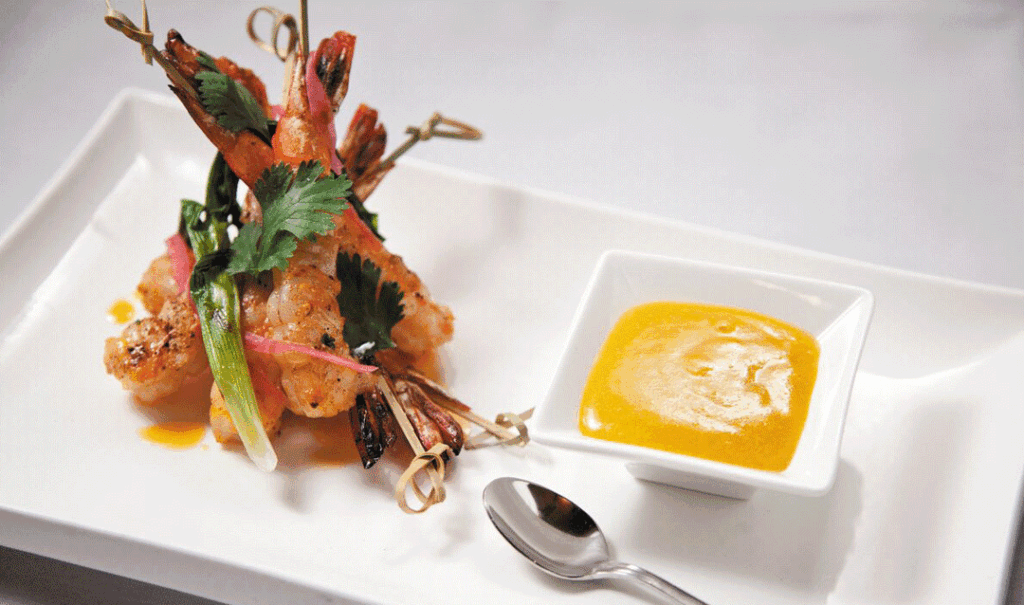
Pair spicy Cajun or Asian shrimp dishes with some of our sweeter white wines.
Because sweeter white wines often have a good amount of acidity to complement their higher sugar levels, they can stand up to spicier foods than you might expect. Our semi-sweet Biltmore Estate® Riesling is a great complement for the hot peppers and cilantro that characterize many Thai dishes, while Chinese and Vietnamese food–especially sweet and sour dishes–are excellent with our nicely balanced Biltmore® Century Sweet White Wine.
Don’t overlook unexpected dessert pairings, either. Banana pudding is perfect with our Biltmore Estate® Limited Release Chenin Blanc—this medium-sweet, fresh and crisp wine enlivens the heavier vanilla and fruit flavors of this traditional Southern favorite.
Let something sweet bubble up!
In the mood to enjoy the slightly sweeter side of bubbly, as well? We suggest our Pas de Deux® Sec with foods ranging from fresh fruit to Cajun spiced shrimp. Try it for your next light brunch and you’ll have your guests raising a toast to your good taste!
Tips
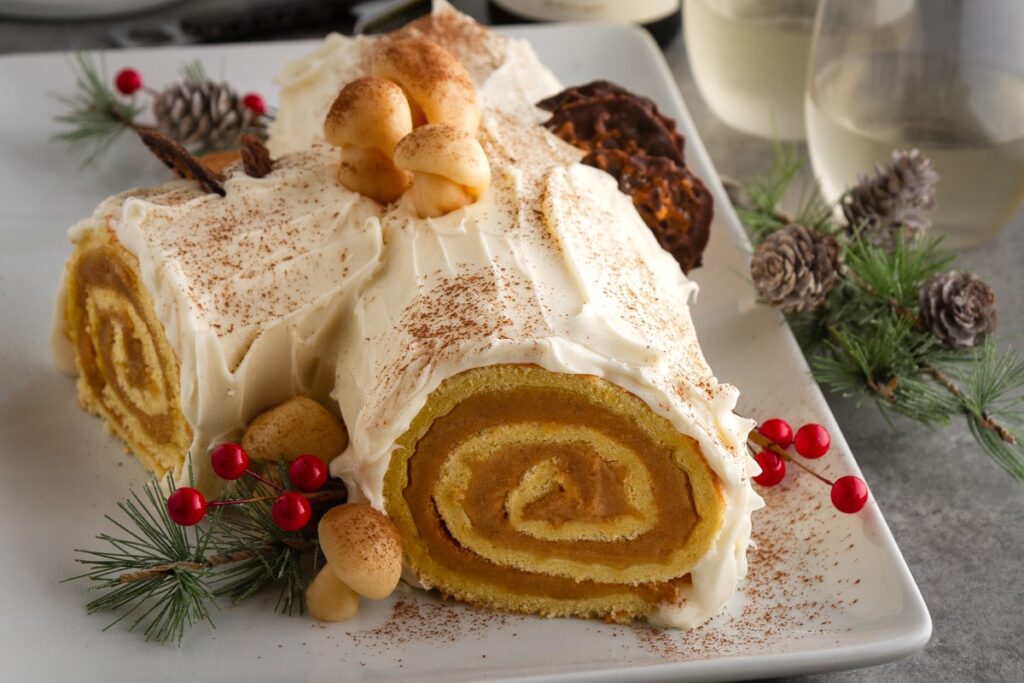
Peanut Butter Yule Log or “Buche de Noel” is a decadent dessert for the season–especially when paired with Biltmore Estate Riesling!
Sweeter white wines can be surprisingly food-friendly and bring out the flavors in many spicy dishes.
Be sure to chill sweeter white wines appropriately so that you can enjoy them at their best. Too cold and you lose a lot of taste; too warm and the wine seems overly sweet and strong. Serve between 39 and 50 degrees, depending on the varietal.
If serving sweeter wines with dessert, the wine should be a bit sweeter than the dessert itself.
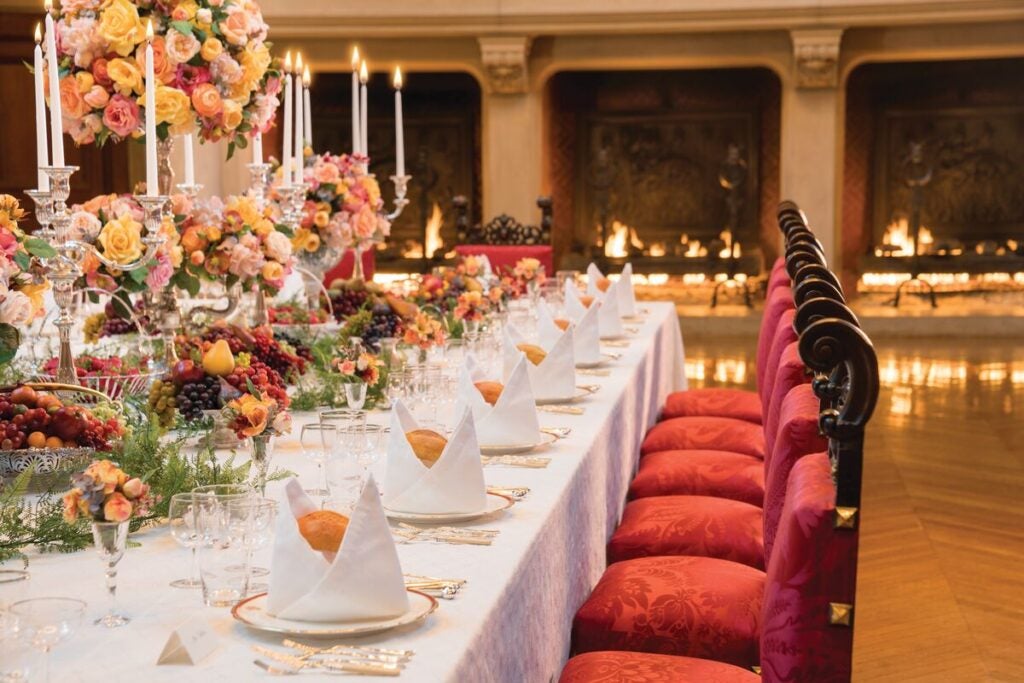
Your holiday table may not be as large as the one in the Banquet Hall of Biltmore House in Asheville, NC, but don’t let that stop you from creating a memorable and sparkly setting for your New Year’s Eve celebrations at home.
Banquet Hall table set for “A Vanderbilt House Party” exhibition in 2019.
Our Biltmore Floral designers are experts in creating shine and polish for all types of events, but especially for New Year’s Eve celebrations around the table.
Here are six ideas for creating Biltmore-inspired decor for your New Year’s Eve celebrations:
Take a look around your home to see what kinds of everyday objects you can transform into extraordinary elements. You’d be surprised by what you can do with what you already have, such as sparkling ornaments from your Christmas tree, candles, glass vases, and the like. Of course, if you come up short, a trip to the local crafts store may be necessary.
Start with table linens to build a base for your centerpiece. Layer your linens, starting with a tablecloth; then add an overlay, and finish with a runner. Build texture by mixing solid colors, metallics, and elegant prints.
If you don’t have them on hand, you can purchase oversized martini or Champagne glasses, or vases for the centerpiece. If room permits, use three different heights and add some tulips to each glass, letting them spill over the edge. Acrylic gems added to the water in the vases will create a sparkling effect.
Another centerpiece idea is to use one or several clear glass vases that are varying in height and fill each vase with water pearls and LED submersible lights (available at any craft store). Metallic twigs in each vase will add extra sparkle to the table.
Don’t forget candlelight! If you have room, use a variety of sizes: pillars, candlesticks, and votives. The more, the better! At the base of your vases and candles, add oversized gems or crystals to reflect the light. For a more whimsical look, add a variety of clocks so you can watch the countdown to the New Year.
Most importantly, remember to have fun and don’t hold back on your creativity.
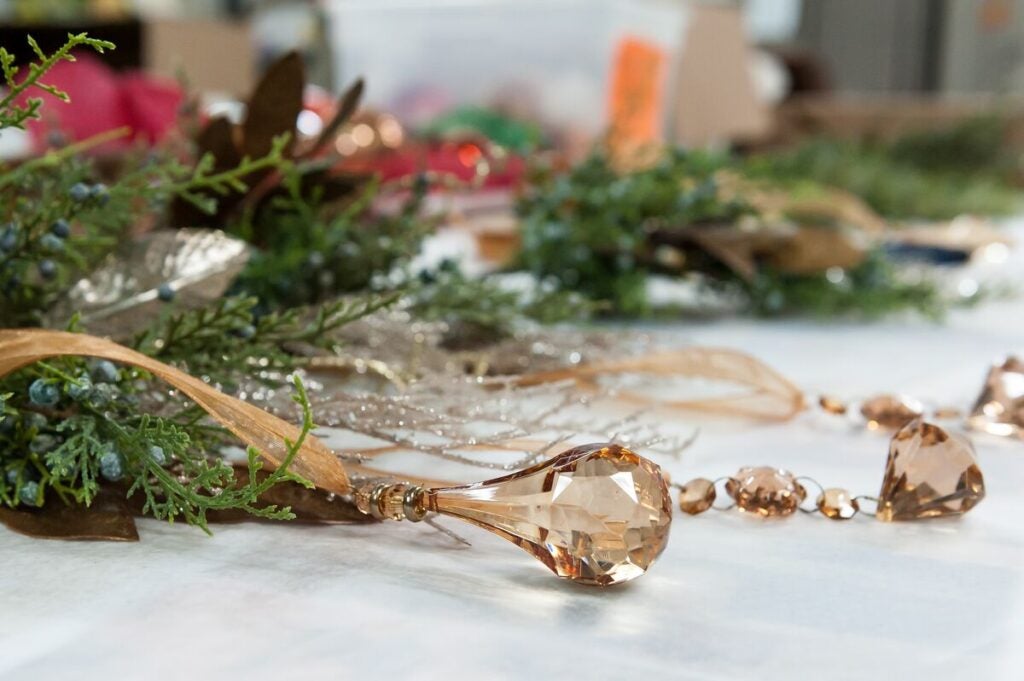
Sparkling ornaments from your Christmas tree can be repurposed for creating a sparkling tablescape.
We hope these ideas from Biltmore’s floral experts help make your New Year’s decor and tablescapes sparkle!
Brie Method Preheat oven to 350ºF. Mix almonds, walnuts, and pecans in a small bowl. Whisk the eggs and cream together in a separate bowl. Using a pastry brush, apply egg mixture to cheese and then coat with the nuts. Place in a baking pan and bake until the cheese is softened and the nuts are golden brown, about 15-20 minutes. Place the cheese on heated plates.
Cherry Chutney Method Combine the dried cherries, orange juice, and vinegar in a saucepan. Add the ginger, coriander seeds, and sugar; mix well. Bring to a boil and reduce the heat. Cook to a syrupy consistency, stirring constantly.
Serve
Cut the Brie cheese into desired portions and place on heated plates. Spoon Cherry Chutney over the cheese and around the edges of the plates. Serve with slices of toasted French baguette.
A gingerbread house is a sweet holiday tradition that tastes as good as it looks!
For Christmas at Biltmore™, one of our finest traditions is the gingerbread-style replica of Biltmore House in the Main Kitchen.
Another tradition we look forward to is the making of our grand scale gingerbread houses, one for Biltmore House and one for our Inn. Each year, our talented pastry chefs create gingerbread replicas, covered in sweet treats down to the smallest details. At Biltmore House, this remarkable creation can be seen by guests in the kitchen of the home. And at the Inn, the gingerbread treat is a highlight of the lobby decor.
You don’t have to be a pastry chef, though, to start your own gingerbread house tradition. Our chefs suggest letting your creativity guide you, using a wide variety of treats to add sparkle, texture and color. You will be surprised how graham crackers can turn into a walkway or boxed cereal can shingle a roof! Use your favorite gingerbread recipe, or the one below from our chefs.
Gingerbread House Recipe
1/4 cup brown sugar
1/4 cup molasses
1/2 cup light corn syrup
1/2 c shortening
1 1/2 teaspoons ginger
1 1/2 teaspoons cinnamon
3 1/2 cup all-purpose flour
In a saucepan, combine brown sugar, molasses, corn syrup and shortening. Melt over medium heat. Mix dry ingredients together in a mixing bowl with the paddle attachment. Pour melted syrup into dry ingredient and mix until combined. Roll dough between two pieces of parchment to desired thickness (1/4” is usually good!). Cut desired shapes from the dough, carefully removing the scraps and leaving the pieces for your house on the parchment. This will keep your shapes from being warped. Bake pieces at 350 until light golden around the edges.
*This dough will bake very firm and will hold up well for gingerbread houses, however is is not the best for eating.
George Vanderbilt was born November 14, 1862. His parents, William Henry and Maria Louisa Vanderbilt, welcomed him into the world at their family home near New Dorp on Staten Island, New York. Named in honor of a paternal uncle, little George was the youngest of a large, lively brood.
Every so often our Museum Services team runs across objects in the collection that shed some light on how the Vanderbilt family celebrated special occasions like birthdays together. It’s always touching to come across tokens of these traditions.
Maria Louisa was a devoted and loving mother to each of her eight children and she and George maintained a particularly close relationship throughout their lives. Read on to learn more about two of the birthday gifts that Maria Louisa bestowed upon her youngest son.
Tucked among Biltmore’s 23,000 books are three treasured volumes that George received from his mother for his ninth birthday. Inscribed “George from Mama Nov. 14th 1871”, the books are part of a popular series of novels written by the Reverend Elijah Kellogg, Jr.
With titles like Boy Farmers of Elm Island and The Ark of Elm Island, one might guess that George had a taste for adventure, but the stories are also instructive. Throughout the series, the main characters are faced with all sorts of ethical dilemmas challenging their resolve to be upstanding young men, all while navigating the treacherous waters of the West Indies. Maria Louisa Vanderbilt’s carefully-selected gift gives us a hint of George’s boyhood interests, as well as how deeply she valued and encouraged her children’s moral and intellectual growth.
Filed away in George’s personal papers, we found an unsigned and undated poem. The three pages are bound with a ribbon and composed in perfect penmanship. Upon reading it, it becomes apparent that the poem is from his mother and was written on the occasion of his 21st birthday. She reflects back upon his birth, celebrates his coming of age, and shares her hopes for his future.
Crowned in an aureole of light, I see grand dreams and visions bright
…there is no scope to youth’s vast boundless wealth of hope, and boundless opportunity for good…”
Through her carefully-crafted prose, Maria Louisa bids her son to heed the call of work, to put right what he finds wrong , and:
To give a kindly word of cheer
To those who heavy burdens bear
Such work will bless, when nobly done.
And such work comes to every one.
He helps the age in which he lives,
Who does his best – and his best gives
To carry sunshine everywhere…
A later stanza relates every mother’s dream of having her child’s greatest aspirations fulfilled.
If in thy heart deep-hidden some cherished wish there be,
One that may bless thy future – that wish is mine for thee.
And with this wish in parting, there comes to light the way
The season’s ripe perfection crowning this festal day.
We can only imagine the pride that Maria Louisa would feel in knowing that her son did indeed improve the age in which he lived, and was able to bring his “grand dreams and bright visions” to fruition as she had hoped. She would undoubtedly be elated to learn that George’s life’s work resulted in the creation of a beautiful estate that remains a peaceful oasis more than 150 years later.
Biltmore wine blends are a great way to chase the chill in the air as autumn approaches. Since the season is cooler and the foods heartier we naturally turn to warmer, richer wines with chef-inspired autumn recipes.
Whether you have just begun your wine journey and are looking for an approachable wine, or you’re confident in your choices and looking to expand your palate, wine blends are well worth your attention. At Biltmore, we appreciate the beauty of blending different grape varietals together because the unique qualities of each grape work together to enhance the common qualities they share, and interesting, well-rounded wine blends are the natural result.
Let’s look at three of our Biltmore wine blends that are crafted to be food-friendly and easy to sip on their own.
Biltmore® Century Sweet White Wine
Sip Biltmore Century Sweet White Wine on its own or with spicy cuisine and desserts.
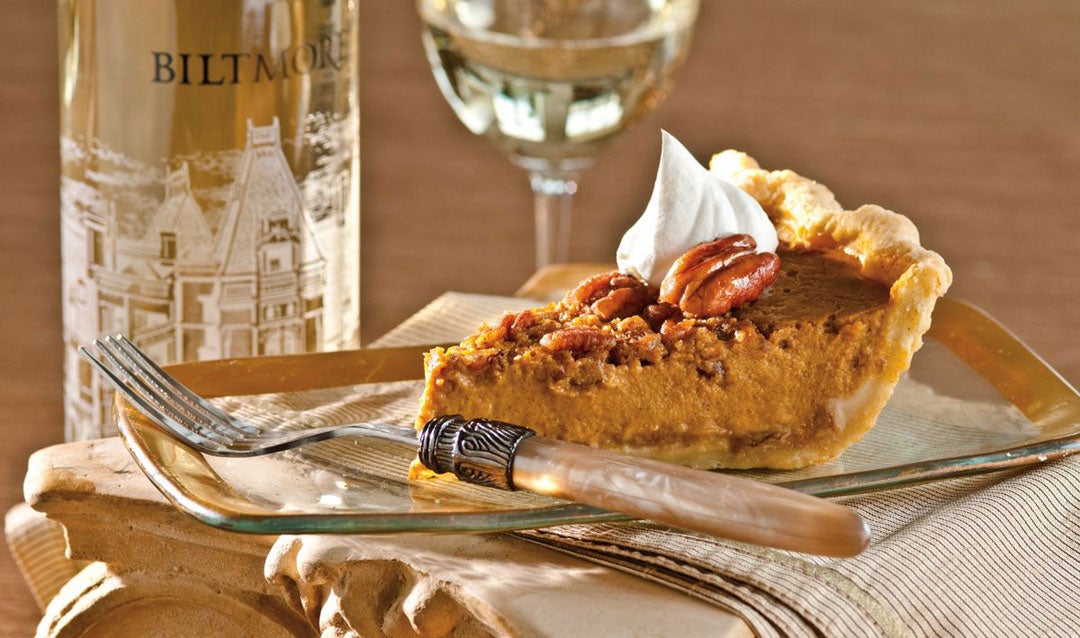
Biltmore® Century Sweet White Wine features a blend of aromatic, fruit-forward grapes including Riesling, Gewürztraminer, and Muscat Canelli. The result is a wine with an intense floral nose and semi-sweet flavors. It’s enjoyable all by itself, but also makes a perfect pairing to lighter desserts or spicy Asian food. We can’t think of a better fall food pairing than this recipe for Praline Pumpkin Pie.
Biltmore Estate® Limited Release Petite Sirah-Syrah
Savor our delicious Biltmore Estate Red Blend with all your fall favorites!
Our medium-to-full-bodied Biltmore Estate® Limited Release Petite Sirah-Syrah is a bold blend of two classic red varietals. It features delicious aromas of cocoa powder and blackberry jam along with flavors of cherry, pomegranate, red currant, and vanilla. Well-integrated oak and soft tannins make it food-friendly and versatile.
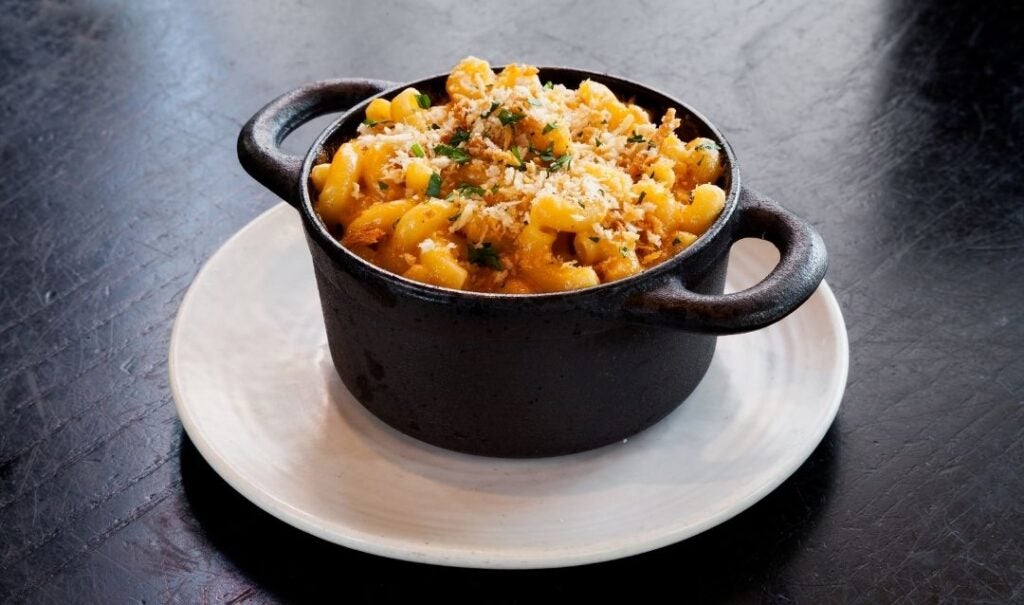
Elevate a casual dinner at home by pairing it with favorites like smoked meats, lamb kebabs, and sweet potatoes. It’s also a surprisingly smooth partner for rich desserts such as candied walnuts and pecan pie. To soothe your craving for hearty comfort food in autumn, pair this red wine blend with our chef’s Smoked Gouda Mac & Cheese.
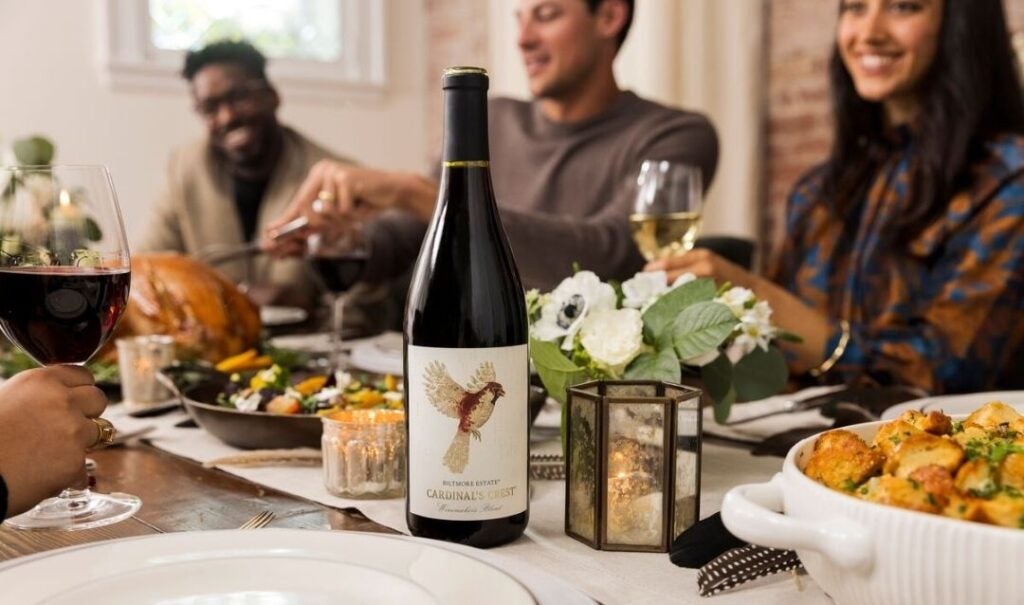
Biltmore Estate® Cardinal’s Crest®
Pair your favorite dishes with versatile, food-friendly Biltmore blends like Cardinal’s Crest.
Biltmore Estate® Cardinal’s Crest® is a velvety smooth red wine blend that has long been a favorite for those who appreciate an easy-drinking red. Scents of tobacco, herbs, blackberry, and pepper hint at its savory side, leading to flavors of cherry and black currant with soft tannins.
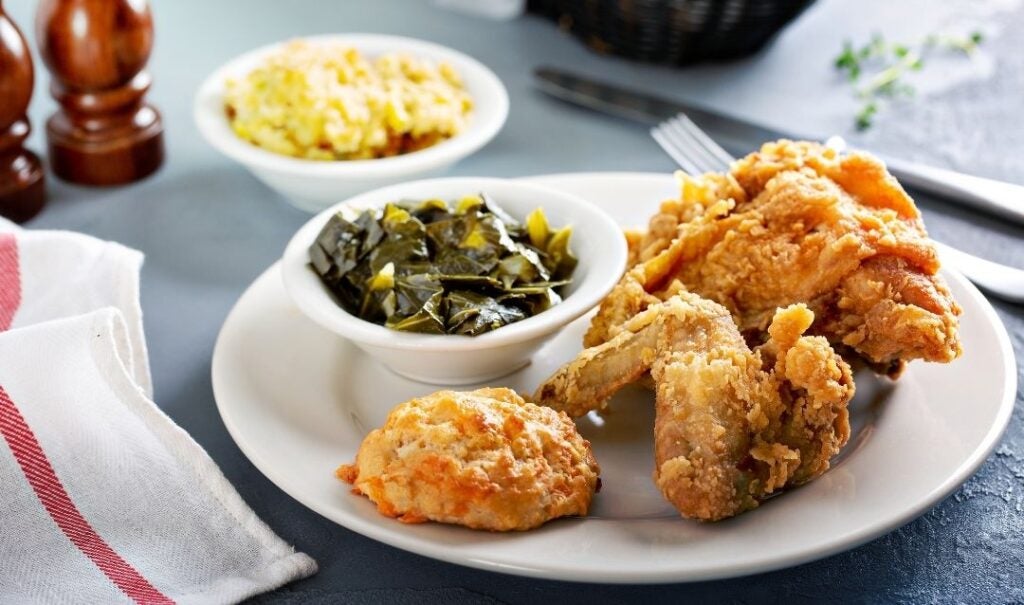
Approachable and food-friendly, this versatile wine pairs well with a wide range of dishes, including traditional Southern fare like fried pork chops and baked sweet potatoes as well as beef stew, bacon, roasted root vegetables, and soft blue cheeses. Try it with our down-home recipe for Southern Quail with Collard Greens.
Pair the rich flavors of Praline Pumpkin Pie with the light sweetness of Biltmore Century Sweet White Wine
Praline Pumpkin Pie
Crust • 1 pie crust, partially baked • 4 tablespoons butter, melted • 1/3 cup brown sugar, packed • ½ cup pecans, chopped
Filling • 3 eggs • 1 egg yolk • ½ cup sugar • ½ cup brown sugar, packed • 1 teaspoon salt • 1 teaspoon cinnamon, ground • ½ teaspoon nutmeg, ground • ½ teaspoon ginger, ground • ½ teaspoon cloves, ground • 1½ cups milk • ½ cup heavy cream • 2 cups pumpkin puree • Candied pecans (optional) • Whipped cream (optional)
Method Preheat oven to 400 degrees. Combine melted butter, brown sugar, and pecans to create the praline mixture for the crust. Press praline mixture into partially baked 9” deep dish pie shell and bake in preheated oven for about 10 minutes. Then place in freezer until praline mixture is semi-frozen.
For the pie filling, combine eggs, egg yolk, sugar, and brown sugar in a bowl. Add the salt and spices, mixing well. Slowly stir in the milk and cream, then add the pumpkin puree. Pour mixture into pie shell over praline mixture. Bake at 400 degrees for 10 minutes, then reduce temperature to 350 degrees and bake for another 40–50 minutes or until set. Consistency of pie will be somewhere between a traditional pumpkin pie and a pumpkin cheesecake. If desired, garnish with candied pecans and whipped cream when cool. Serves 8.
Smoked gouda mac and cheese
Smoked Gouda Mac & Cheese
Ingredients • 2 cups elbow macaroni pasta, dry • 2½ cups heavy cream • 1 cup shredded smoked gouda cheese • ½ cup shredded parmesan cheese • 1 cup panko breadcrumbs • Chopped parsley (optional)
Method Cook macaroni in salted boiling water until done. Drain and pour into baking dish. In a sauce pan, heat cream and add gouda and half of parmesan. Whisk vigorously over low heat to melt cheese, making sure not to let scorch on the bottom. When cheese is melted into cream, pour mixture over macaroni. Sprinkle panko bread crumbs and rest of parmesan cheese over macaroni and bake at 350 degrees for 10 minutes or until breadcrumbs are golden brown. Cut into 4 portions, serve hot.
Method Soak the quail in buttermilk for 1 hour. In two mixing bowls, place cornmeal in one and flour in the other seasoned with salt and pepper. Heat the corn oil in a deep frying pan or fryer. Remove the quail from the buttermilk and let excess milk drip off. Place the quail in the flour and lightly toss. Shake off the excess flour and return to the buttermilk. Once covered, let the excess milk drip off and place in the cornmeal. Lightly toss the quail in the cornmeal and shake off the excess, ensuring the fowl is completely coated. Drop the quail in the oil and fry until golden brown, 3-5 minutes.
Braised Collard Greens
Ingredients • 2 bunches collards, washed • 1 onion, small diced • 2 tablespoons garlic, minced • ½ pound bacon, chopped • 1 cup cider vinegar • ½ cup sugar • 1 quart chicken stock • Salt and pepper to taste
Method Strip the stalk off the collards, cut in half and then into 1-inch pieces. Cook chopped bacon slowly; add the onion and garlic, sweat until the onion is translucent. Deglaze with vinegar and add sugar. Reduce vinegar by 3/4. Add the collards and chicken stock. Simmer over medium heat until the collards have become tender. Season to taste.
Wine lovers take note: Biltmore’s Winery, located on the estate in Asheville, NC, offers a relaxing way to learn more about our handcrafted wines.
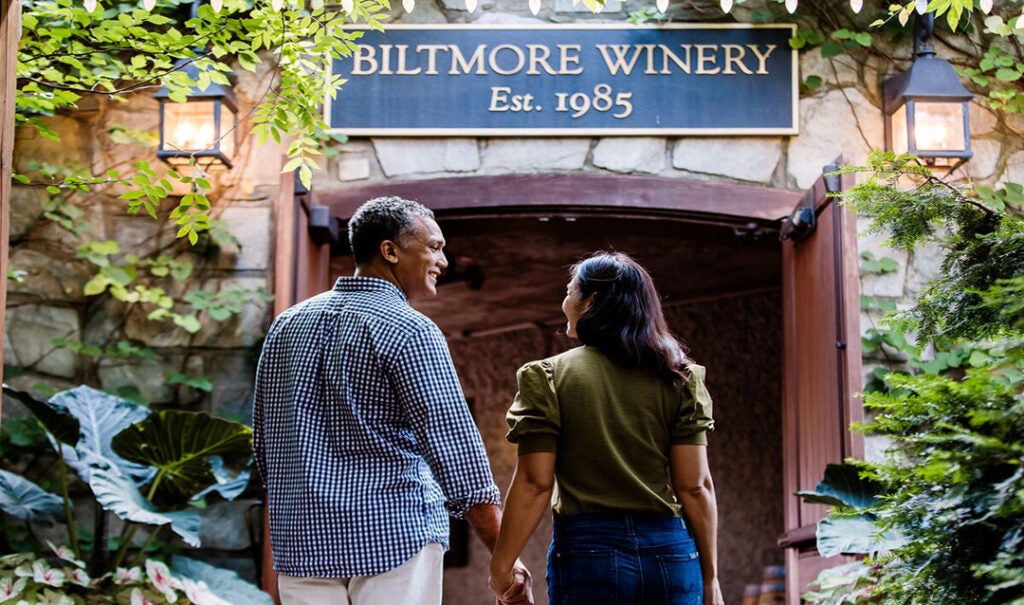
The conversion of the dairy barn began in 1983 and our state-of-the-art winery opened in 1985.
Originally designed as the estate’s main dairy barn by Biltmore House architect Richard Morris Hunt, the Winery features unique architectural elements like a stone-walled entrance tunnel that leads from Antler Hill Village to our Tasting Room.
Ready for a Taste?
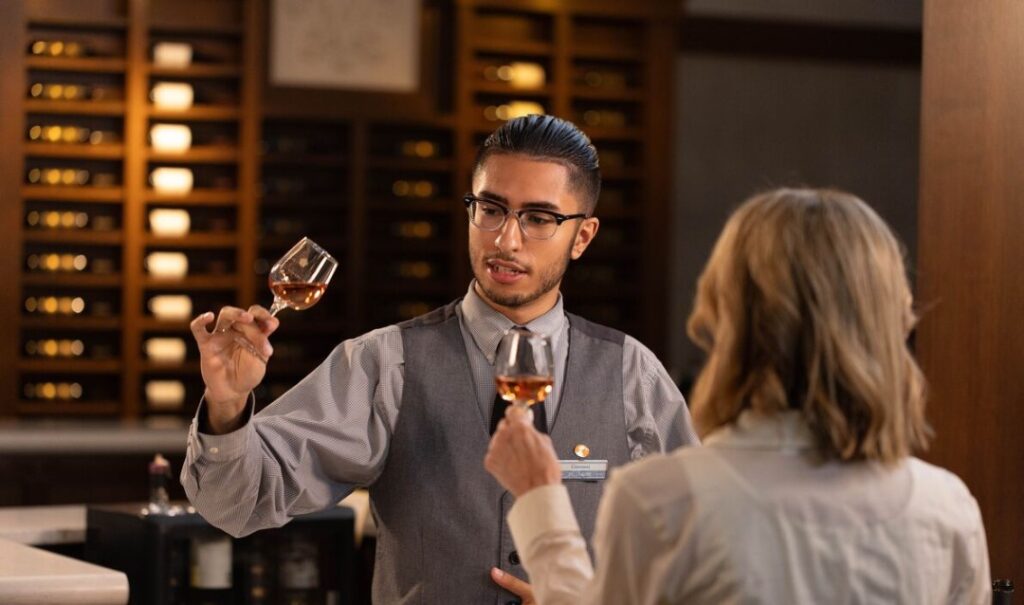
Our knowledgeable Tasting Room hosts guide you through a fun and informative tasting of Biltmore wines.
Drop into our spacious Tasting Room and let a friendly wine host take you through a complimentary tasting of Biltmore wines, from floral whites to robust reds. Non–alcoholic grape juice is available, too. See a complete list of Biltmore wines.
Guests are required to be at least 21 years of age to taste wine. Please be prepared to show your ID. Acceptable forms of identification include:
Valid driver’s license, not expired, must have a photo. International photo license is valid if it meets all other conditions.
Valid North Carolina state issued ID card (no other state issued ID can be honored).
US active duty military ID.
Passport.
Relax at the Wine Bar
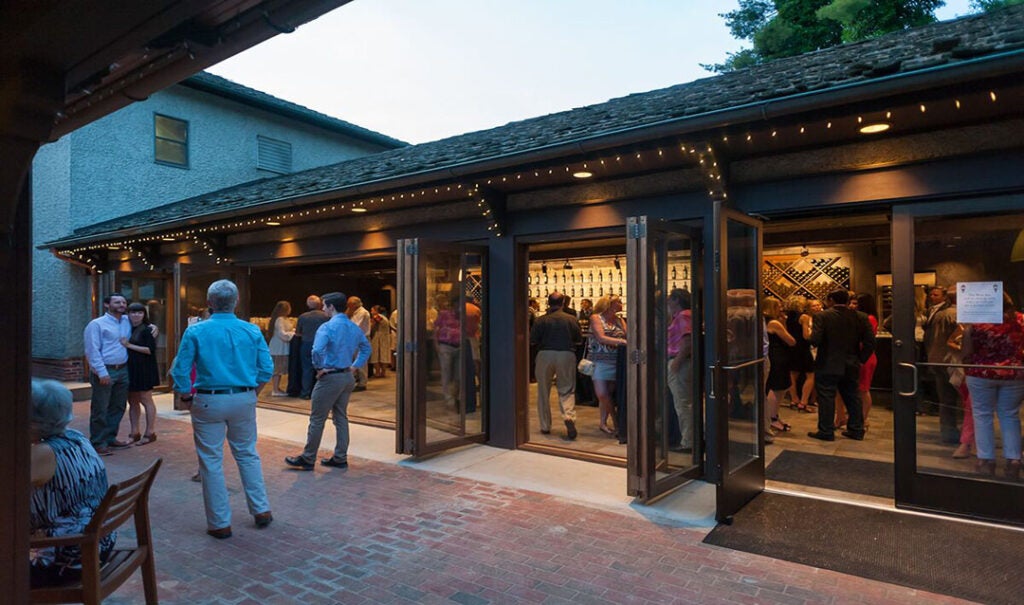
There are so many ways to relax inside and out at Wine Bar! Grab a table indoors, on the patio, or pull up a chair next to the fire pit.
Next door to the Winery, you’ll find our indoor/outdoor Wine Bar. Sit back, relax, and treat yourself to our finest award-winning wines by the glass (or bottle).
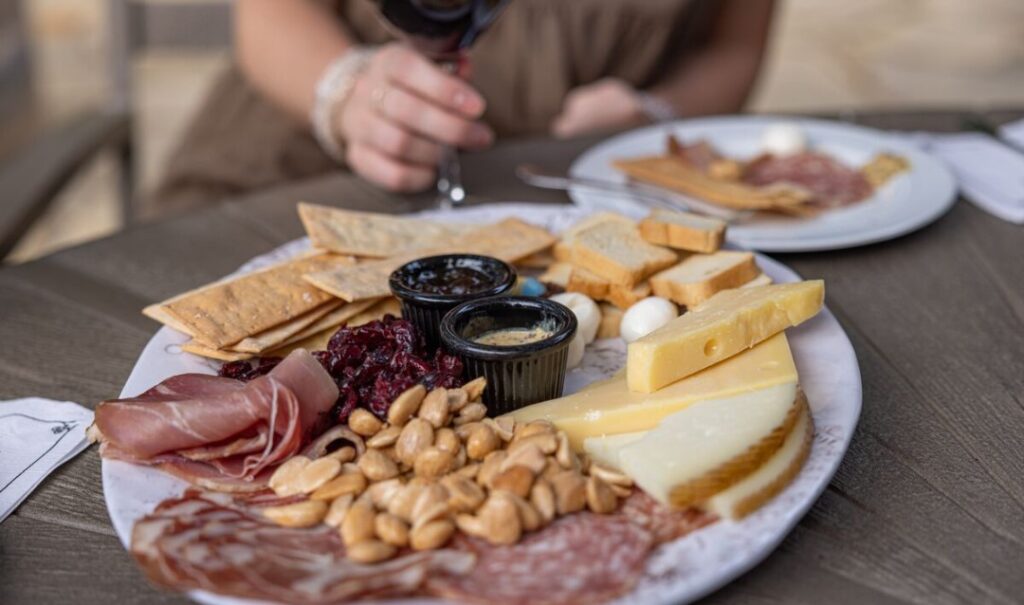
Savor a delicious charcuterie plate along with your favorite Biltmore wines at the Wine Bar.
Feeling peckish after your long day on the estate? Pair your wine with one of our delightful small bites like locally made artisan truffles and charcuterie.
Shopping and dining: tasty provisions
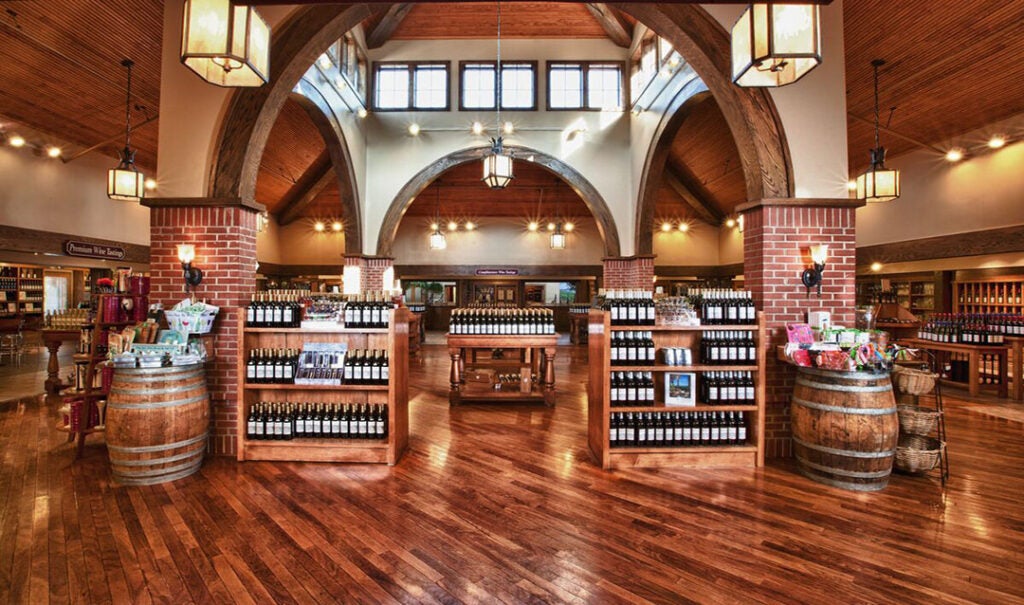
Don’t forget to stop by the Wine Shop to take home a bottle (or two!) of your favorite Biltmore Wines.
Foodies and wine lovers take note: the Wine Shop is your store. In addition to the full line of Biltmore wines, the shop offers hard–to–find wine accessories, unique dishware, Biltmore’s own line of gourmet foods, kitchen gadgets, and more.
One cannot live by wine alone–at least that’s our thinking! Delicious wine deserves equally sumptuous foods, so you’ll find several exceptional dining options near the Winery. Gather around the open kitchen inside the Bistro and watch our chefs at work, creating fresh dishes for you with food grown right on the estate.
Find Biltmore wines near you
Purchase Biltmore wines at the estate or find a local retailer near you. To have our wines shipped directly to your door, become a member of theVanderbilt Wine Club® and enjoy the benefits of special events, discounted (or FREE!) shipping, and your favorite wines 20–25% off!