Designed both for aesthetics and hospitality, Biltmore’s hidden doors were designed to create a seamless appearance but provide access for staff providing service and convenience for guests.
Discover a few of the often overlooked doors throughout America’s Largest Home.
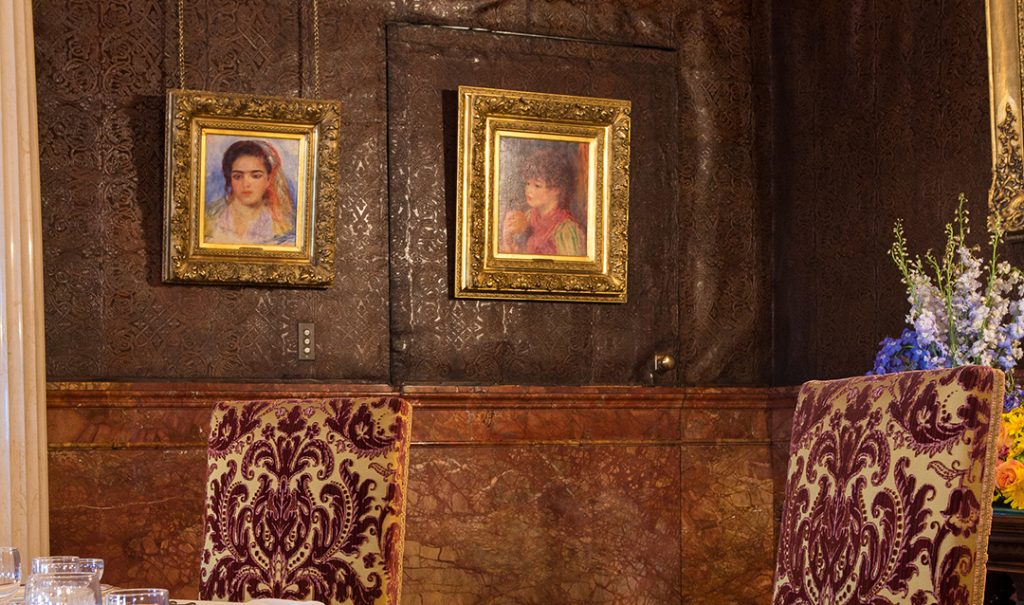
Concealed servant’s entrance in the Breakfast Room
When you’re in the Breakfast Room, your attention is bound to be drawn to the two Renoir portraits “Young Algerian Girl” and “Child with an Orange.” If you look just below “Child with an Orange,” you’ll notice the doorknob to the concealed door, designed to create a seamless appearance on the wall but allow servants to enter with hot meals.
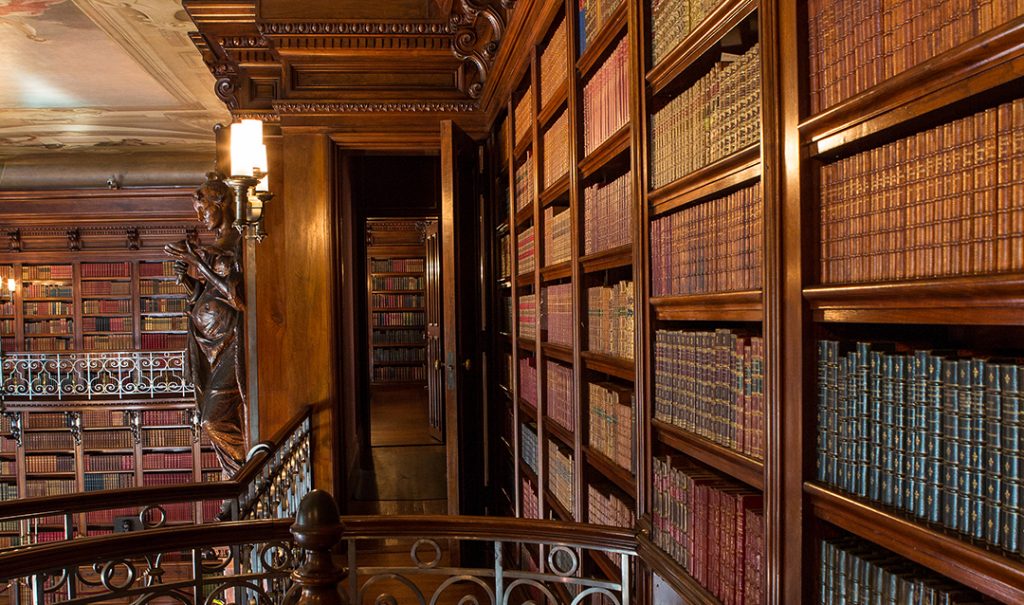
Doors in the Library lead to a passageway connected to the Second Floor Living Hall.
Have you ever wondered what’s behind the hidden doors on the top floor of the Library? Here’s your peek. The doors located on both sides of the overmantel lead to a passageway connected to the Second Floor Living Hall.
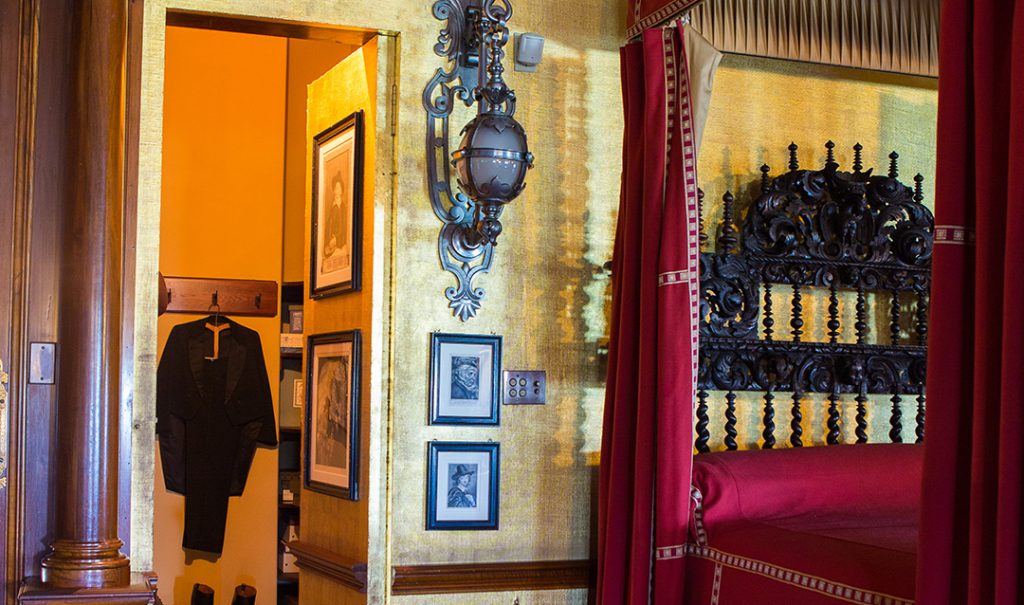
Concealed closet door in Mr. Vanderbilt’s Bedroom
Every detail of the architecture at Biltmore was carefully considered. To avoid the break in symmetry that would be required by a door frame, closet doors were concealed in certain rooms, such as this one in Mr. Vanderbilt’s Bedroom.
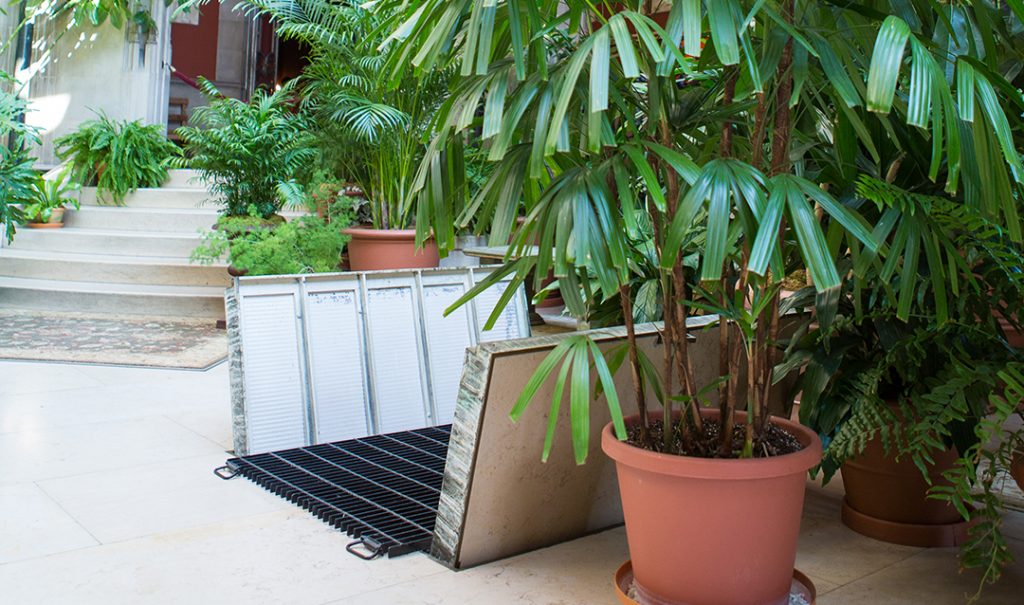
This hidden door in the floor of the Winter Garden in Biltmore House allowed plants to be brought back and forth from the Conservatory without disturbing guests.
Although early plans indicate that there was to be an elevator in the Winter Garden, one was never installed and instead, there’s a ladder. The door is covered in marble slabs and is rarely opened except to allow for ventilation in the employee break room below it in the summer.
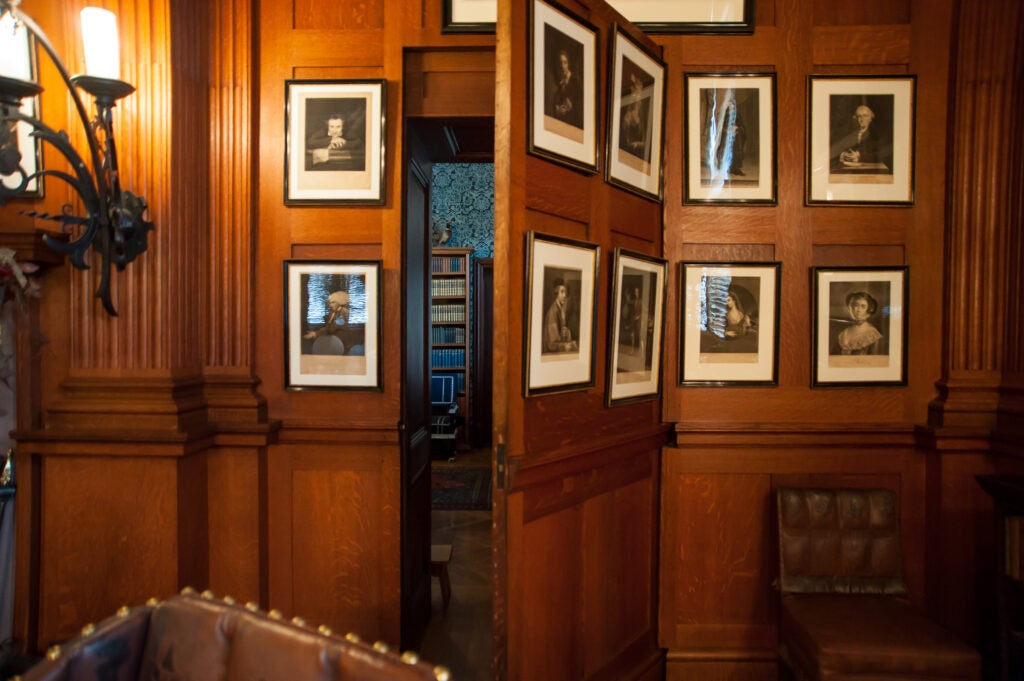
This hidden door leads to the Smoking and Gun Rooms inside Biltmore House.
Be sure to look for these secret doors inside Biltmore House during your next visit, like this door designed for gentlemen to retire to the Smoking Room after a game of billiards.
An outdoor sculpture comes clean, with help from the expert conservators at Biltmore.
“From the iconic marble lions in front of Biltmore House to terra cotta figures, bronzes, and more, the estate features 37 pieces of outdoor sculpture and historic plaques,” said Kara Warren, Preventive Conservation Specialist.
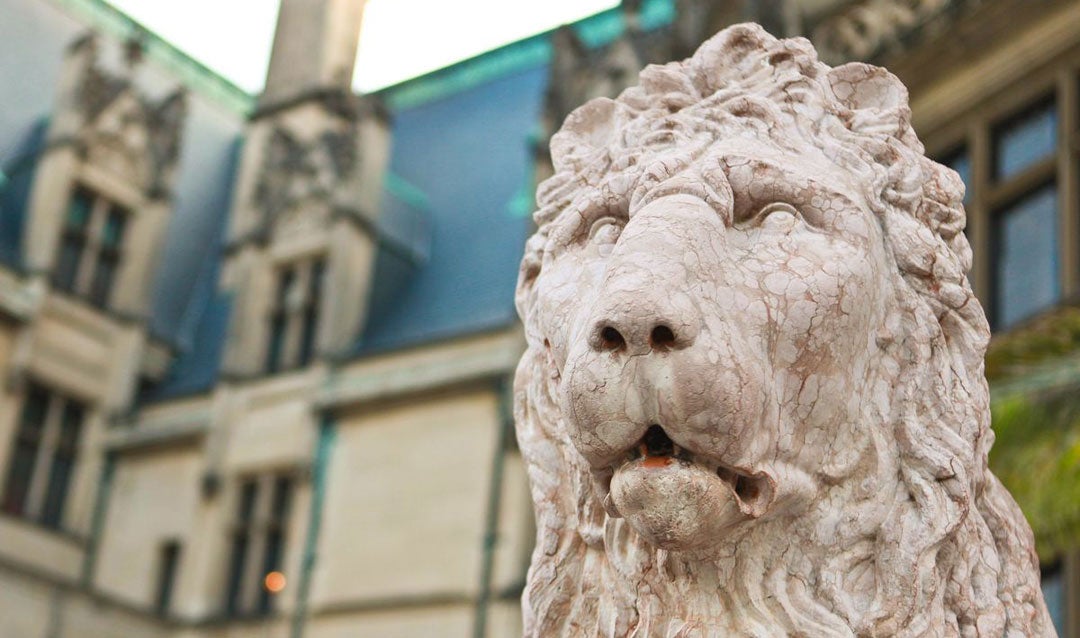
One of the two grand marble lion sculptures that guard the Front Door of Biltmore House.
According to Kara, each piece of outdoor sculpture is carefully examined and photographed every six months to determine its “health” and what type of cleaning, stabilization, or repairs might be needed.
There are four sphinx sculptures atop stone pillars guarding the massive iron entry and exit gates through which guests pass to get their first glimpse of Biltmore House.
The sphinx appears in Egyptian and Greek mythology as a creature with a human head and torso–usually female–and the hindquarters of a lion. Egypt’s massive Great Sphinx of Giza sculpture is probably the best-known example in the world.
The following photos illustrate how important Biltmore’s process is and what a difference cleaning and preservation make:
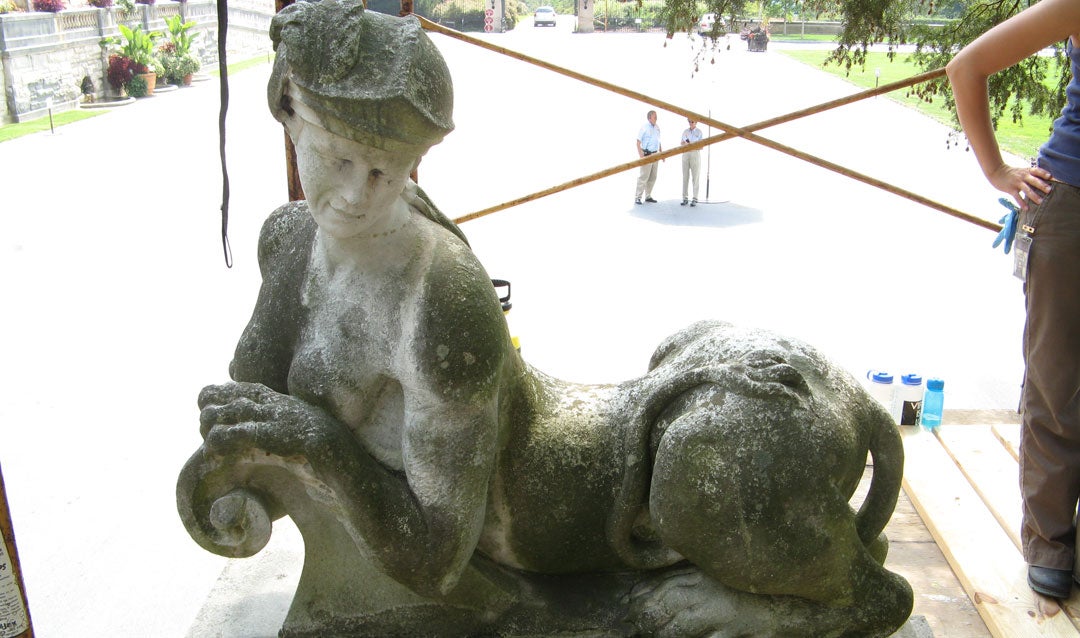
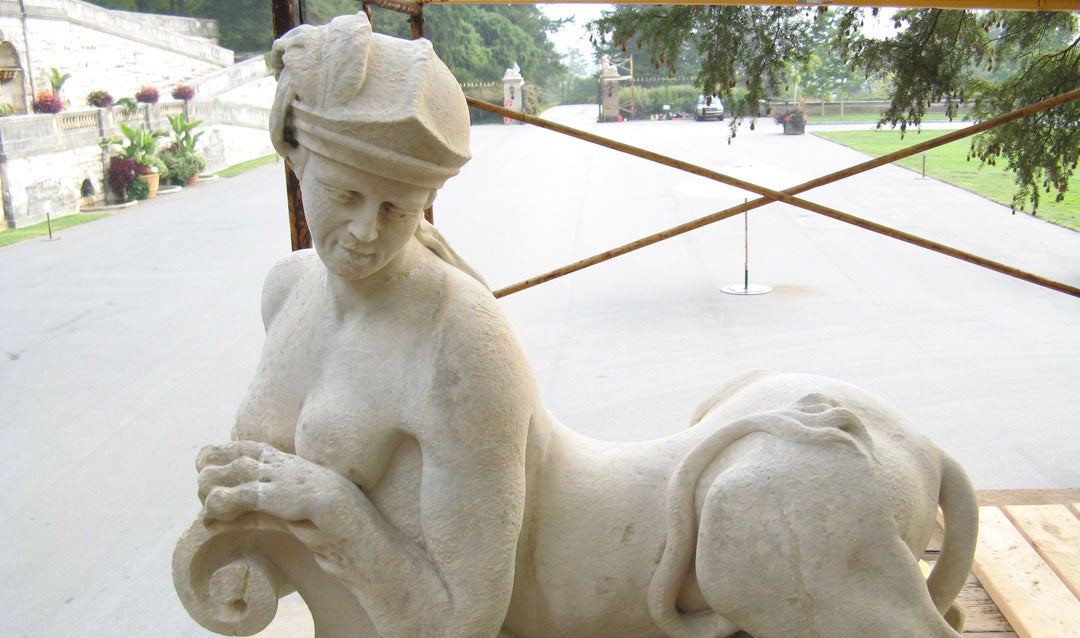
This elegant sphinx guards the right side of the North Gate entrance to Biltmore House.
This sphinx is turned as if to watch the Approach Road while the sphinx on the opposite side of the North Gate looks toward Biltmore House. The sculpture was in need of a thorough cleansing to rid it of biological growth. Scaffolding was built around the sphinx so our conservators could clean it in place.
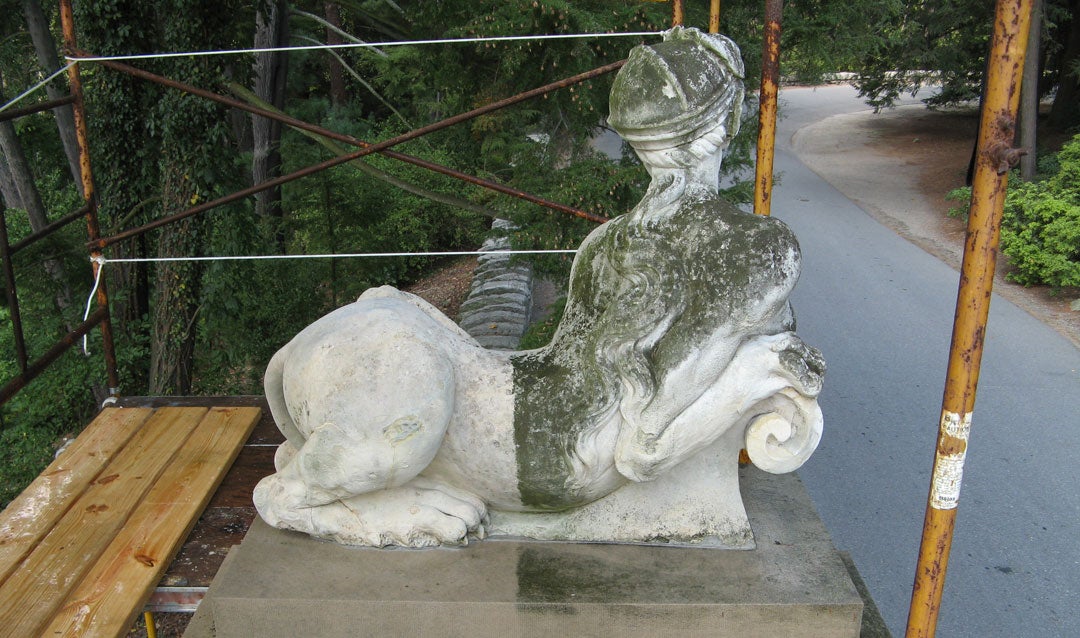
Conservators carefully cleaned half of the sphinx to show the remarkable difference proper care makes.
Biltmore’s preservation experts worked on half of the sculpture at a time to illustrate different stages of the cleaning process. Note how much detail is revealed when the dark biological growth was removed from the hindquarters of this sphinx.
This outdoor sphinx sculpture at Biltmore’s North Gate has been cleaned and restored to her full glory.
After a thorough cleaning, the classic sphinx sculpture once again welcomes guests to Biltmore House in regal style.
At Biltmore in Asheville, NC, our legacy of loving care extends across the estate, encompassing each piece of the collection, from art and furnishings inside America’s Largest Home® to outdoor sculptures and more.
Iconic lions at Biltmore House
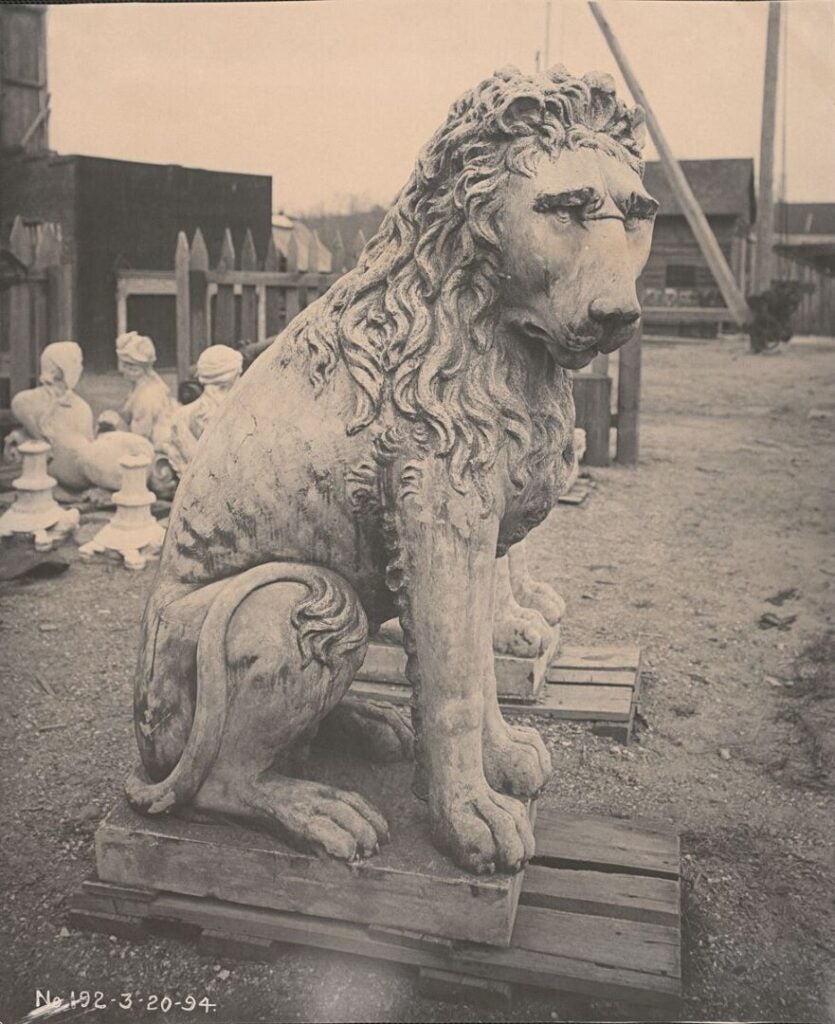
One of the two marble lions out of its shipping crate and awaiting placement in front of Biltmore House, circa 1895.
While the lions may appear to be made of terra cotta, closer inspection reveals the unique and beautiful color patterns of Italian rose marble (Rosso di Verona) ranging from beige to orange to red. Today’s visitors may notice some areas where the surface has been polished to a high sheen.
Our staff at work
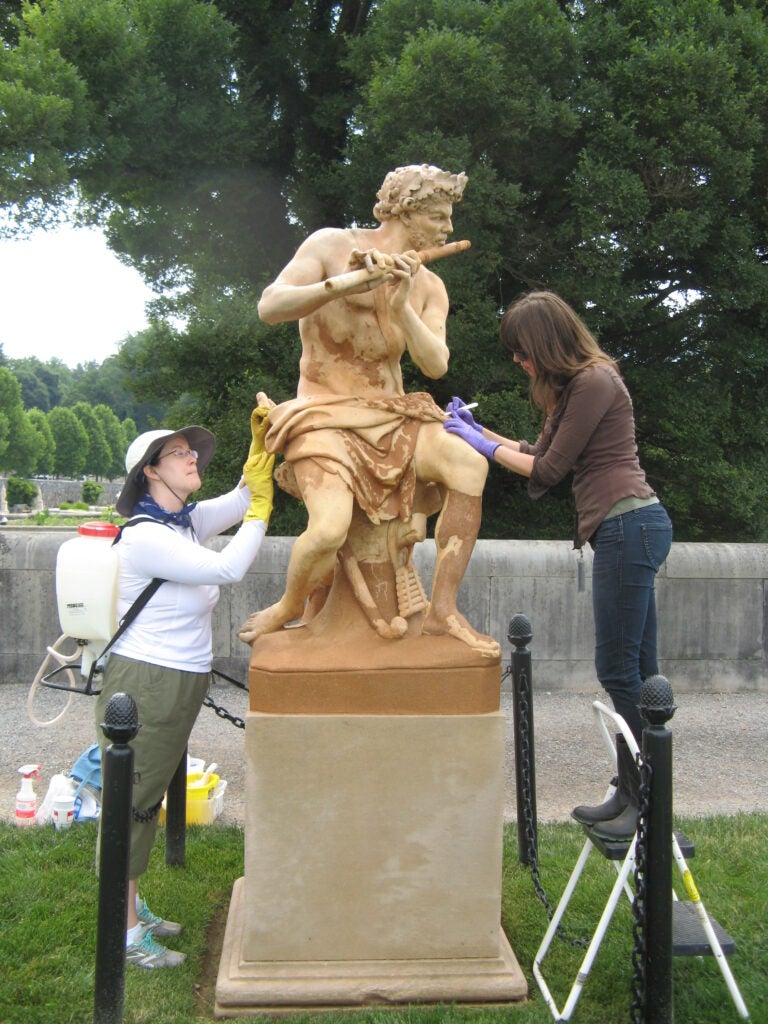
Museum Services staff members Genevieve Bieniosek (left) and Kara Warren (right) work together to clean an outdoor statue of Pan on the South Terrace of Biltmore House.
“For more than a century, these friendly beasts have greeted guests as they enter Biltmore House,” said Kara Warren, Preventive Conservation Specialist. “So that sheen is actually the result of millions of hands rubbing the marble away through the years.”
Kara oversees the care for the lions and 37 other outdoor statues and historic plaques through the implementation of the estate’s ongoing preventive conservation program. The job requires a combined knowledge of material science and artistic skill in order to properly analyze, treat, and restore the sculptures.
According to Kara, the longevity of any outdoor statue depends on the nature of its construction, environmental exposure, and the maintenance it receives. Records in our archives indicate restoration to the garden statuary began as early as 1934.The descriptions of repair work have become part of the history of each piece, documenting the care it received over the years.
Preserving each piece
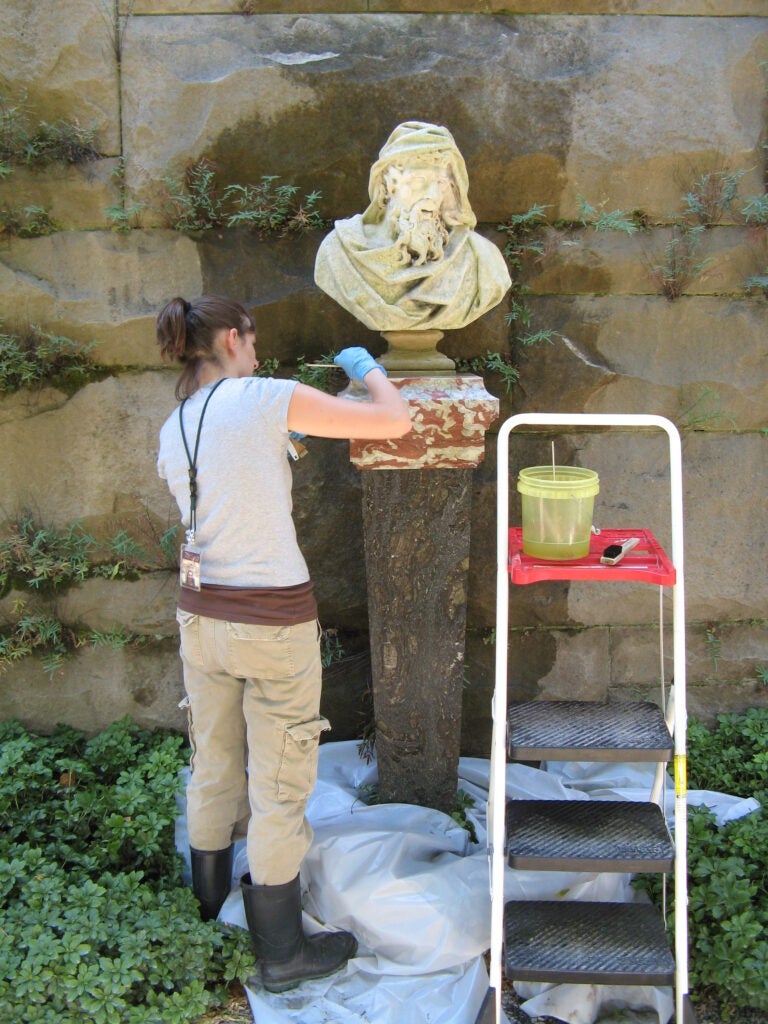
A member of the Museum Services team cleaning the marble plinth of a bust under the Pergola below the Italian Garden.
To help preserve our collection of outdoor statuary, each piece is examined, photographed, cleaned, and stabilized as needed every six months. Sometimes the statues simply need a gentle spray of water and an antimicrobial wash to reduce biological growth. Other times, patching or repair is required.
“Outdoor sculptures are vulnerable because they are exposed to so many types of deterioration,” said Kara. “Our preventive maintenance program is important because pollution, biological growth, and even repeated touching can damage these vulnerable objects. Cyclical maintenance allows us to gently clean, repair, and stabilize the original material before severe damage occurs.”
Our legacy of loving care
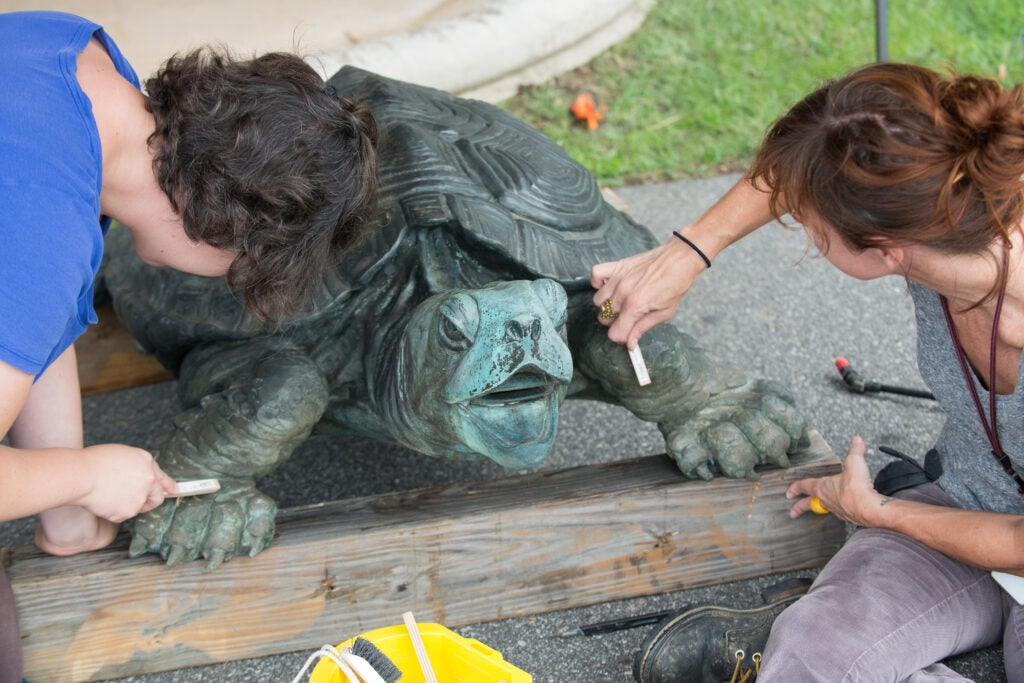
Staff members clean one of three bronze tortoise fountain sculptures below the Rampe Deuce at Biltmore House.
Most of Biltmore’s outdoor sculptures were purchased from France and Italy in the late 1800s, and some date to earlier times. The collection includes bronze, marble, limestone, granite, and terra cotta sculptures. As with all our efforts to preserve Biltmore, the loving care our statuary receives allows these sculptures to be enjoyed by today’s guests, our Annual Passholders, and future generations.
Preserving generations of Biltmore china and crystal is a delicate job.
If you have fine china or crystal handed down in your family, you can imagine the care it takes to clean and preserve all the fragile place settings and glassware in the Biltmore collection!
Generations of fragile china and crystal
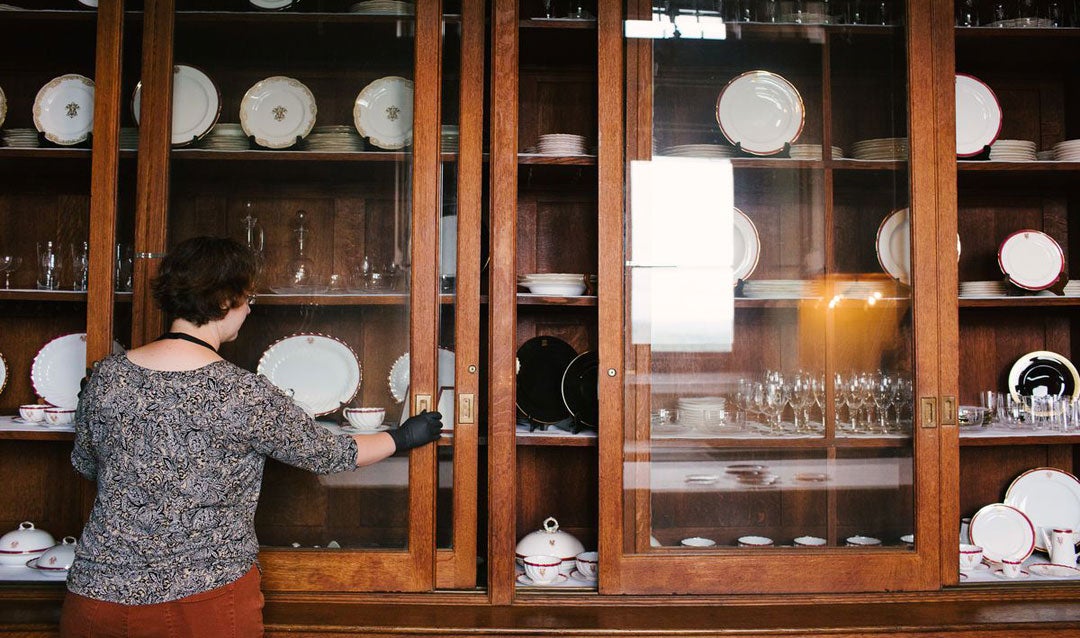
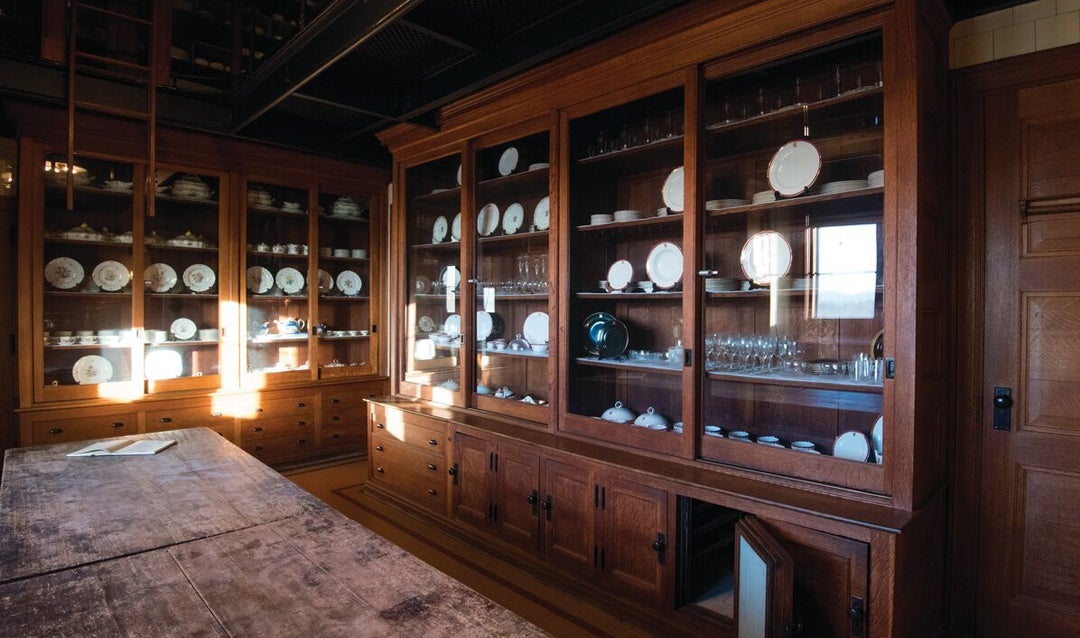
Gevevieve Bieniosek opens the china cabinet in the Butler’s Pantry
There are three generations of china and crystal stored in Biltmore House, and much of it is more than 100 years old.
These fragile pieces of the collection are stored in glass-front cabinets in the two-story Butler’s Pantry, and a comprehensive inventory system helps our conservators keep track of each object.
A unique identification number is assigned to every dish and glass, the location of the piece is recorded, and a digital photo of it is included in an inventory database.
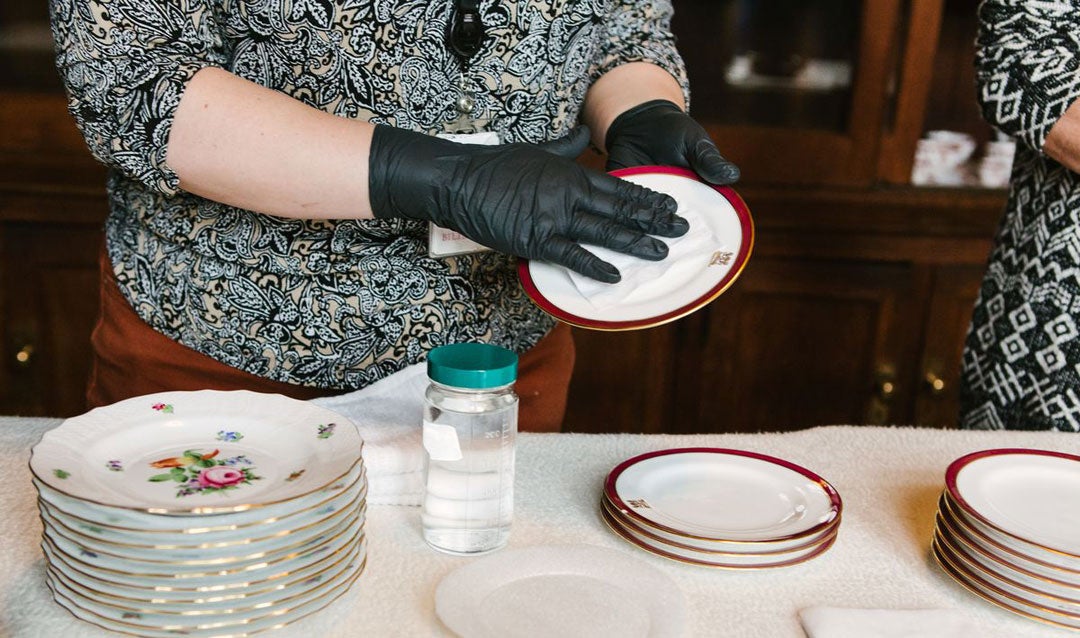
Genevieve cleans saucers that bear George Vanderbilt’s monogram, while the floral patterned plates on the left were chosen by Vanderbilt’s grandson, William A.V. Cecil, for Biltmore’s centennial celebration in 1995
Cleaning all the china and crystal in the Butler’s Pantry is a process that takes several weeks to complete. Each piece is dusted, wiped with a mixture of ethanol and water, and dried with lint-free cloths. All the objects are inspected for unstable cracks.
“Most of the cleaning and dusting is done in the Butler’s Pantry, because the less we move such fragile pieces, the better,” said Genevieve Bieniosek, Furniture Conservator.
Preventing problems
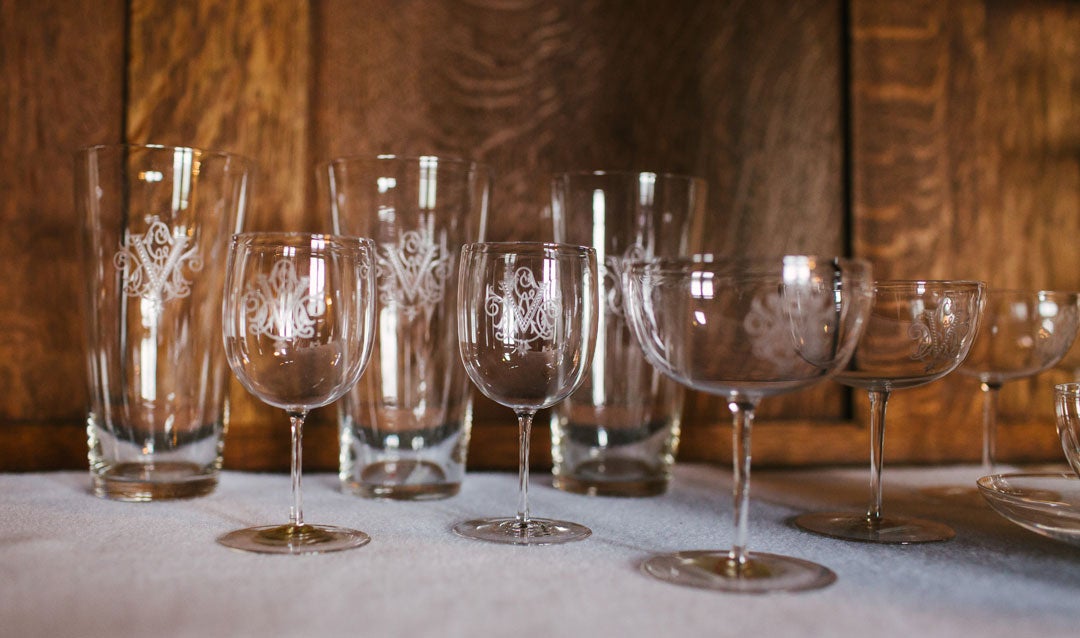
Delicate crystal glassware with George Vanderbilt’s monogram in the Butler’s Pantry
During a recent cleaning project, the conservators noticed that some of the crystal on display was suffering from ‘glass disease.’ According to Genevieve, this is a condition where components in the glass structure leach out over time, causing the glass to appear cloudy.
“If left untreated,” Genevieve explained, “it will eventually create a fine network of cracks over the piece.”
The glasses were treated by washing them with mild soap and water, drying them with soft towels, and letting them air dry for several hours.
“By treating them now, we avoid permanent damage from the glass disease,” said Genevieve.
Improving the process of storing crystal and china
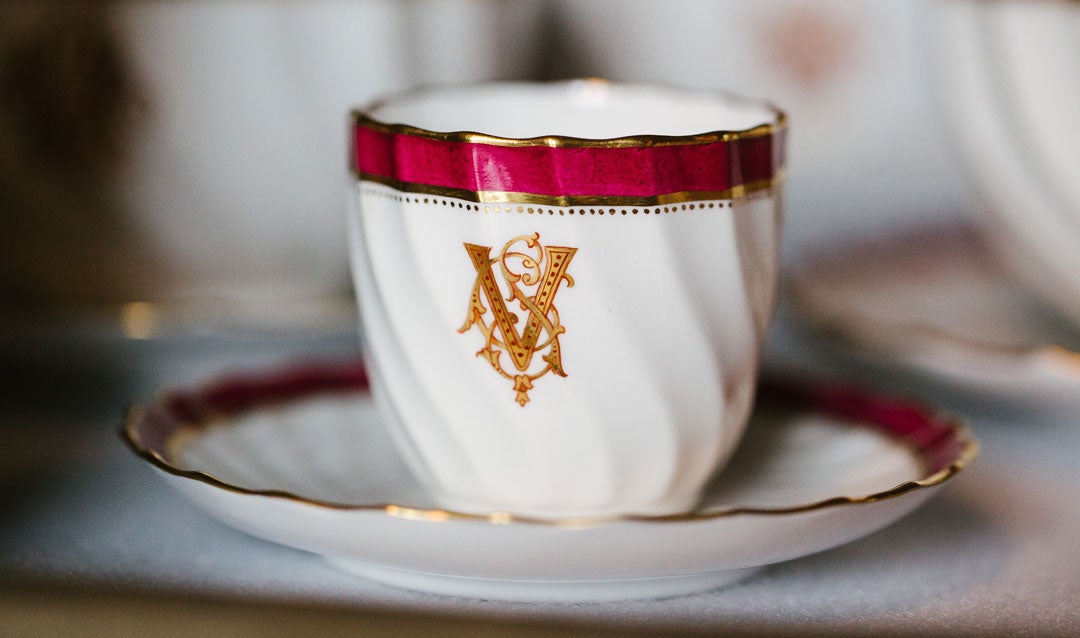
This fluted cup and saucer bear Cornelia Vanderbilt’s monogram
In addition to careful cleaning of these fragile pieces, our conservators are always looking for ways to improve the overall process for preserving the china and crystal.
“We recently looked into different types of padding material to keep the china safer, and placed sheets of polyethylene foam between each dish. The material is very stable, so the sheets don’t break down and create chemicals that could harm the china,” noted Genevieve.
Take a behind-the-scenes guided tour
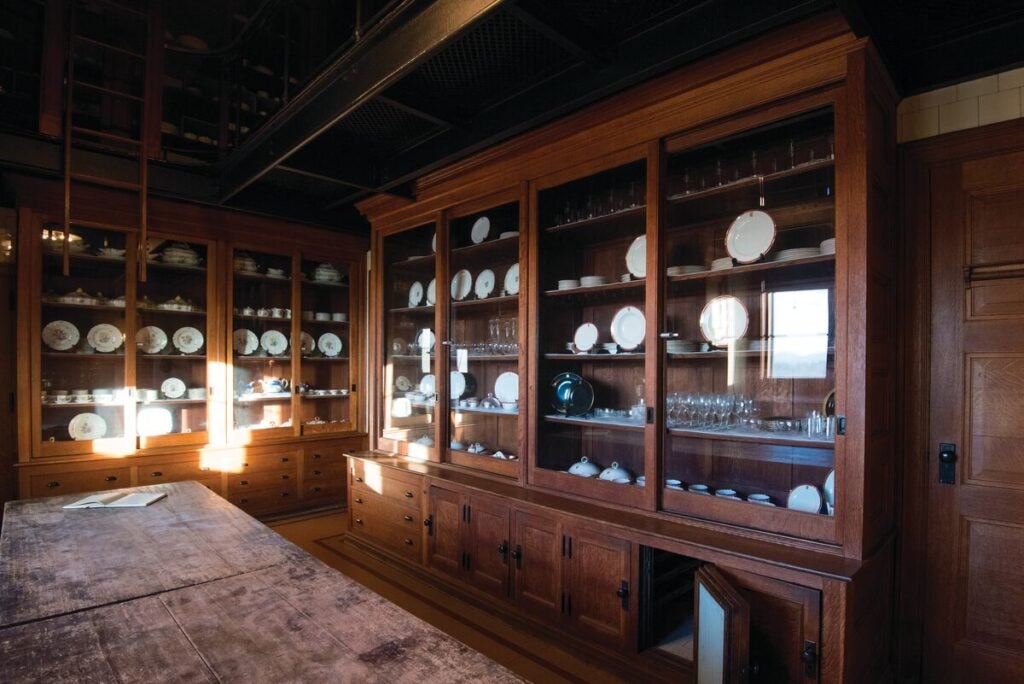
The Butler’s Pantry, as seen on The Biltmore House Backstairs Tour
Plan a visit to America’s Largest Home today, and treat yourself to The Biltmore House Backstairs Tour. You’ll experience an in-depth look at servant life at Biltmore with this 60-minute guided tour, including rarely-seen areas such as the Butler’s Pantry as you hear fascinating stories of those who worked and lived on the estate in the Vanderbilts’ era.
Featured blog image: Biltmore conservators Genevieve Bieniosek and Renee Jolly clean china and crystal in the Butler’s Pantry of Biltmore House
Frederick Law Olmsted selected the major plantings at Biltmore with the utmost attention. Each had a specific purpose: to provide a certain color, texture or function, such as shade or height. But the manmade features of the gardens−statuary and planters−are more like the icing on the cake, hitting graceful notes throughout the landscape. So, what do we know about the artwork in Biltmore’s open air museum?
“To our knowledge, Olmsted did not specify any statuary at Biltmore,” says Bill Alexander, Biltmore’s Landscape and Forest Historian. Research shows most of the statues were purchased in the late 1800s in France and Italy by George Vanderbilt and Richard Morris Hunt, Biltmore’s architect. It’s likely that Olmsted did play a role in the placement of the statues because the three men worked so closely on every aspect of the design of Biltmore House and Gardens.
Classic Influences
Walking through the gardens, you’ll notice a number of statues featuring characters from Greek myth. The four terra cotta figures on the South Terrace—Faun, Adonis, Venus, and Hamadryad—are modeled after originals created by Antoine Coysevox, a prolific sculptor from the 17th century. If you look closely at the figure at the far right end of the Terrace, you’ll see Coysevox’s maker’s mark.
In the Italian Garden, you’ll find several variations of late-19th-century putti—winged figures that were popular in both statuary and painting during the Italian Renaissance. The small terra cotta angel located at the end of the Italian Garden is based on a work of art that’s housed in the Louvre. Although there’s a fountain bowl in front of this putto, Kara Warren, Preventive Conservation Specialist, says there is no record that water was ever used in the fountain.
Aging Naturally
Whether made from bronze, marble, limestone, granite, or terra cotta, each outdoor statue has to weather the elements. Storms and environmental pollutants have taken their toll of them over the last century. According to Kara, some repairs and restorations date back to 1934.
“Reading the descriptions of repair work from our archival records is like having a mini history lesson. Each repair documents the care the statue received over the year. Today, we occasionally need to repair the repairs, replacing corroded iron elements with stainless steel or replacing mortar that has crumbled over time,” she continues.
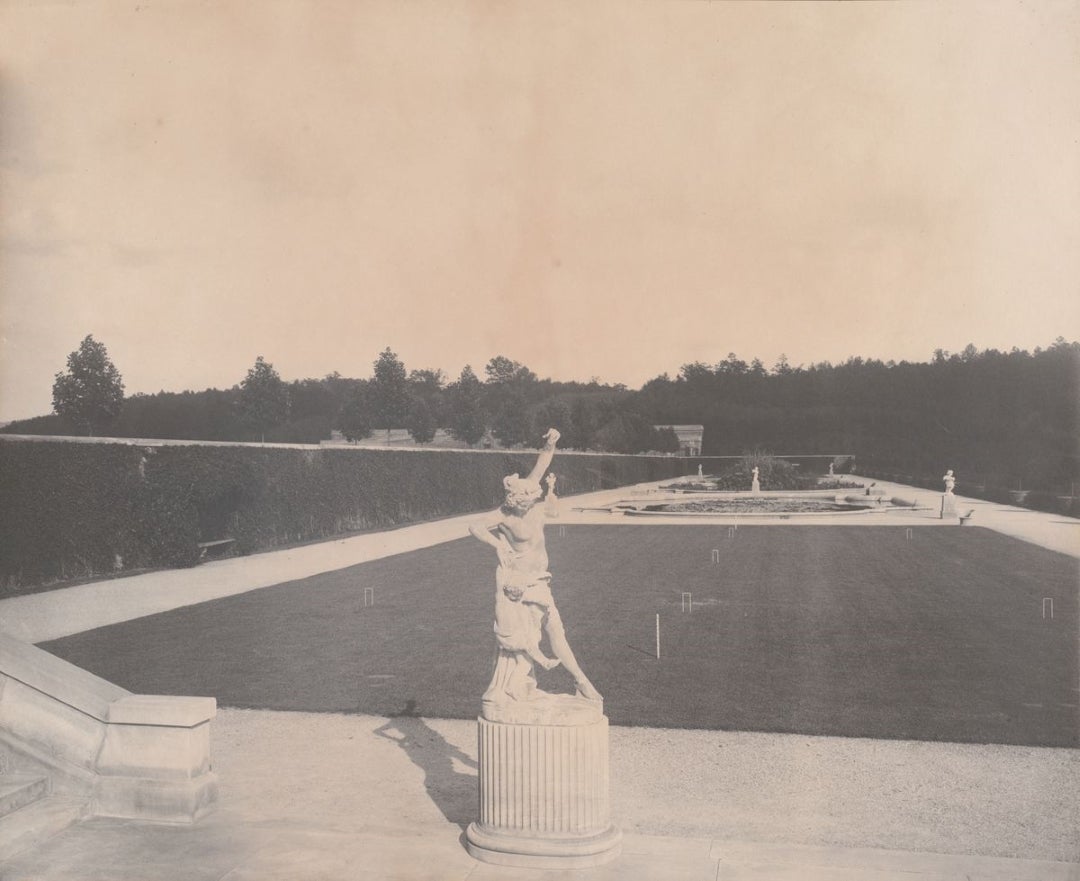
Near the stairway leading from the house to the Italian Garden, you’ll notice the Italian white marble statue that’s known as “The Dancing Lesson.” The original, made of terra cotta, was replaced by this copy in the 1970s after it was damaged in a storm.
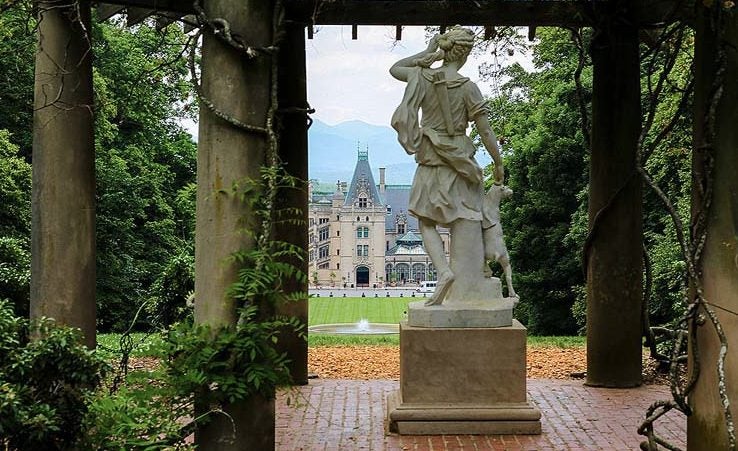
Perhaps Biltmore’s most famous statue, Diana, goddess of the hunt, located on the hill overlooking the house, met a similar fate. The original terra cotta work, based on a marble housed in the Louvre, was replaced with today’s marble version carved by H. Whinery Oppice in the 1970s.
In Harmony with Nature
As you walk through the gardens, statuary sometimes plays a supporting role to the ever-changing natural beauty that takes center stage. But each garden element is an important part of this living landscape that has been recognized as a National Historic Landmark.
Even in Biltmore House, where so many rooms are filled with amazing collections of beautiful things, the Library still shines as a special place. George Vanderbilt was a remarkable man, and it’s fascinating to learn more about him through the creation of his magnificent and enduring library at Biltmore.
Learn more about George Vanderbilt’s tastes and interests with this look at some noteworthy books that form the Biltmore House Library collection.
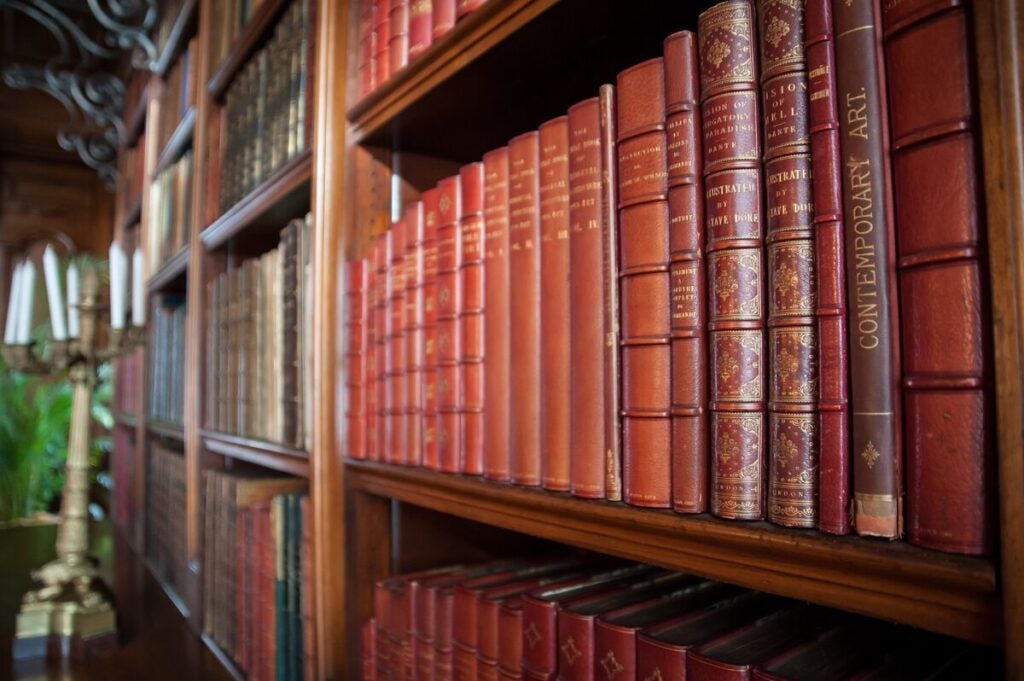
An up-close look at leather-bound books in the collection
Logging literary pursuits
When he was 12, George Vanderbilt began recording the names of each book he read in a journal, and he continued that habit throughout his life. If we look at any representative year, we get a sense of the breadth of his intellect. In 1899, Mr. Vanderbilt read a total of 51 books: 31 were novels, including The Two Magies and The Awkward Age by Henry James and Antonia or the Fall of Rome by Wilkie Collins.
The non-fiction list from that year is just as fascinating and includes The Renaissance in Italy (a two-volume study by J. A. Symonds); Oceana or England and Her Colonies by James Anthony Froude; and Human Immortality: Four Supposed Objections to the Doctrine and The Will to Believe and Other Essays in Popular Philosophy by Henry James’ brother William.
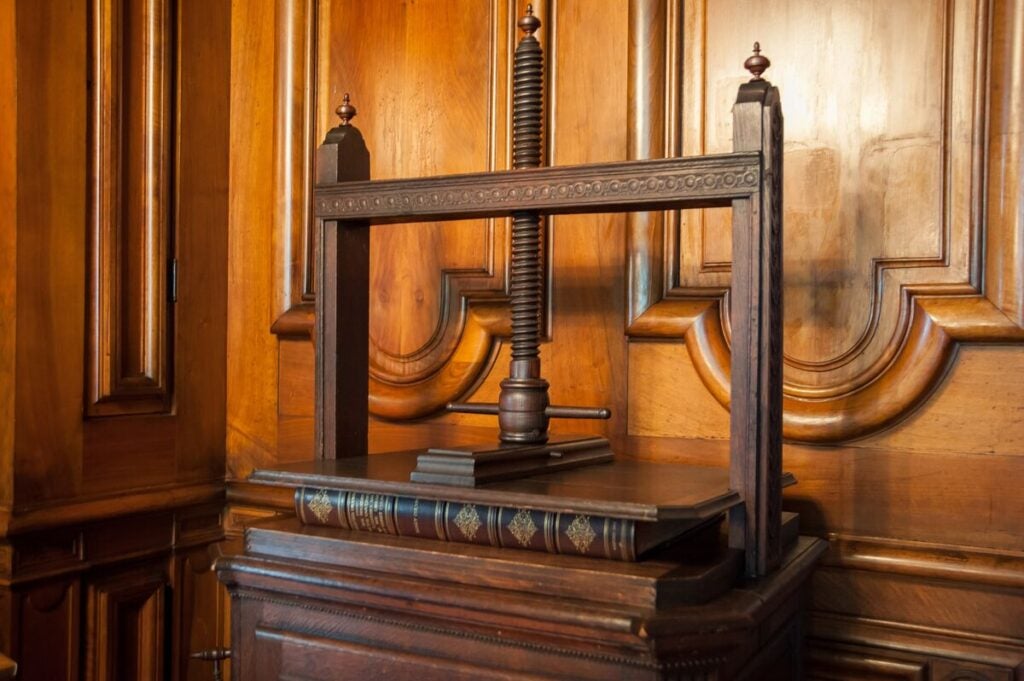
Detailed look at a large bookpress in Library in Biltmore House
A man of many interests
By the time of his death, George Vanderbilt had collected more than 23,000 volumes. Approximately one-third of the volumes were antiquarian purchases, with the oldest appearing to be an Italian work published in 1561. The major strengths of the collection are 19th-century English and American literature, art and architecture; travel, philosophy and religion; history; and French fiction and non-fiction reflecting both his and his wife’s interest in France and their fluency in the French language.
Most of the books George Vanderbilt collected were sent to one of the great bookbinders of the period, such as Riviere, Stikeman, Lortic, or David. A few months later they would be returned beautifully bound in Moroccan leather, with gilt lettering and decoration, to be placed on the shelves of the Biltmore House Library.
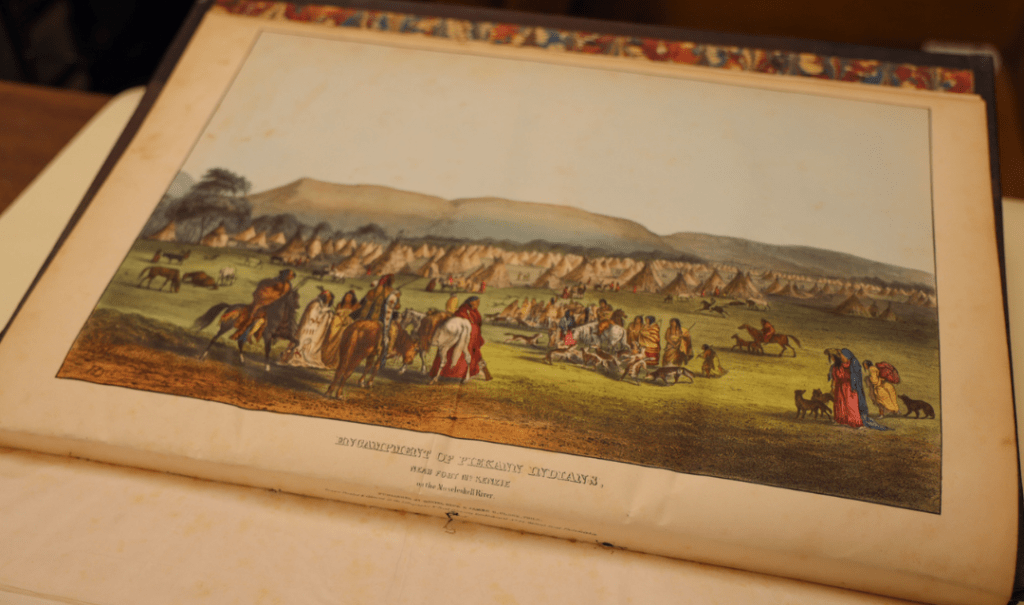
Lithograph from Thomas McKenney and James Hall’s History of the Indian Tribes of North America, 1844.
Rare Biltmore Library collections
The Biltmore House Library contains Thomas McKenney and James Hall’s History of the Indian Tribes of North America. Our volumes are the original large folio edition, published in 1844, and contain a full set of the original 120 hand-colored lithographs, which have remarkably retained their vibrancy despite being 180 years old.
This work is widely regarded as one of the most significant publications on Native Americans ever produced, as well as one of the most important color plate books of the 19th century. It provides a remarkable glimpse into the lives and appearances of Native American leaders during a pivotal time in American history and of Biltmore’s earliest inhabitants.
Tragically, many of Charles Bird King’s original oil paintings, from which these folio prints were created, were destroyed in a fire at the Smithsonian in 1865. The rarity of the original folio printing, combined with its historical significance and the unfortunate destruction of the source material, makes this set an invaluable part of our collection.
Other notable works include the complete set of James Audubon’s The Birds of America and The Quadrapeds of America. The copies are unusual in that they are the smaller octavo edition, not the very large elephant folio edition so prized by print collectors. What makes Biltmore’s set particularly interesting is that they are bound with the original paper wrappers that accompanied each part as Audubon’s publisher issued them.
What’s the best way to enjoy all that our sprawling, 8,000-acre private mountain estate has to offer on a rainy day when Mother Nature isn’t cooperating?
In George and Edith Vanderbilt’s day, you could curl up in the Library with a good book, enjoy a dip in the indoor pool, warm up with a brisk workout in the Gymnasium, or even spend the afternoon bowling—all without ever leaving Biltmore House! Fast-forward over a century, and there’s still plenty to do to ensure a rainy day doesn’t dampen your vacation to Biltmore Estate in Asheville, North Carolina!
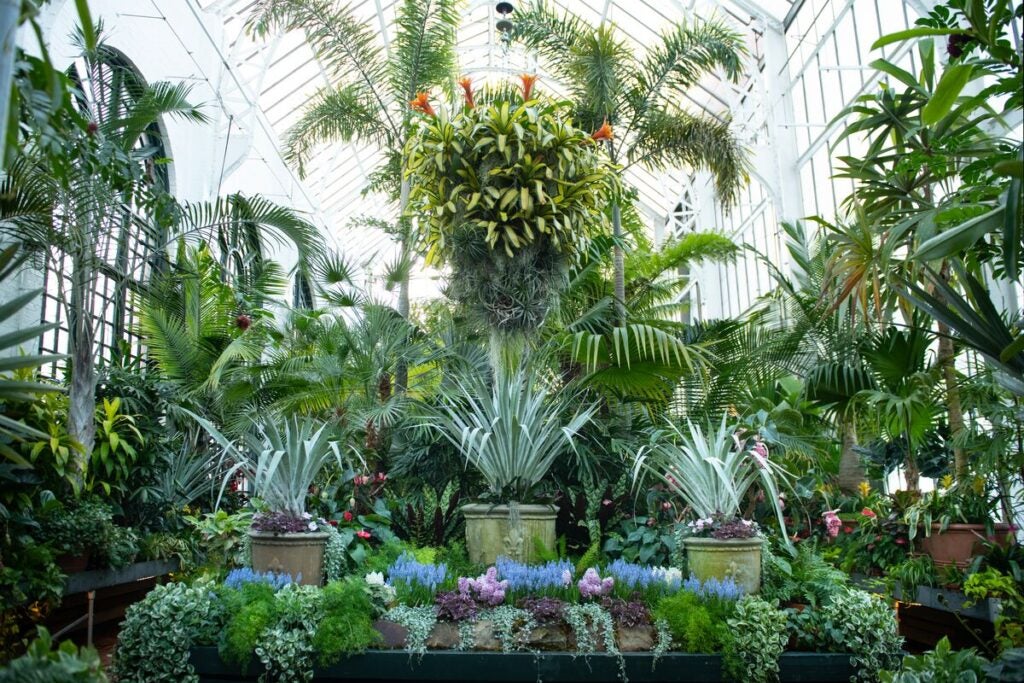
Biltmore’s historic Conservatory is a tropical getaway all year long, but an especially nice retreat during a rainy day at Biltmore!
Explore our historic Conservatory
Situated down the hill from Biltmore House and past the Walled Garden, this glorious garden-under-glass is a fascinating place to explore in any weather, but it’s especially nice to enjoy all the benefits of a lush garden full of tropical plants without getting drenched in a downpour!
Step inside the Bulter’s Pantry of Biltmore House with a specialty tour.
Upgrade your visit to include a Biltmore House specialty tour
Let the rain fall while you experience a different side of Biltmore House and its surroundings. Specialty tours such as the Biltmore House Backstairs Tour offer a behind-the-scenes look at the rarely-seen domestic staff’s areas and what it was like to work at America’s Largest Home over a century ago.
Tip: Specialty tours offered in Biltmore House will change periodically and may have limited capacity. For our most current offerings, please visit our Tours page online.
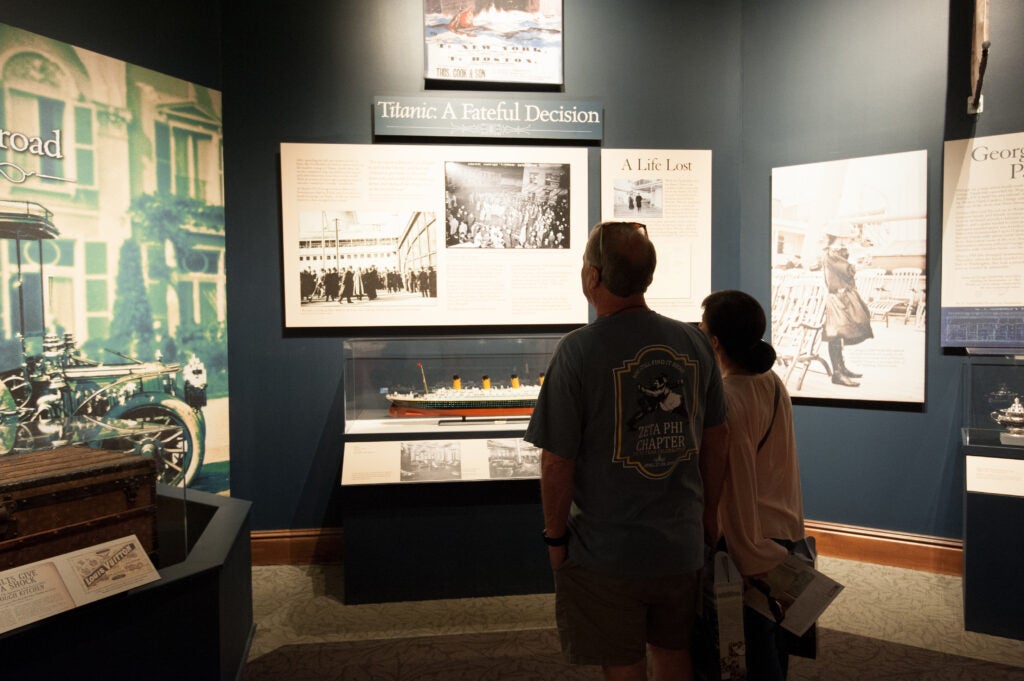
Learn about the Vanderbilt family and their travels, including their fateful decision to not board the Titanic as planned.
Learn more about the Vanderbilts at The Biltmore Legacy
Antler Hill Village is home to The Biltmore Legacy, an exhibition space that features a fascinating glimpse into the lives of the Vanderbilt family and their treasures with our The Vanderbilts at Home and Abroad exhibition. Exploring this guest-favorite exhibition is a perfect rainy-day activity at Biltmore!
Stay dry while sipping our estate-crafted wines
Let it pour outside while you enjoy the “pours” inside at America’s most-visited winery! This original estate dairy barn was converted to a winery in 1985, and you can experience a complimentary wine tasting (included with any admission type!) and other delicious offerings! Plus, Biltmore’s Winery recently welcomed a stunning Chandelier by world-renowned artist, Dale Chihuly, which is on display daily inside our Wine Shop.
Savor field-to-table seasonal dining at Biltmore’s restaurants.
Shop, savor, and stay cozy
What better way to wait out a rain shower than to savor decadent farm-to-table meals or pick out mementos from your time at Biltmore? With over 20 unique shops and restaurants on the estate available only to Biltmore guests and Passholders, you’ll have plenty to choose from!
Make your time on George Vanderbilt’s visionary estate even more memorable with a cozy overnight stay at one of our unique lodging properties, including our four-star Inn on Biltmore Estate, cozy Village Hotel on Biltmore Estate, or a historic, private Cottage on Biltmore Estate.
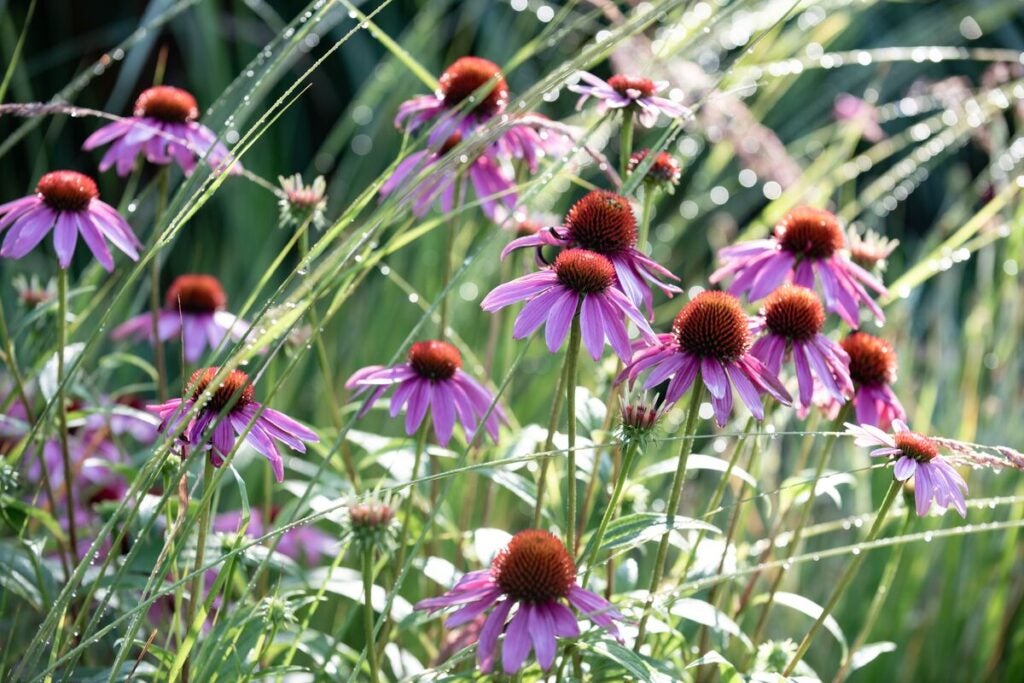
Summer rain showers leave glistening drops on native coneflowers in Biltmore’s gardens.
Pack an umbrella and explore our gardens and grounds
The weather in the mountains changes frequently, so much so that the locals in Asheville often say “If you don’t like the weather, just wait ten minutes.” During light showers, you might even enjoy grabbing your umbrella or rain poncho for a peaceful stroll through our historic gardens.
Tip: Be sure to check the local weather radar and have a backup plan in case the forecasts predict more severe weather than a mild sprinkle.The weather in our region can change quickly, which may result in unexpected temporary closures of our trails or outdoor activities during severe weather. We appreciate your understanding!
What are your favorite ways to enjoy Biltmore during the rain? Let us know by sharing on social and tagging #Biltmore @biltmoreestate.
You may not realize it from her position, but one of the significant figures in Biltmore’s past is Emily Rand King, who served as housekeeper and head of staff for the Vanderbilts from 1897–1914.
Learn about the life of Biltmore’s longtime housekeeper, Mrs. King, in this blog.
Housekeeper’s room in Biltmore House.
Three things to know:
Although we don’t have photographs of her, there is a great deal of correspondence in the Biltmore archives concerning Mrs. King.
She was always referred to as “Mrs.” King, although we believe she was unmarried while working at Biltmore. The title was likely a courtesy used to reflect a level of authority, age, and respect—similar to “Mrs. Hughes,” the head housekeeper in Downton Abbey.
Housekeepers of the time were responsible for managing a large staff and keeping track of household expenses in addition to maintaining most aspects of daily life in the home.
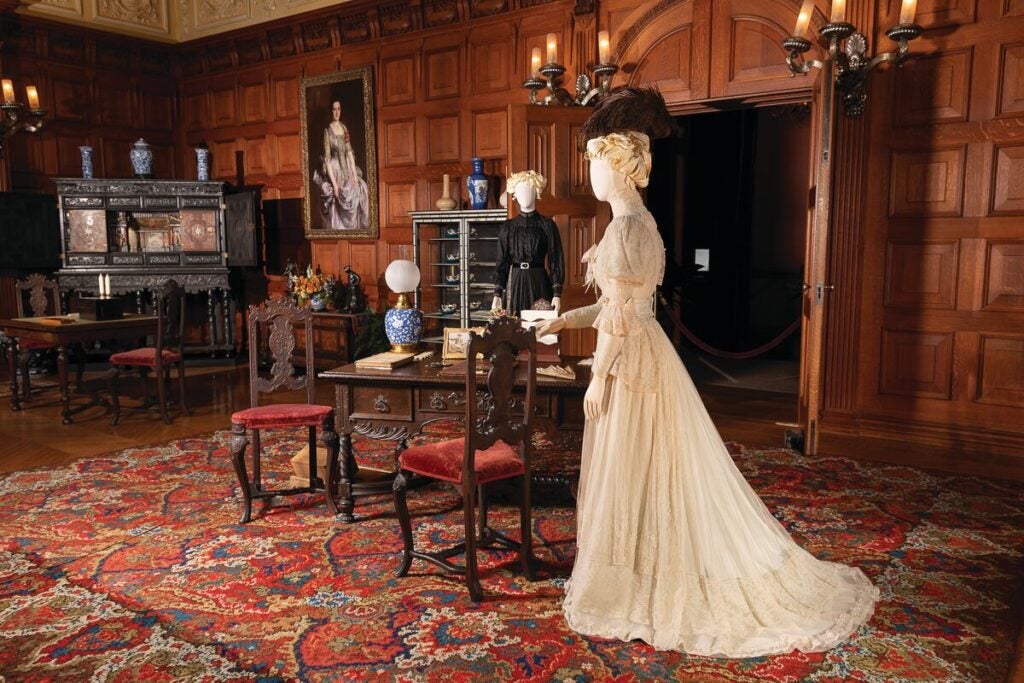
Vignette of Mrs. King and Edith Vanderbilt in the Oak Sitting Room as displayed in the 2019 exhibition, “A Vanderbilt House Party.”
Early Life & Arrival to Biltmore
Emily King was born December 7, 1853,in the village of Horndon on the Hill, Essex County, England. By her early 20s, she worked as a domestic servant for a London physician.
Sometime prior to August 1897, she traveled to New York on her way to Biltmore, where she joined several English servants on the estate, including the valet, four butlers, a cook, a housemaid, and a coachman. Adding further international flair to the household was an Irish butler, French chef, Swedish laundress, and Italian stable boss.
Biltmore’s archives make it clear Mrs. King was responsible for cleaning the house, caring for the staff, hiring and firing staff members, and also coordinating many aspects of the family’s lives such as meeting with the Vanderbilts each morning to review the chef’s suggested menus and plan for guest activities, then meeting with the Chef and Head Butler to review the plans. She and the Head Butler supervised all staff except for the kitchen staff who worked for the Chef.
During the family’s frequent travels, Mrs. King stayed behind with the Head Butler to ensure the smooth operation of the house, including making arrangements for special guests staying at Biltmore in the family’s absence and preparing the house for their return. She also extended social invitations for Mrs. Vanderbilt, serving as a personal secretary of sorts.
As a high-ranking member of Biltmore’s domestic staff, Mrs. King was provided with horses for her use and was allowed to keep her own dogs in Biltmore House—the dog gate still exists in the Kitchen Hallway that Mrs. Vanderbilt installed to keep the housekeeper’s dogs out.
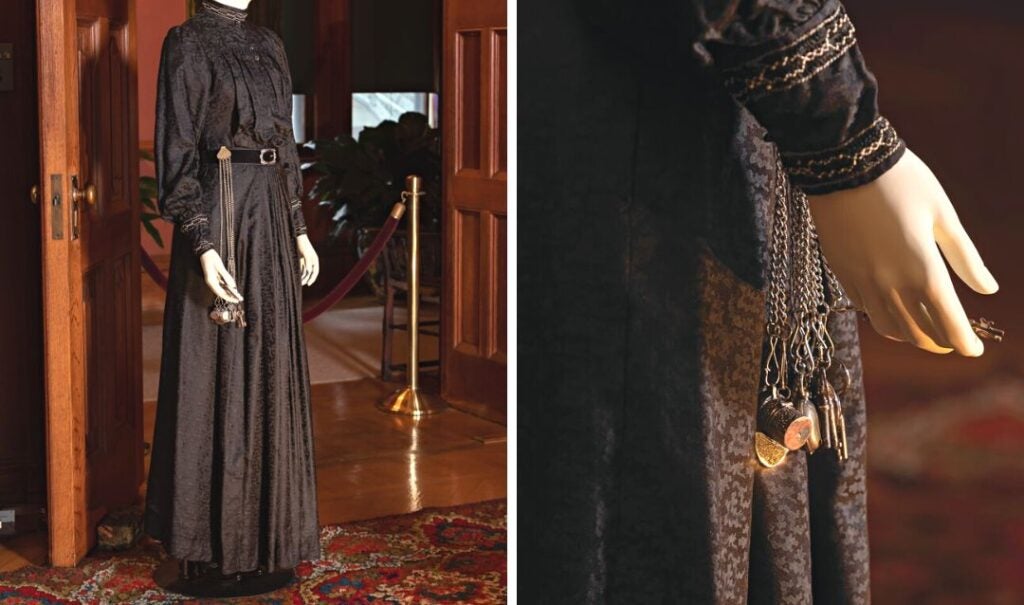
Detailed view of Mrs. King’s clothing recreation as displayed in “A Vanderbilt House Party” in 2019.
Life After Biltmore
Soon after George Vanderbilt’s death in 1914, Emily King resigned and embarked upon a new life. She met and married W.C. Jones, a widowed farmer from near Raleigh, NC, and moved to Pennsylvania to be near family. Sometime later that year, the couple purchased an orange grove near Apopka, FL. In December 1914, estate superintendent Chauncey Beadle wrote a note of thanks for the box of oranges Mrs. Jones sent to Biltmore for the holidays.
Biltmore curators learned that Emily King Jones purchased and managed a boarding house in Apopka, which she named the Biltmore Inn, and operated it until the early 1920s.
After retiring from a lifetime of serving others, Mrs. Jones returned to Pennsylvania, where she resided until her death in 1926.
The typical duties of a Vanderbilt-era valet included attending to their employer, especially assisting with dressing and preparing for the day, much like a lady’s maid. They would often travel with their employer, arranging for accommodations and transportation and managing luggage.
While we do not have a lot of information about Mr. Vanderbilt’s valets over the years, we do know a bit about one in particular named Wilfred Shackley including:
He was employed by George Vanderbilt from around 1900-1906.
It is believed that his wife, Madeleine Henry Shackley, was the Mademoiselle Henry that was once Edith Vanderbilt’s lady’s maid.
Wilfred Shackley was English and was engaged by Mr. Vanderbilt while abroad in 1899.
He spoke German and French fluently, which was highly beneficial given how widely he would travel alongside Mr. Vanderbilt.
Recreation of clothing worn by George Vanderbilt’s valet as it was displayed in “A Vanderbilt House Party” exhibition in 2019. Over his arm is a driving duster, as if he is assisting George prepare for a drive across his estate.
Fascinating glimpses into the life and times of Mr. Shackley
In researching the domestic staff who worked for the Vanderbilts, our Museum Services team uncovered a 1973 newspaper article in the Hendersonville Times-News about Wilfred George Shackley.
“Few people have been able to cram into their lifetime book of memories as many world trips, as many confrontations with kings and potentates and as much hobnobbing with world celebrities as Wilfred G. Shackley of Flat Rock who celebrated his 98th birthday last week.
“Sleeping in the White House at the invitation of President Theodore Roosevelt, meeting Kaiser Wilhelm of Germany and King Edward of England and traveling around the world with millionaire George Vanderbilt, original owner of Biltmore House are only a few of the highlights of Shackley’s career.
“Born in June 17, 1875 Shackley attended school in England and came to the United States when he was 15 years old. When he came to this country he worked and attended night school and learned accounting, bookkeeping and typing. When he was 19 years old a cotton broker engaged him to go to Shanghai with him.
“He was there eight months and returned to London wearing the white type of clothing usually worn in China.
“When he checked in at the hotel where he usually stayed the clerk greeted him and said ‘You’re just the man we are looking for.’ He added ‘There’s a millionaire here from America looking for someone to travel around the world and keep his records.’
“Shackley says he was introduced to Vanderbilt and when the millionaire learned he spoke several languages he immediately hired him. He said ‘we leave for Paris day after tomorrow.’ Shackley said he told Vanderbilt it would be impossible because all the clothing he had was light clothing he brought from the Orient. Vanderbilt postponed the start of the journey ten days for Shackley’s convenience.
“The Flat Rock retiree spent a number of years traveling with Mr. and Mrs. Vanderbilt, keeping records of their travels, purchases and other details. Among the countries visited were Russia, Germany, France, Holland, Italy, China, Japan, the Philippines and Canada.
“In his travels Vanderbilt was seeking art treasures, tapestries, statuary, works in silver and gold and historic treasures.
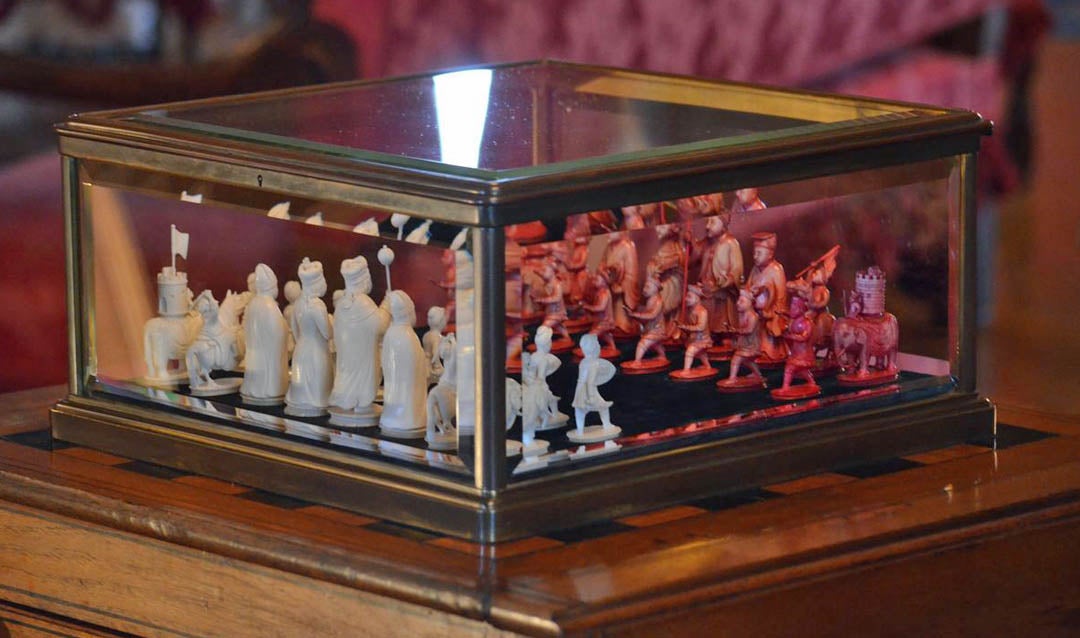
“Shackley has also played chess with a set of chessmen which Napoleon used while he was imprisoned at St. Helena. Vanderbilt acquired the set and it is a part of the possessions at Biltmore House.”
George Vanderbilt’s friend James McHenry gifted him a chess set made of natural and red-stained ivory that once belonged to Napoleon Bonaparte, former emperor of France. Photo credit: @Kristen.Maag
Life after Biltmore
After leaving service at Biltmore, Shackley went to work for a Wall Street bond company, later selling bonds in Paris. He served in World War II with the War Department then became vice president of Henry Rump and Sons, a wholesale fruit and vegetable business founded by his father-in-law. The Shackleys ran this business until his retirement in 1966 when he turned 90.
He passed away at the age of 101 in Hendersonville, NC.
Credit: Excerpts from “William [sic] Shackley At Age 98 Has Led A Full Life,” July 23, 1973, Hendersonville News-Times.
Biltmore in Asheville, North Carolina was officially nominated as a National Historic Landmark on May 23, 1963.
The original landmark designation was based on the theme “Conservation of Natural Resources.” The description for Biltmore was:
At Biltmore, the George W. Vanderbilt estate near Asheville, Gifford Pinchot demonstrated for the first time in the United States that scientific forest management could be profitable and was, thus, good business practice. Another ‘first’ in forestry occurred here in 1898 when the first forestry school in the United States was opened, the Biltmore Forest School, headed by Dr. Carl A. Schenck. Nearly 87,000 acres of the estate’s forest land is now included in Pisgah National Forest. The building in which the school was conducted is owned by the city of Asheville and used today for offices.
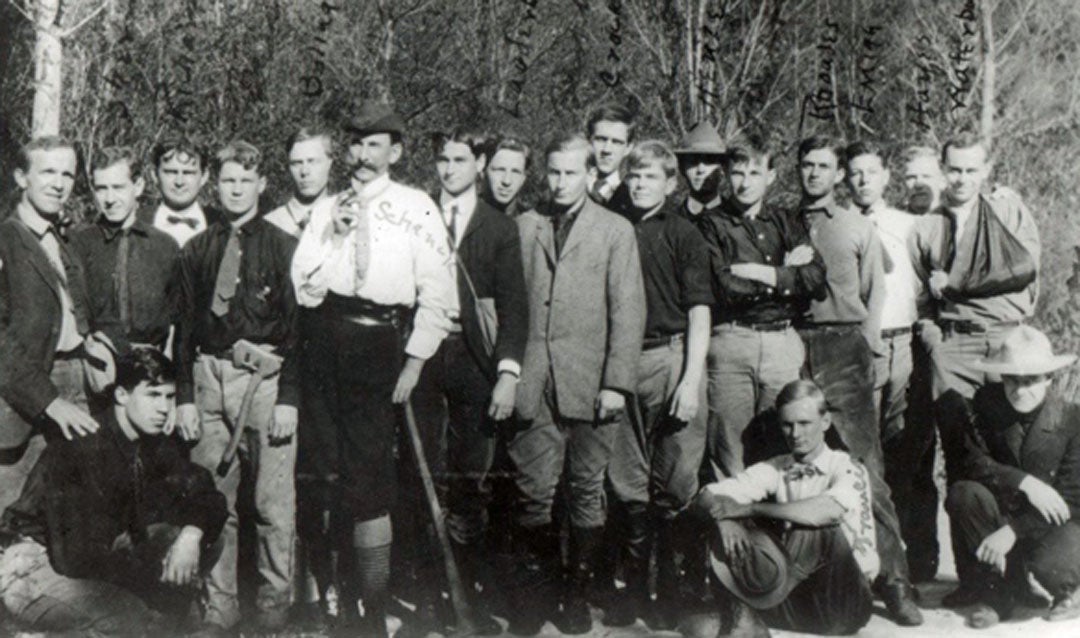
Dr. Carl A. Schenck with Biltmore Forest School students, 1900. Image courtesy of National Forests of North Carolina Historic Photographs, D.H. Ramsey Library Special Collections, University of North Carolina Asheville, Asheville, NC.
Beginning in 2000, Biltmore began an effort to expand the landmark designation beyond conservation to include the themes of architecture, landscape architecture, and social history, and to extend the period of significance to 1950 to include the contributions of Chauncey Beadle, estate superintendent, and improvements and significance of the Biltmore Dairy during those years. The Secretary of the Interior approved this expansion on April 5, 2005.
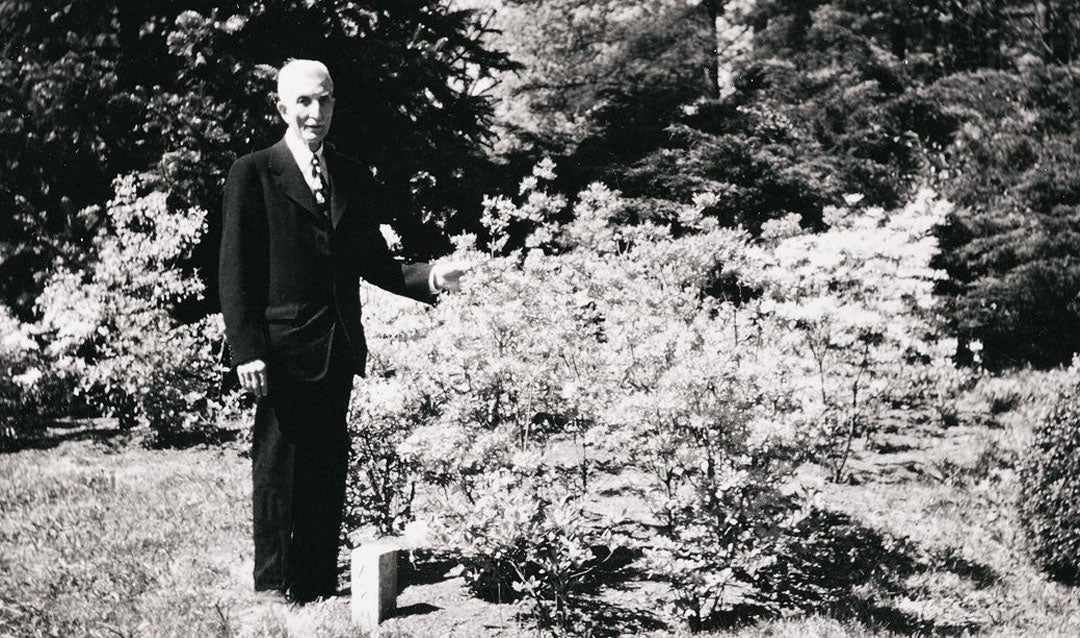
Estate Superintendent Chauncey Beadle, 1948
Bill Alexander, Biltmore’s former landscape and forest historian and participant in the five-year project of gathering additional documentation for the expanded designation, said that Biltmore has to submit periodic reports to the National Park Service to describe any changes occurring to the property, including natural disasters and damage such as the floods and tree loss caused by Hurricanes Frances and Ivan in 2005.
He also noted that the building referenced in the original nomination is located in Biltmore Village.
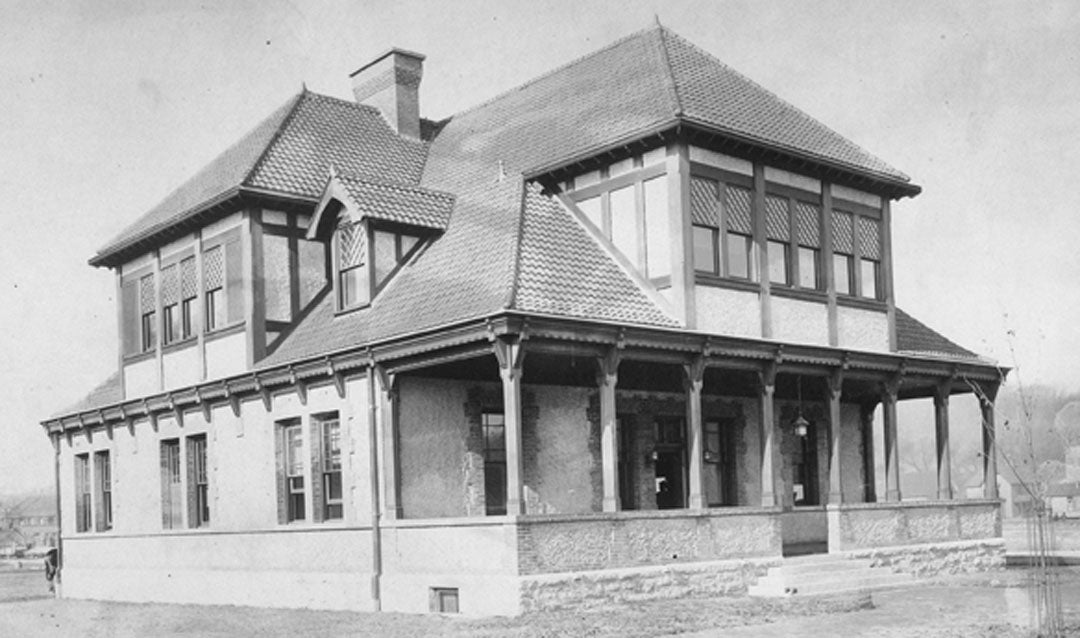
“The office building at 1 Biltmore Plaza was where the Biltmore Forest School held its fall and winter classes for a number of years,” Bill said. “It was the first new, permanent structure completed in Biltmore Village after George Vanderbilt purchased the village in 1894, followed by the passenger train depot in 1895 and All Souls Church in 1896, all designed by architect Richard Morris Hunt.”
1 Biltmore Plaza in Biltmore Village, 1895
“Biltmore sold the office building to the City of Asheville in 1929, and leased the downstairs for corporate offices while the upstairs was used as a substation of the Asheville Fire Department.”
Biltmore eventually repurchased the building and currently uses it for office space.
The National Park Service lists more than 2,500 historic properties “that illustrate the heritage of the United States.” National Historic Landmarks include historic buildings, sites, structures, objects, and districts, with each landmark representing an outstanding aspect of American history and culture.
Plan your visit to Biltmore today and enjoy the splendor of this National Historic Landmark.