Falconry soars at Biltmore

Falconry soars at Biltmore as a pair of dedicated falconers showcase the powerful skills of the beautiful birds in their care. Learn more about this experience hosted on the grounds of George Vanderbilt’s estate in Asheville, NC.

Meet your falconry team
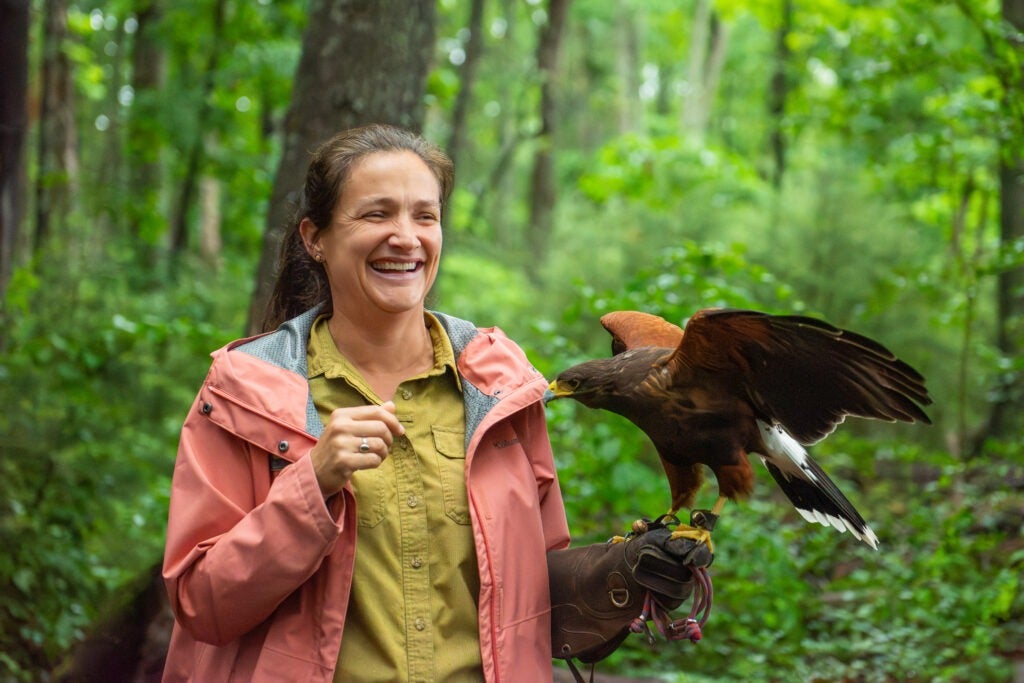
A trainer holds a Harris' hawk during the falconry experience at Biltmore.
Samantha gives falconry participants a chance to see a Harris’ hawk up close.

Participants meet Samantha Bristow and Jeff Curtis, members of Biltmore’s Outdoor Adventure Center team who lead our falconry experience, in the Lobby of The Inn on Biltmore Estate. From there, it’s a short walk to the wooded area beyond The Inn where each bird of prey is housed in its own separate enclosure.
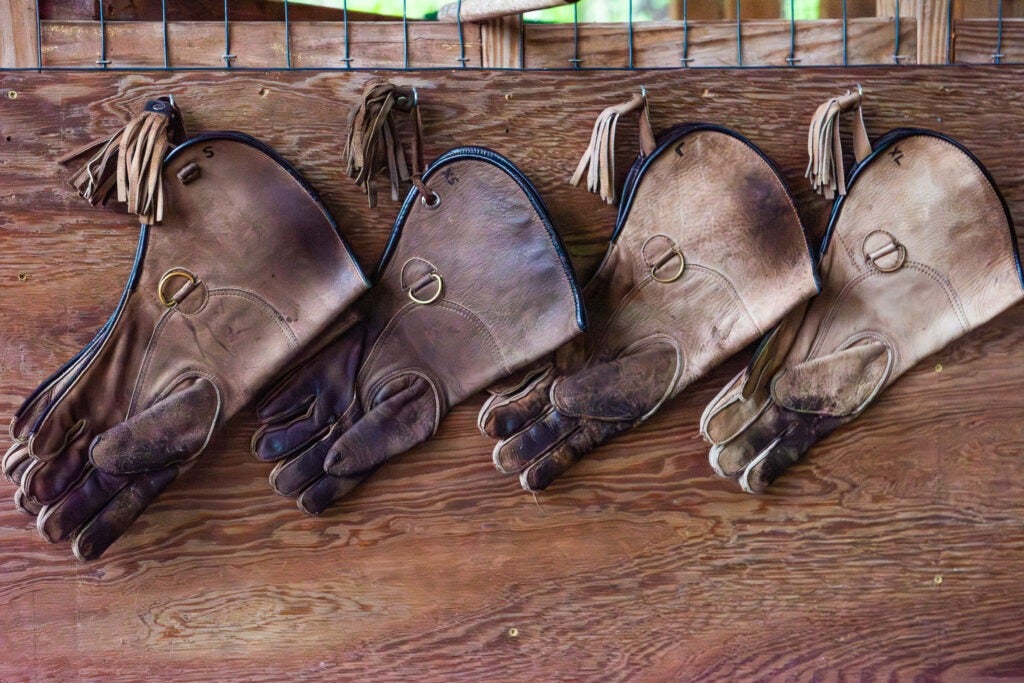
Leather gauntlets hanging on a wooden wall.
Leather gauntlets protect your hand and arm while giving the birds a firm surface to grip with their talons.

After a brief overview of the history of falconry and Biltmore’s program, participants have an opportunity, one at a time, to don a heavy leather gauntlet that protects the hand and forearm and allow a raptor to perch there while Jeff and Samantha provide rich details about these fascinating birds of prey.

Fun falconry fact: The activity is known as falconry whether you’re interacting with hawks, owls, eagles, or falcons.

Handling birds of prey
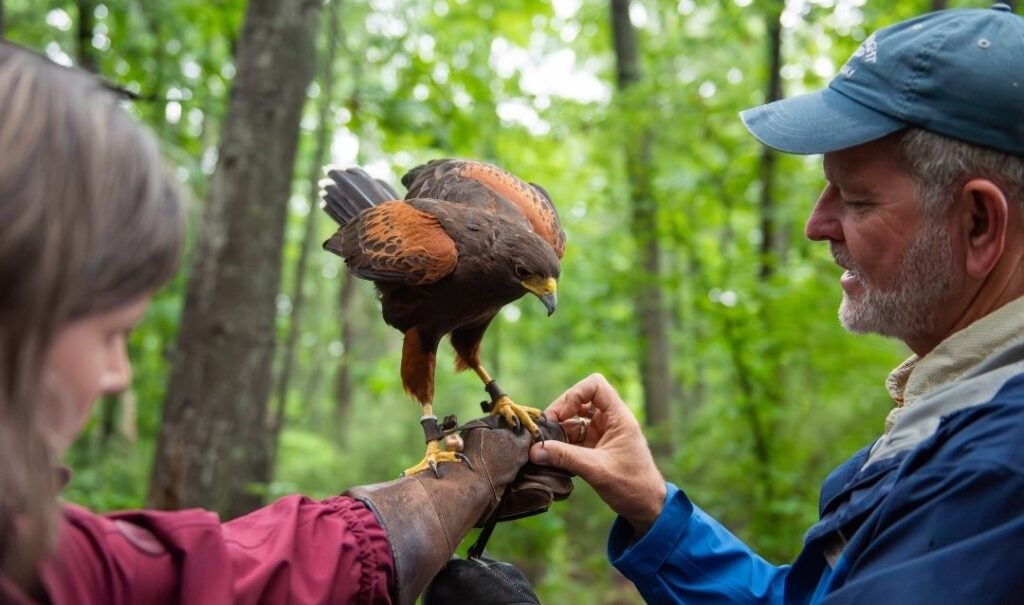
A trainer helps a hawk settle on a guest's arm during Biltmore's falconry program.
Jeff helps a Harris’ hawk settle on a guest’s gauntlet as part of Biltmore’s falconry experience.

“We usually start with Sam and Hoppy, which are both Harris’ hawks. They are are the only social species of hawk in the world, and that makes them a good fit for the type of falconry program Biltmore offers,” said Jeff, who is also a Master Falconer and Falconry Guide with a local outfitting service. “Sam, in particular, has a good temperament that makes him a great ambassador for raptors, especially when we are working with school groups.”

In addition to Sam and Hoppy, you’ll have an opportunity to handle trained raptors such as Ray, a red-tailed hawk, and Oskar, a barn owl. Hawks and owls hunt differently, with hawks using their keen eyesight to spot prey from above, while owls have very sensitive hearing that helps them target their prey.
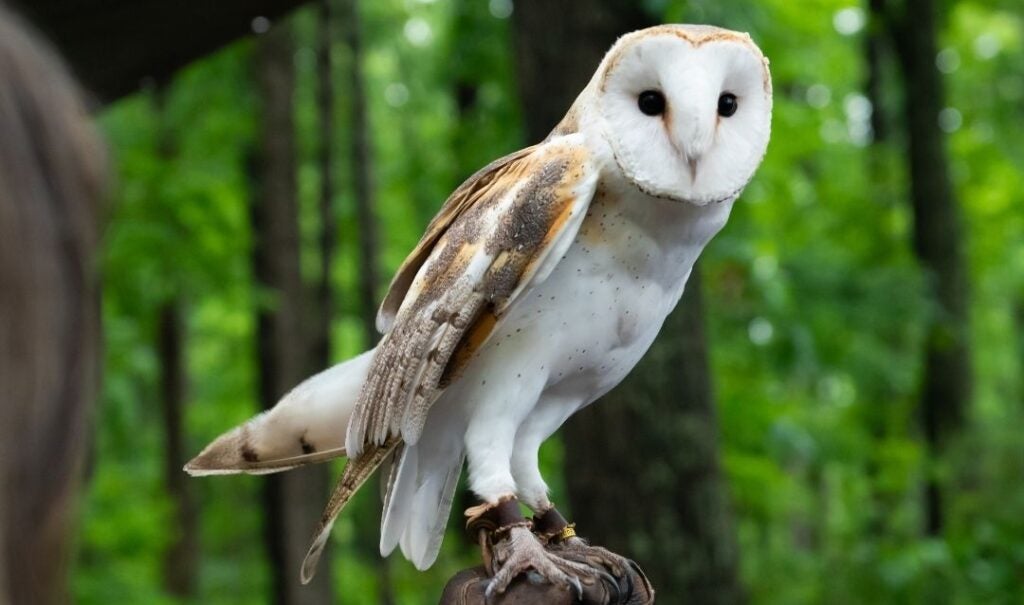
Barn owl held by a guest at Biltmore.
Oskar, a barn owl, interacts with guests who participate in Biltmore’s falconry program.

“All of our birds are well-trained, and they trust us, but it’s not the same relationship you might have with an animal like a dog. These are tame birds, but not domesticated, and their strong instincts to hunt prey can supersede their training,” Jeff said.

Fun falconry fact: With 14 vertebrae in their necks as opposed to seven for humans, hawks can turn their heads 220 degrees in each direction, while owls can turn their heads an astonishing 270 degrees!

Prepare for a thrilling flight
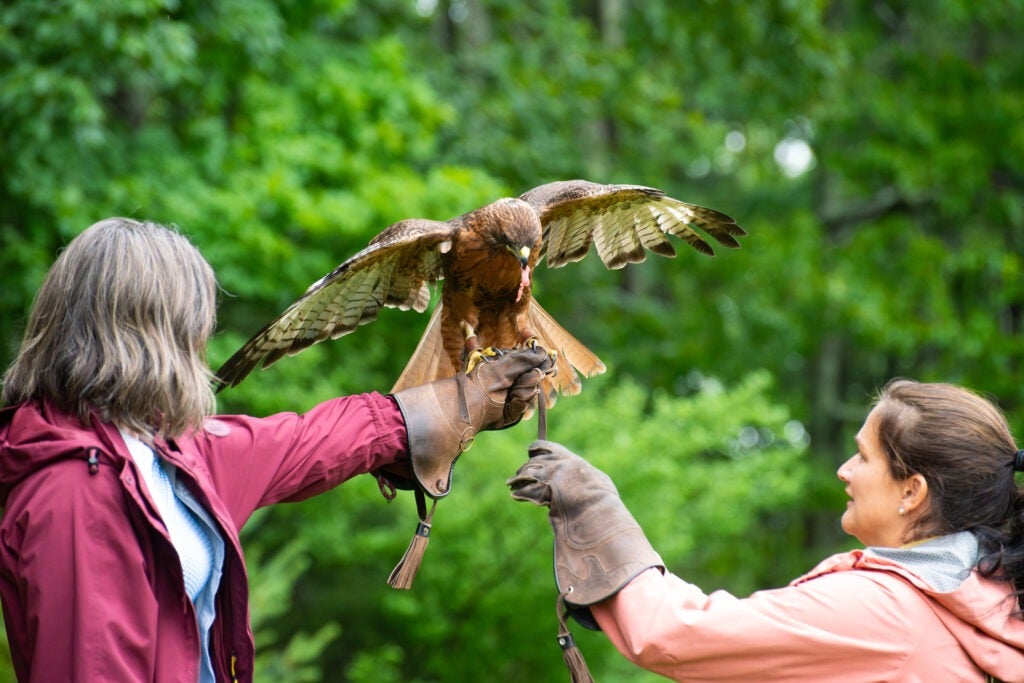
A red-tailed hawk lands on a guest's gauntlet while a trainer secures its harness.
A red-tailed hawk retrieves a reward from a guest’s gloved hand while Samantha secures his flight jesses.

After you’ve had a chance to see the birds up close, you’ll prepare to have one of these majestic raptors fly through the open air to land on your gloved hand. While one falconer holds the bird, the other helps you get into position with a small cube of raw meat to reward the raptor.

“When you’re ready, you’ll bring your arm up to a horizontal position and that signals the bird that it’s time to fly,” explained Samantha. “Our hawks have a 3–4 foot wingspan, so you want to have your arm and hand fully extended to give them plenty of room to land.”

Fun falconry fact: A slightly hungry raptor is much more likely to fly to your glove for a reward than one who’s eaten recently.

Training vs. instinct

As Jeff noted, a bird can sometimes follow their instincts rather than their training, so it’s always possible that a hawk like Ray might decide to fly into the trees around you to investigate something rather than settling on your gauntlet.
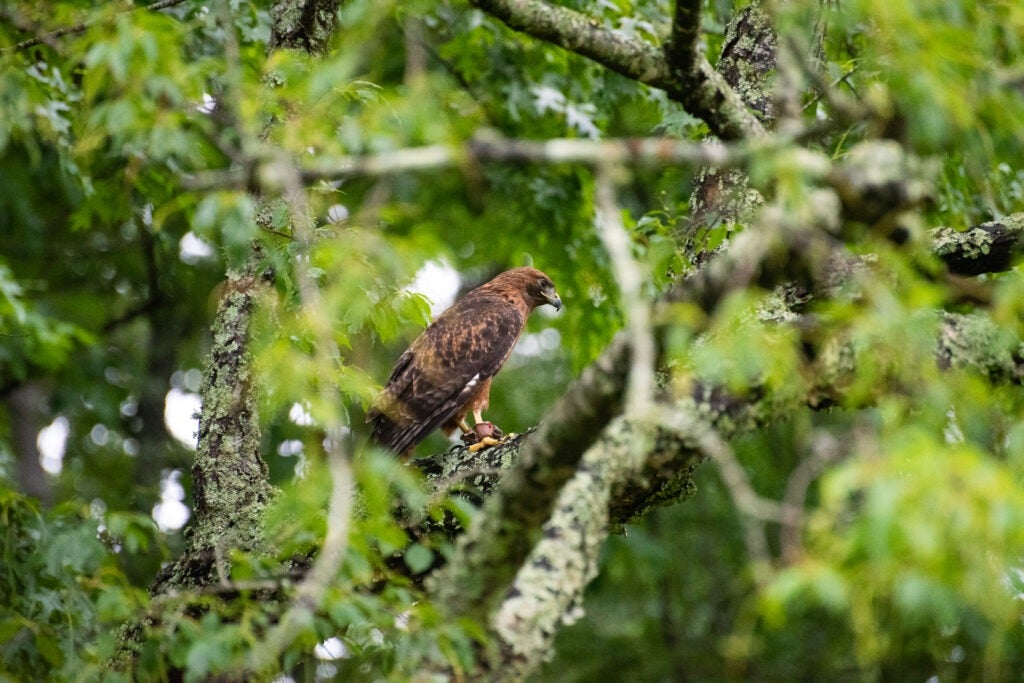
A hawk sitting on a branch surrounded by foliage.
Ray, a red-tailed hawk, spent some time in the trees during a recent falconry demonstration.

“If that happens, we’ll work to get them refocused, but we’re not always successful–especially if they’ve spotted potential prey or even a possible mate,” Jeff said. “That’s why our birds wear small bells as part of their harness, so we can hear them in the trees, and light-weight radio trackers in case they go farther afield.”

Fun falconry fact: The falconers once tracked a hawk for three days before they could catch up with it.

Can you find a falcon in Biltmore House?
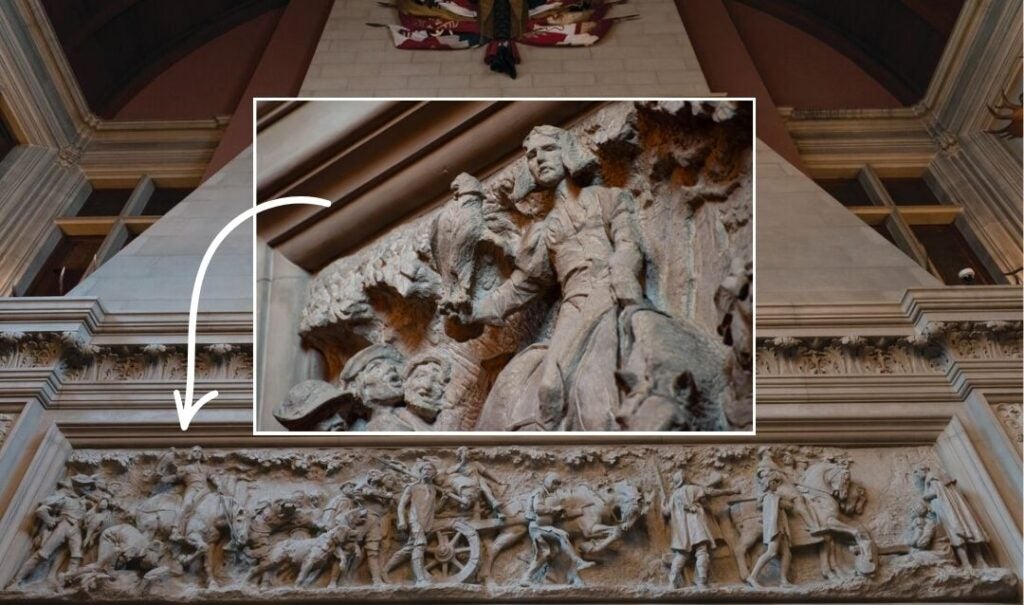
Inset image of a falconer carved above the triple fireplaces in the Banquet Hall of Biltmore House.
“Return From the Chase,” a frieze carved above the fireplaces in the Banquet Hall, includes a falconer with a hooded falcon on his arm.

While visiting Biltmore House, keep an eye out for a falcon in the grand Banquet Hall. The carved stone frieze above the room’s triple fireplaces shows a scene entitled “Return From the Chase” from Richard Wagner’s opera Tannhäuser. The tallest figure on the left side is a falconer with his hooded hunting partner on his arm. (See inset photo for detail.)

Fun falconry fact: Birds of prey wear hoods to reduce visual stimulation and reduce anxiety, which is safer for both the bird and the falconer. Removing the hood can also act as a cue that it’s time to begin the hunt or flight.

Explore falconry at Biltmore
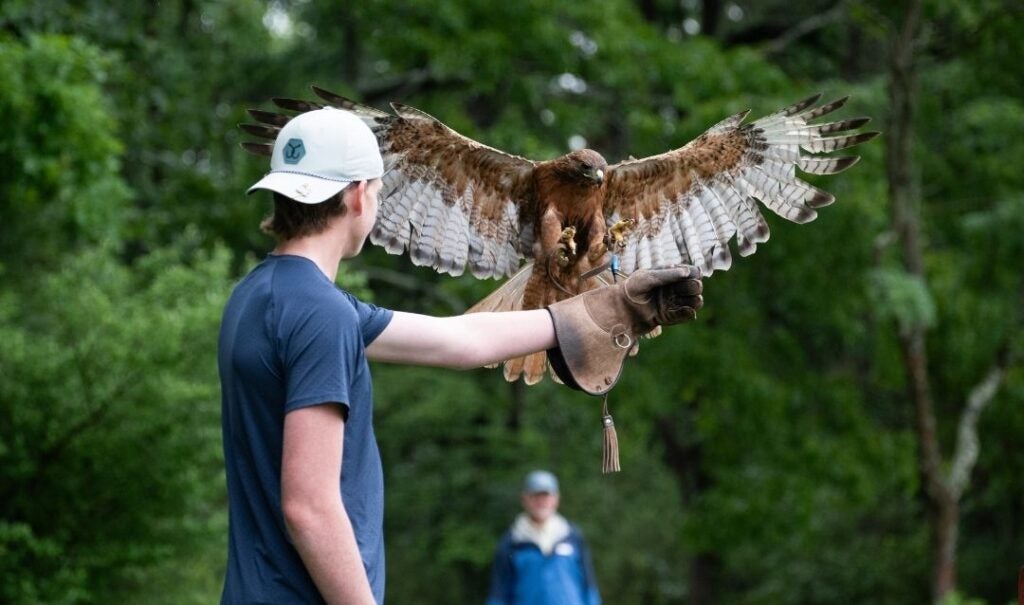
Falconry at Biltmore.
A red-tailed hawk flies to a guest’s hand during Biltmore’s falconry experience.

“Falconry began in the Middle East and Mongolia more than 6,000 years ago, and continues to be a recognized hunting practice around the world,” said Samantha. “Often called ‘the sport of kings’ and reserved for royalty, it is still a status symbol in some cultures. For us, it’s a wonderful way to introduce you to these spectacular birds and let you learn more about them up close.”

Don’t miss your one-of-a-kind opportunity to interact with these majestic raptors at Biltmore. Reserve your 90-minute falconry experience now by calling 828-225-1425.

NOTE: To purchase this activity, you must have an estate admission ticket, a Biltmore Annual Pass, or a stay at one of the estate’s overnight properties.

Top reasons you’ll want to visit Biltmore this winter

Traveling to Biltmore Estate in the wintertime may not seem like an obvious choice. But with Asheville’s mild winter weather and our lowest rates of the year, it can be a more peaceful (and romantic!) way to experience the iconic destination compared to peak travel seasons.

Whether you’re traveling with your family, sweetheart, besties, or solo this winter, here are our top reasons why you’ll want to add a relaxing and restorative winter visit to Biltmore to your bucket list.

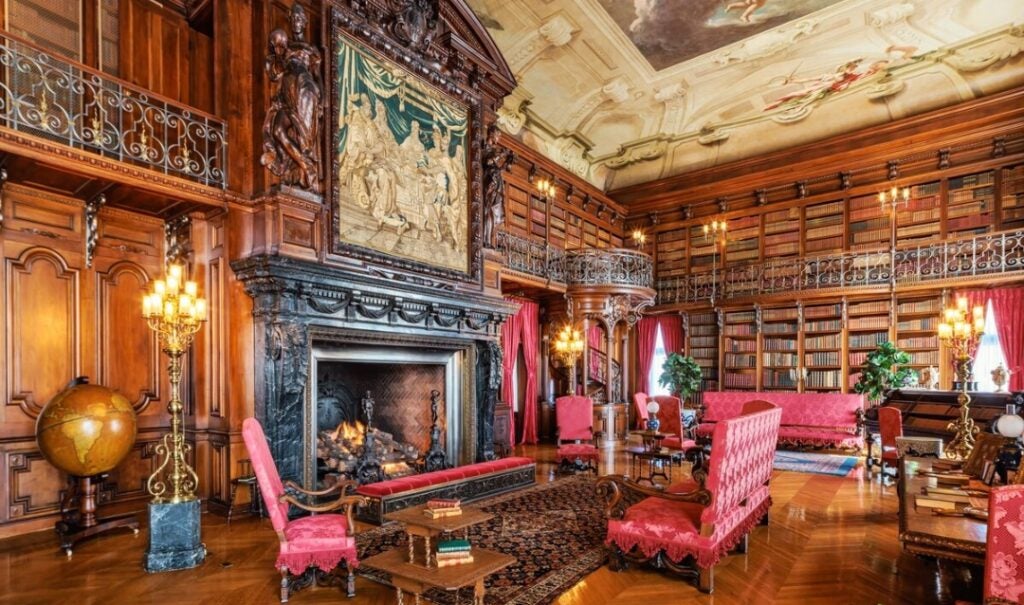
Imagine curling up by the fireplace with a book in the Library during winter in George Vanderbilt’s era.

6. Discover our great indoors

An audio-guided tour of Biltmore House is yours to behold this winter. With grand interiors, fascinating stories, and cozy decor, you’ll want to linger inside this marvel of architecture, art, and design.

The indoor adventure continues with guided tours* of Biltmore House, such as the Exclusive 90-Minute Guided Tour: Guests of the Vanderbilts for fascinating stories and rarely-accessed areas of the home, the Rooftop Tour for long-range views and unique perspectives on the design of Biltmore House, or the Backstairs Tour for an in-depth look at what it was like to work in America’s Largest Home over a century ago.

Cattleya Mary Schroder orchid in Conservatory
Orchids inside Biltmore’s Conservatory, like this Cattleya Mary Schroder orchid, reach peak bloom during winter months.

5. Take a tropical escape

There’s no better way to shake winter’s chill than with a tropical excursion through Biltmore’s historic Conservatory, located a short distance away from Biltmore House. Each room in this glass-topped greenhouse features an impressive display of towering plants!

As a bonus, orchids reach peak bloom during the winter months, so guests are in for a real treat as the Orchid Room boasts a vibrant collection of over 500 plants.

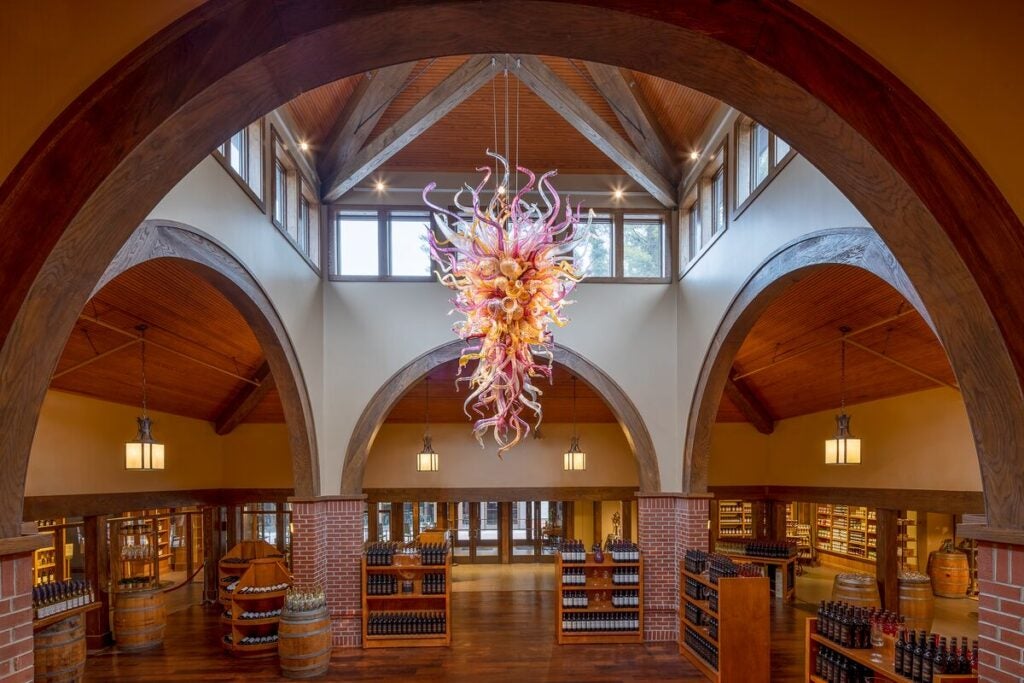
Dale Chihuly, Iris Gold and Garnet Chandelier, 2022, 9 1/2 x 6 x 6′, Biltmore Winery, Asheville, North Carolina, Installed 2023.

4. Sip your favorite winter wines

Whether you’re a wine connoisseur or new to the world of viticulture, a Complimentary Wine Tasting at our award-winning Biltmore Winery during your wintertime visit is a great way to discover new and favorite vintages.

At our Wine Shop, you can restock your wine rack while marveling at the stunning blown-glass Iris Gold and Garnet Chandelier by world-renowned artist Dale Chihuly, on permanent display.

Cozy up with your sweetheart during a stop at our Wine Bar and enjoy our favorite red, white, and sparkling winter varietals by the glass or bottle.

Tip: If you’re interested in learning about and becoming a Vanderbilt Wine Club member, our Winery hosts would be happy to help!

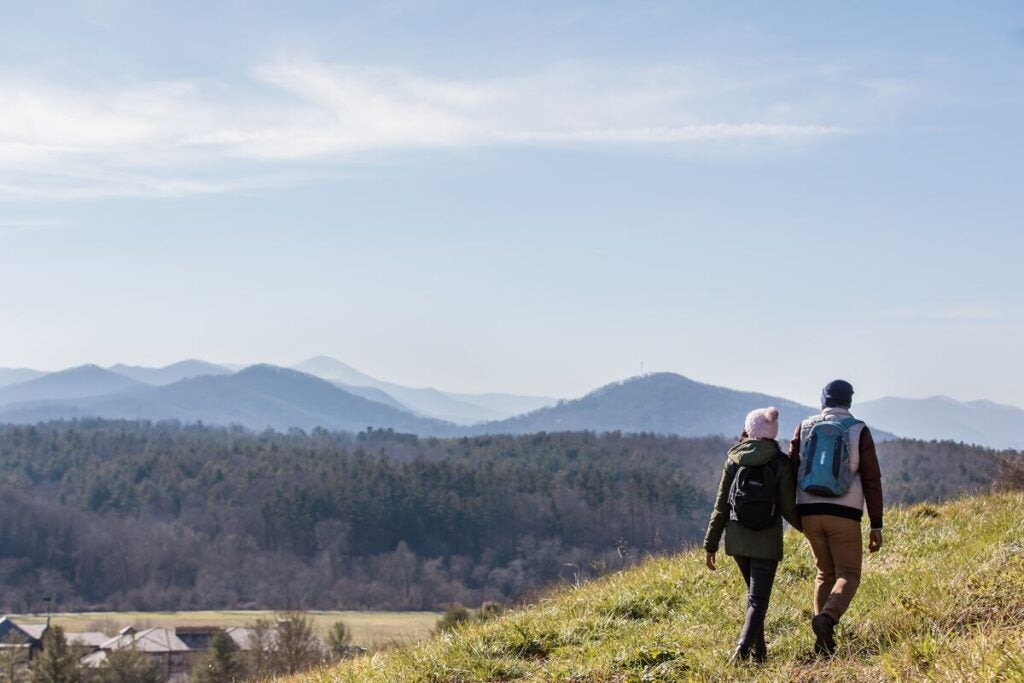
Couple hiking near The Inn on Biltmore Estate during the winter season
Wintertime offers spectacular long-range mountain views from the trails and meadows on our private estate.

3. Embrace the great outdoors

There’s a reason that Asheville locals love outdoor exploration in the wintertime. The crisp air and long-range Blue Ridge Mountain views simply cannot be beat! Plus, the Asheville area boasts relatively mild winter weather, making outdoor exploration even more enjoyable.

Bundle up and experience the breathtaking beauty of George Vanderbilt’s 8,000-acre mountain estate! Though the garden beds are dormant, they are still an impressive sight to behold as you can more easily appreciate the innovative landscape design by Frederick Law Olmsted.

For more active explorations, embark on our 22 miles of private nature trails and acres of historic gardens. Nearby, behold the beauty of Pisgah National Forest, which used to be part of the estate!

If a more restorative getaway is what you’re longing for this winter, consider nature journaling, meditation, or even bird-watching!

Tip: Select admission tickets include FREE next-day grounds access, which means you have even more time to explore all that the estate has to offer! Download our Trail Map for current information on which trails are open or closed. Trail hours vary seasonally and may be closed at any time. Please obey posted signs.

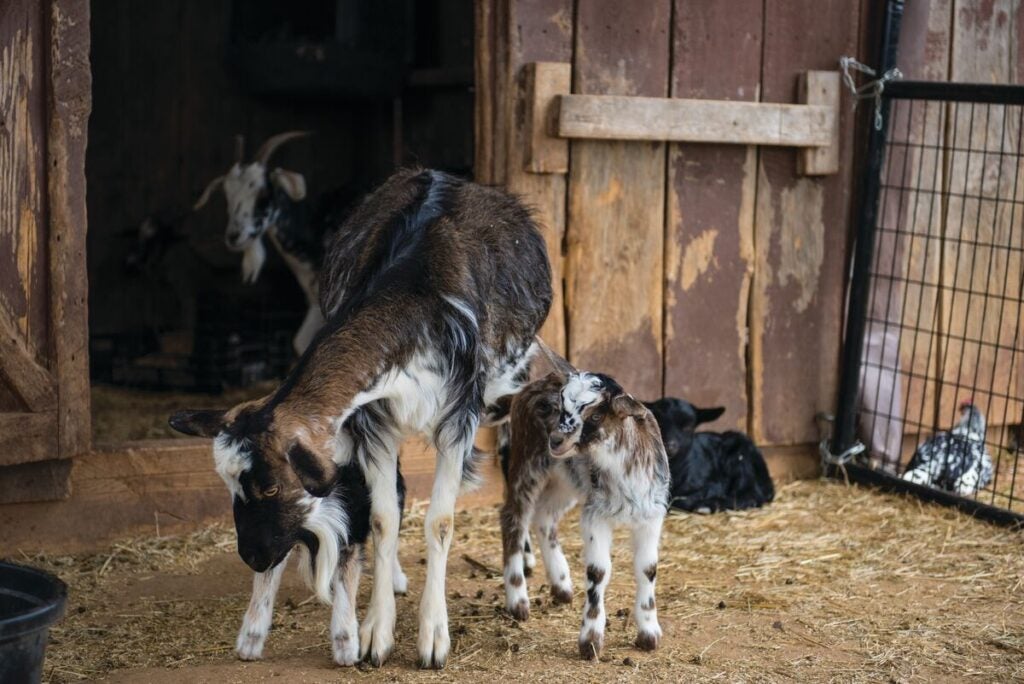
Our Farmyard is a fun-for-all-ages way to learn about Biltmore’s farming legacy.

2. Make your way around Antler Hill Village

This European-inspired village boasts unique opportunities to learn about Biltmore’s farming legacy and the Vanderbilt family history, shop for momentos to remember your winter visit to Biltmore, indulge in true field-to-table flavors at our estate restaurants featuring estate-grown ingredients, and savor our handcrafted estate wines… all in one charming and walkable area!

Tip: If you’re traveling with little ones, be sure to spend some time at Pisgah Playground!

West facade of Biltmore House in snow
While heavy snowfall isn’t common in our area, it is a spectacular winter treat to see the estate is blanketed in white.

1. Wake to an 8,000-acre winter wonderland

Discover just how cozy, peaceful, and romantic a winter visit to Biltmore Estate can be with an overnight stay! Imagine waking up with tranquil Blue Ridge Mountain beauty, world-class hospitality, all of our top wintertime activities, and easy access to nearby attractions just outside your door.

All this and more is available when you plan your winter visit now to experience Biltmore’s most peaceful season with the lowest rates of the year on admission and special overnight packages. To experience the grandeur of Biltmore all year long, plus exclusive discounts and perks, consider joining our Annual Passholder family.