Laura's favorite things

Sometimes it’s the smallest detail that makes an object stand out in your mind. That’s the case with this week’s favorite thing for a member of Biltmore’s Museum Services staff. We invite you to visit soon to admire the details in Biltmore House and discover your own personal favorites!two prints of Charles II hanging on the west wall in Mr. Vanderbilt’s Bedroom

Laura Cope Overbey, Collections Manager in Museum Services, joined Biltmore 14 years ago as the Associate Collections Manager and has been in her current position since 2008. Her job gives her a close look at items in the collection. Among the thousands of objects she has seen, two prints stand out for a special reason—even if most guests never even notice them.

“Mr. Vanderbilt collected more than 1,300 prints that are in our collection today,” Laura said. “My favorites are two prints of Charles II hanging on the west wall in Mr. Vanderbilt’s Bedroom.”

According to Laura, the prints appear to be identical and are by the same artists, 17th-century Dutch painter Pieter Nason and Dutch printmaker Cornelis van Dalen II. Both date from the early 1660s and depict Charles II in the same stance, outfit, and background.

two prints of Charles II hanging on the west wall in Mr. Vanderbilt’s BedroomYet, there is a slight difference between the two prints; one has the addition of three small objects in the bottom left corner—a crown, orb, and scepter. And those objects tell a fascinating story about the life of the English king.

“If you look carefully, you can see clues to the historical significance of the two prints,” Laura said. “At the beginning of his reign, Charles II was a king without a country. During his youth, he had witnessed the English Civil War, the end of the English monarchy, and the execution of his father, Charles I. Since his father’s death, Charles II was a king in exile.

“In 1660, the political tide changed and the English wanted to reinstate the monarchy. These prints illustrate this transition: the first shows a king without a country, and the second shows a king fully restored with the crown and country,” she said.

Left photo: Charles II without a country. Right photo: Charles II with his crown, orb, and scepter.

Chocolate-Dipped Meringue Bites

Add some sparkle to any occasion

Whether you’re celebrating Valentine’s Day or simply want to add a touch of special sweetness to any occasion, our Chocolate-Dipped Meringue Bites are sure to please. Pair them with our Biltmore Pas de Deux Sparkling Wine, and the compliments will continue to bubble up!

Preparing meringue cookies at home may sound challenging, but it’s actually a simple recipe from our new cookbook entitled Biltmore Traditions, A Collection of Menus, Recipes, and Stories. The cookies are rich but not too sweet and the semisweet Chocolate Dipping Sauce adds another layer of flavor to each bite.

Sparkling wine is a natural choice to complement the taste and texture of the Chocolate-Dipped Meringue Bites, and we think serving them with our Pas de Deux makes a good thing even better. Made with Muscat Canelli grapes, this semi-sweet sparkling wine tastes of wild strawberry and lemon. It is also handcrafted in the traditional méthode champenoise style which results in fine bubbles that make any occasion more festive.

Chocolate-Dipped Meringue Bites 

Makes 20–24 cookies

Meringue Bites

• 2 egg whites
• ¼ tsp cream of tartar
• 1 1/3 cups sifted confectioner’s sugar

Method: Let the egg whites stand at room temperature in a mixing bowl for 30 minutes. Line a large baking sheet with parchment paper or foil.

Add the cream of tartar to the egg whites. Beat at medium speed until soft peaks form. Add the confectioner’s sugar, 1 tablespoon at a time, beating after each addition. Beat 6–7 minutes on high until stiff peaks form.

Preheat the oven to 300 degrees. Spoon the meringue into a sealable plastic bag. Snip off 1 corner. Pipe 20 – 24 cookies 1½–2 inches long and 1½ inches apart onto the prepared baking sheet. Bake in a standard oven for 20 minutes or in a convection oven for 10 minutes. Turn off the oven. Leave the cookies in the oven with the door closed for 30 minutes. Remove the cookies from the sheet and cool completely. Store in an airtight container for up to 3 days.

Chocolate Dipping Sauce

• ½ cup (6 ounces) semisweet chocolate pieces
• ½ teaspoon shortening

Combine the chocolate and shortening in a saucepan. Cook over low heat until the chocolate melts, stirring constantly. Dip one side or the tip of each cookie into the Chocolate Dipping Sauce. Let dry on a rack until the chocolate is set.

Purchase Pas de Deux Sparkling online here.

Check out all the delicious recipes in our new cookbook, available through our online store.

Rick's favorite thing

As we continue our focus on the details that make Biltmore so amazing, we invite you to visit this winter to admire the combination of architecture, art, and sculpture that makes Biltmore House uniquely beautiful. Today, we hear from a long-time employee who has a different take on his favorite thing: the beauty of mechanical ingenuity. Check back next week for another insider’s favorite.

Rick Conard, Vice President of Attraction Operations Support, joined Biltmore more than 20 years ago as an electrician. Since then, he’s been involved in just about every project around the estate, and knows Biltmore House inside and out.

Soon after he started at Biltmore, one of his first tasks involved spending more than three weeks working around the service elevator in Biltmore House. Less prominent (and significantly less decorative) than the passenger elevator in the main entry, the service elevator is located by the stairs in the Bachelors’ Wing.

This elevator was designed to carry workers as well as equipment and luggage, and traveled 80 feet from the Sub-Basement to the Fourth Floor. While it could lift 2,000 pounds, it was not the speediest mode of transport, taking nearly a minute to go six floors. Of course, the alternative of manually hauling a ton of luggage up several flights of winding stairs wouldn’t be all that fast either!

Rick was very involved in bringing the service elevator back to good working order, and he was working on the elevator when he got a call from his wife that she was headed to the hospital to have their first child—which explains why this ranks as his personal favorite.

If you’re interested in seeing the service elevator plus some of the other innovative mechanical systems in Biltmore House, take the guided Behind-the-Scenes Butler’s Tour that spends time in areas of the house not included in the regular visit.

These days you may see Rick around the estate with Cedric, a St. Bernard named in honor of George Vanderbilt’s favorite dog. They are often in Antler Hill Village, so keep an eye out for them during your next visit.

Cathy's favorite things

Winter is a perfect time to visit Biltmore and admire the combination of architecture, art, and sculpture that makes Biltmore House so amazing. In case you haven’t noticed every little detail, we’ve asked employees to share their favorite things so you too can appreciate what makes Biltmore special. Check back next week for another insider’s favorite!

Cathy Barnhardt, Floral Displays Manager, has spent 35 years at Biltmore and is nationally known for her work heading up our amazing Christmas decorations in Biltmore House. She began her career in the estate’s greenhouse, was promoted to manager, and then was asked to “do Christmas.”

Little did she know that 26 years later she would still be “doing” Christmas at Biltmore—a celebration that began with five trees and has grown into an estate-wide extravaganza with more than 60 decorated trees in the house alone!

For Cathy, two paintings in the Breakfast Room on the First Floor hold lasting appeal no matter how many times she sees them.

“I love the Renoir portraits,” she said. “I like Impressionist paintings and Renoir, and the Mediterranean colors remind me that one day I hope to go there.”Young Algerian Girl

The two portraits are Young Algerian Girl and Child with an Orange, both painted in the 1880s by Pierre-Auguste Renoir as he traveled through the Mediterranean and Northern Africa.

According to our curators, George Vanderbilt acquired both paintings in 1892 from famed Parisian art dealer Joseph Durand-Ruel. Durand-Ruel is credited with doing more than just about anyone to promote the success of French Impressionists at a time when most other art critics and dealers looked upon them with disdain.

While George Vanderbilt was greatly influenced by his father’s art collection and was inspired by the earlier artists his father admired, George also supported more modern, progressive artists who embraced contemporary themes and new technologies. He funded the development of The American Fine Arts Society in New York, which represented young, avant-garde artists, and collected works by Renoir, John Singer Sargent, James McNeill Whistler, Maxime Maufra, and—although no longer in the Biltmore collection—Claude Monet and Édouard Manet.

About the photos:  Child with an Orange, top, and  Young Algerian Girl, bottom right.

Winter birding at Biltmore

It may not be the first thing that comes to mind when you think about Biltmore, but opportunities to go bird watching are a wonderful way to enjoy all its natural beauty—even in the winter.

During his 34 years with Biltmore, Bill Alexander, Landscape and Forest Historian, has identified more than 200 species of birds on the estate.

“The largest river in Western North Carolina runs through the estate, and we have the Lagoon, Bass Pond and streams with aquatic plants, meadows, pastures, and parklands, thickets, pine forests, and hardwoods. All these habitats are ideal for different types of birds,” Bill said.

Combine these water features with the estate’s meadows, pastures, fields, and woods, and it’s easy to see why the estate is such a prime birding venue as well as an official site on the North Carolina Birding Trail.

According to Bill, winter is a good time to see waterfowl, especially ducks such as buffleheads, hooded mergansers, teal, ring-necked ducks and occasionally pintails and shovelers. Some winters, we may have flocks of blue and snow geese interspersed with the ubiquitous Canada geese. You may even see great blue herons or common snipe in and around wet spots, creeks and drainage ditches.

“We also see strays each fall and winter,” he said. “I’ve seen tundra swans and Sandhill cranes.”


Permanent residents

Bluebird on bird house

Some of our year-round birds include blue jays, cardinals, sparrows, crows, blackbirds, mourning doves, bobwhites, Carolina chickadees, tufted titmice, red-tailed hawks, ruffed grouse, and turkeys. Pileated woodpeckers and flickers are plentiful, and you can spot red-bellied and downy woodpeckers. Eastern meadowlarks can often be seen and heard in the fields near Antler Hill Farm even during the winter months. Watch for killdeer and bobolinks as well.

Throughout Western North Carolina, bluebirds and robins are common and many make their presence known at Biltmore in winter, too. Bluebirds—famed for their appetites for insects—are encouraged to stay and raise families with the estate’s Bluebird Nest Box Program. Employees volunteer to monitor more than 100 bluebird boxes, checking to see if boxes are occupied, recording the number of eggs and chicks, and cleaning out nests between broods. 


The eerie screeching and hooting of owlsBill Owl

Our most common owls, the great horned and screech owls are woodland birds that prefer mature forests and parklands like those that blanket Biltmore. Great places to find them include the woodlands near the Bass Pond, the trail around the Spring Garden, and forests around the Inn. Great horned owls begin breeding and nesting in January and February and their calls are most often heard this time of year. Sometimes you can locate a screech owl on a low branch in the forest just before dark by listening to its mysterious quavering call. Or, if you spend as much time as Bill does on the estate, you may get a closer look.

“I was walking in the woods just before dawn one winter, and something hit me on the top of my head,” Bill said. “All of a sudden my toboggan was flying through the air in the clutches of a great horned owl!”


Protecting birds for a century

Birds and Biltmore have been a thriving pairing for more than a century. George and Edith Vanderbilt were sustaining members of the N.C. Audubon Society, and estate employees were advocates for protecting birds. Landscape Architect Frederick Law Olmsted designed islands for the Lagoon and Bass Pond as safe places for nesting birds. Today, we intentionally leave some fallen trees, snags, and uncut meadows as habitat for birds and other wildlife.

According to Bill, anyone can become a birder with a decent pair of binoculars and a bird book. “Start by looking for birds by body size, flight pattern, and song,” he advised. “The best viewing times are typically early morning or late afternoon. It’s a great way to enjoy the outdoors in winter.”

About the photos

Photos of the tundra swan at the Lagoon and the immature great horned owl were taken by Bill Alexander on his many forays around Biltmore.

Leslie's favorite thing

Winter is a perfect time to visit Biltmore and admire the combination of architecture, art and sculpture that makes Biltmore House so amazing. In case you don’t have time to notice every little detail, we’ve asked employees to share their favorite things in the house so you too can appreciate what makes Biltmore special. Check back next week for another insider’s favorite!

Leslie Klingner has been Biltmore’s Curator of Interpretation for nearly seven years, and has an unusual view of her favorite to recount.

“I love the Guastavino tile vaulting throughout Biltmore House, especially in the swimming pool,” she said. “I got to observe it from a unique perspective one day—from the bottom of the pool when I retrieved a lost pearl earring that a guest had dropped.”

The ceiling in the swimming pool was designed by Spanish architect Rafael Guastavino, who came to America in the 1880s and quickly became known for perfecting a unique system of building tiled ceiling vaults including the first New York City subways.

“His work is a technical feat built on ancient Catalan traditions,” Leslie said. You can see more of his skills by looking up at the ceiling as you walk from the Winter Garden into the Billiard Room.

Guastavino retired and built a home in Black Mountain, where he lived until his death in 1908. The Basilica of St. Lawrence in downtown Asheville—where his crypt is located— also displays his tilework and vaulting expertise.

Happy Birthday, Dear Edith

Today, January 17, is the 140th anniversary of Edith Vanderbilt’s birthday. In celebration of her life and legacy, we thought it would be fun to share some little-known stories about her.

 Edith VanderbiltOne of my favorites is a very glamorous Edith dressed as a peacock for a party in the early 1920s, as seen in the main photo above. A lover of costume or ‘fancy dress’ parties her whole life, Edith entertained often at Biltmore and clearly had a flair for the dramatic. In preparation for a party planned for August 1922, she contacted the legendary Ziegfeld Follies in New York to inquire about renting a ‘White Peacock’ costume made famous by a showgirl known as Dolores. It appears that Edith had little luck in obtaining the outfit and resorted to having her own peacock costume made a year later. It’s not completely clear at what event Edith chose to strut her stuff, but we suspect the celebration was held in honor of her daughter Cornelia’s 23rd birthday.
Biltmore’s costume collection includes seed pearl jewelry and glass bead hair ornaments which were worn at other fancy dress parties during the 1920s, and a dazzling metallic mermaid costume that will go on display in the exhibition, “The Vanderbilts at Home and Abroad” this spring in Antler Hill Village.

Edith’s love of drama began at an early age. As a child, she and her sisters frequently played charades and imaginative games of “house.” Edith and her youngest sister, Pauline, also loved witnessing the theatrical transformation of Newport’s grand interiors that were typical for Gilded Age entertaining. In a memoir, Pauline recalled helping with preparations for lavish dinner parties and then taking delight in spying on the guests!

”…In August … we children would be kept busy wiring flowers for enormous centerpieces, for those were the days when tables were overloaded and great satin ribbons lay on the table cloths; extending from one solid bed of flowers to another. The blossoms of pink hollyhocks were fastened on toothpicks and pierced into moss-filled flat baskets joined by huge bow knots of pink satin ribbons which wound their way amid silver tankards and baskets of hothouse fruits. Edith and I used to climb out on the tin roof over the dining room and peer down through the sky-light at the guests, scuttling back to bed when the roof creaked and we feared detection. Of course the voices below drowned any noise we might have made, but we didn’t realize that…”

In her teens and early 20s, Edith lived in Paris and was a member of an amateur group that frequently hosted “theater parties.” If the peacock photograph is any indication, Edith’s penchant for drama was most pronounced during the Roaring Twenties, a time when many women felt a heightened sense of independence and freedom to express themselves creatively.

Edith hosted a number of masquerade balls at Biltmore House, as well as tableaux vivants, a popular form of entertainment in the late 19th and early 20th centuries. French for “living pictures,” tableaux vivants were elaborate productions in which costumed participants would pose in the guise of mythological or literary figures, famous paintings or individuals from history. These amusing spectacles were enhanced by live music, props and dramatic lighting.

No matter the occasion, it seems that Edith always took pleasure in finding ways to enhance the everyday. Her spirit lingers on, inspiring so much of what we do at Biltmore.

Thank you, Edith – and Happy Birthday!

Spa at Home Experience

Few things in life are as relaxing as a visit to a luxurious spa.

How can you get create the same feeling in your own home? We asked the experts at The Spa, located in the Inn on Biltmore Estate, for some do-it-yourself ideas that anyone can enjoy.

 Soak it up

A long soak in a hot tub can work miracles for tired muscles and a stressed mind. Treat yourself—or someone special—to a soothing experience with our Biltmore Bath & Body products. The clean, refreshing fragrances of this collection offer peace of mind and help relax your senses while moisturizing your skin. Try our Foaming Shower Gel for your home spa soak (or shower, if your time is limited). Follow up with Shea Butter Body Lotion and Hand Lotion to make the experience last even longer.


Indulge in the entire paraben-free Biltmore Bath & Body collection crafted with exceptional ingredients and featuring alluring scents such as Blood Orange, Black Orchid, The Gardens, Blackberries and Cream, and more.

Shop the complete Biltmore Bath & Body Collection at Belk.  

Spa Tip: to stay hydrated, be sure to drink plenty of tepid water while you are soaking.

Throw in the towel

 While enjoying your home-spa soak, you may want to roll up a towel to place behind your neck. This will cushion you from the harder surface of the tub and help keep your face dry.

Ready to unlock spa secrets to lush locks? While soaking or showering, apply a moisturizing treatment to your hair (try salon recommendations or make your own home-based version). Wrap hair in a towel and relax while the treatment does its work.

Group of Belk blue and white Legacy Towels

Enjoy our luxurious Biltmore For Your Home towels, available at Belk in four collections: Legacy, Century, Chateau, and Everyday Luxury.

Shop all Biltmore For Your Home Towels at Belk.  

Spa Tip: to enhance your home spa experience, use towels in calming colors such as greens and blues.

Wrap it up

Whether you’re opting for a luxurious spa soak, a rejuvenating shower, or simply trying to carve out a bit of time for yourself, go ahead and schedule those precious minutes each week. Otherwise, it’s easy to forego the time you need to relax your mind, recharge your spirits, and refresh your body!

“Nonsense” and a Very Good Time with the Vanderbilts

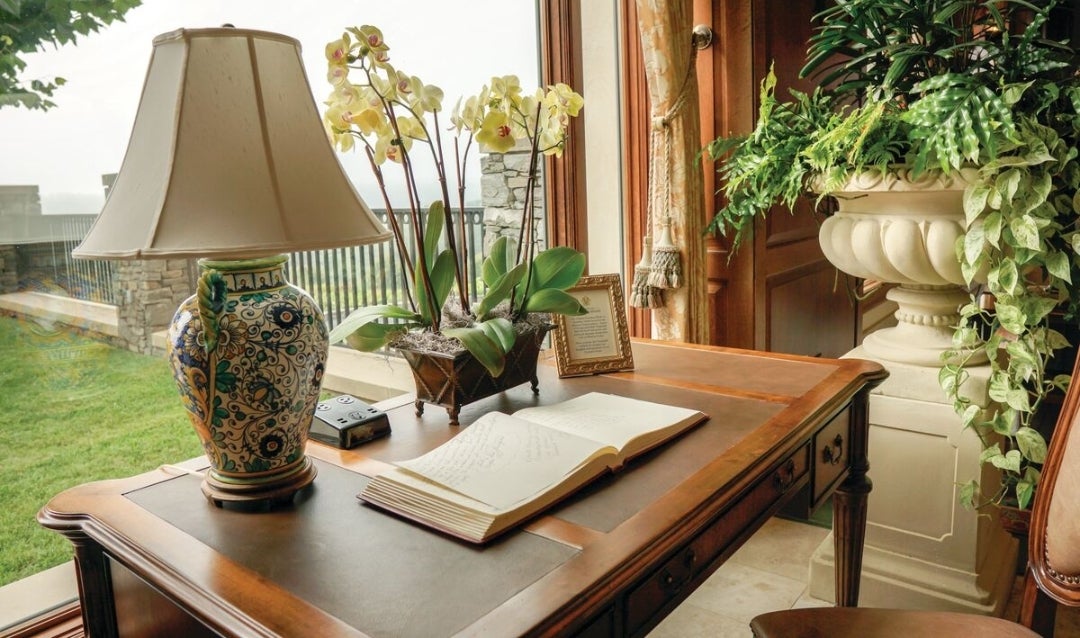
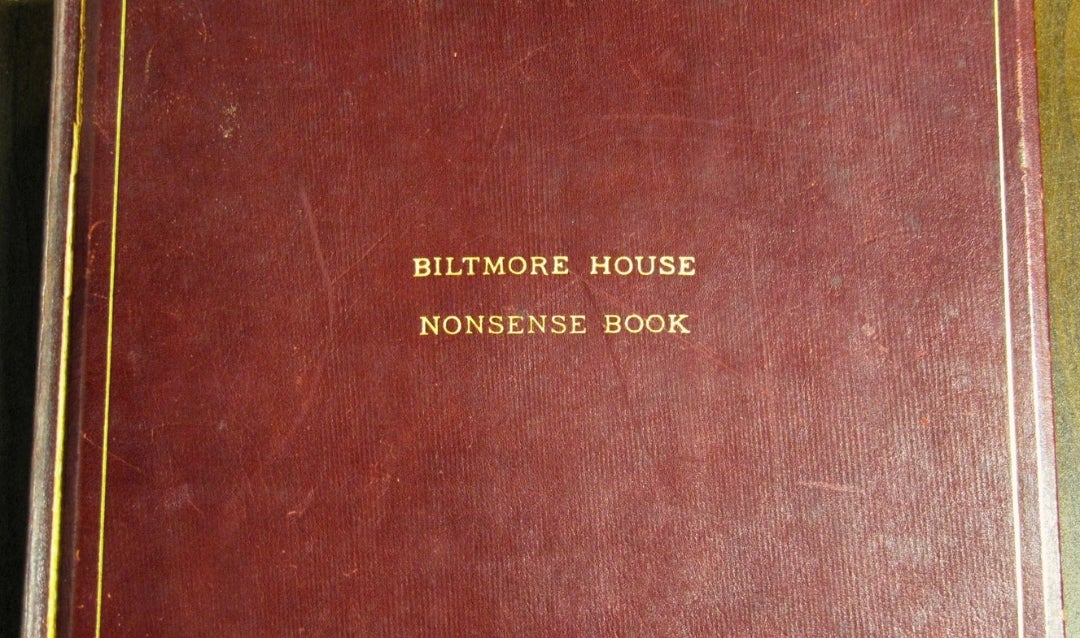
The “Nonsense Book” of Biltmore House is filled with handwritten poems and limericks, along with illustrations, telegrams, and photographs. This unique book was a way for guests of the Vanderbilts to commemorate their stay. It also captures the personalities of those who visited, while simultaneously offering a glimpse into their experiences while at Biltmore.

Continue reading for a look inside this charming—and perhaps unexpected—Gilded Age guest book from our archival collection.

A look at the original “Nonsense Book” in Biltmore’s archival collection.

New Year, New Nonsense

To mark the turning of 1901 into 1902, George and Edith Vanderbilt hosted a house party for 20 of the movers and shakers of Boston and New York society. Among the revelers that year were Larz Anderson, an American diplomat who had served in Rome and London, and his wife Isabel, an author of children’s books and travelogues.

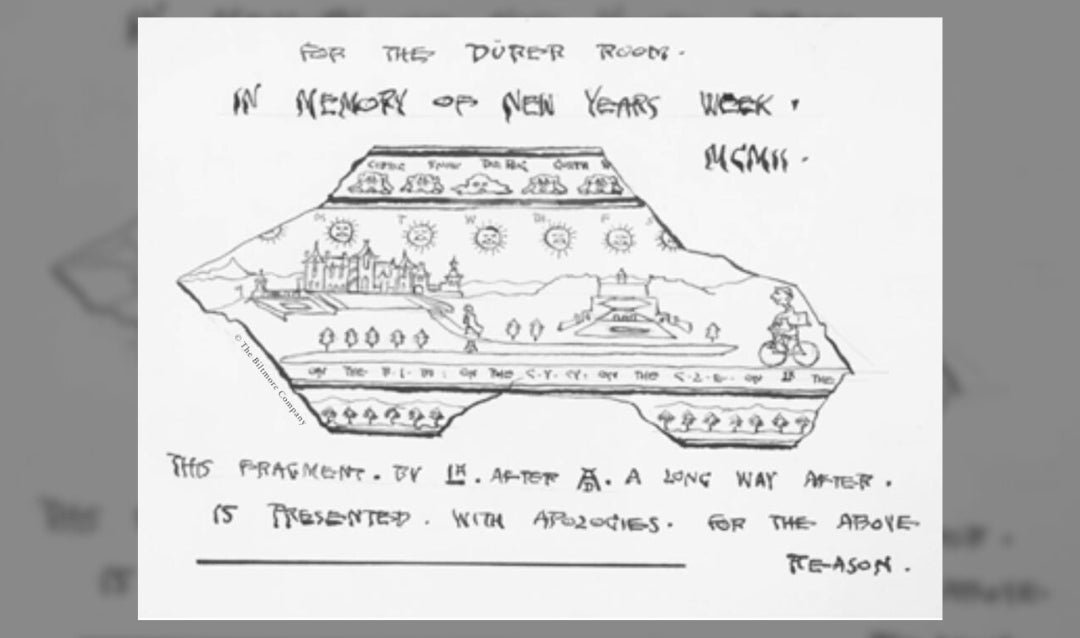
To commemorate the week-long festivities, Larz left an illustration in the Vanderbilts’ “Nonsense Book,” a bound leather volume full of notes and scribbles, rhymes and limericks inspired by one of George Vanderbilt’s favorite authors, Edward Lear.

With entries from many of the Vanderbilts’ guests, the Nonsense Book gives us a glimpse into the various entertainment activities held at Biltmore.

Larz Anderson left his amusing mark in the Vanderbilt “Nonsense Book,” detailing his frequent bicycle rides around the estate.

Drawn as if it were a scrap from George’s print collection, the top of Larz’s entry reads: “For the Dürer Room – In Memory of New Years Week MCMII.” The “Dürer Room” refers to a den off of the Library where George Vanderbilt displayed many of his prints by the famed artist Albrecht Dürer, a brilliant German virtuoso of the late 1400 and early 1500s.  Dürer’s prints, including The Triumphal Arch of Maximilian, which now hangs in the Music Room, are museum-quality masterpieces that one wouldn’t expect to find in a private home.

Larz was impressed with Vanderbilt’s collection of engravings and was struck by the design and layout of Biltmore House, reporting to his mother by letter that “well, we all agree it is the finest thing in America – and one of the finest in the world….” Their week started off with several days of bad weather, but a few days into their stay, Larz wrote, “today is beautiful… the air is magnificent and yesterday I had a ten-mile climb over the mountains.”

Apparently, Larz also got in a good bit of bicycling during his stay. Echoing Dürer’s artistic style, Anderson draws himself astride a bike peddling across the estate and past the Esplanade.  A small figure labeled “AD” for Albrecht Dürer follows a path toward the eastern façade of Biltmore House.  Anderson labeled the cartoon of himself with his initials, “LA,” in the same distinctive script that Dürer used to sign his works. Larz’s doodle documents the mountainous scenery he enjoyed firsthand and the fine weather that finished out the first week of their new year. And, quite amusingly, he references several of the Vanderbilt family’s St. Bernards, including Cedric and his mate Snow, who presumably could often be found flopped down on Biltmore’s gleaming herringbone floors in a manner resembling a polar bear rug.

Join in on the Nonsense

An iteration of the original “Nonsense Book” is still in use today. It resides in the lobby of the Inn on Biltmore Estate, and our guests are welcome to sign it and describe their adventures during their stay.

During your next overnight stay at Biltmore, be sure to sign and join in on the nonsense!

What's Cooking?

Belk Cookware Set

Looking for a thoughtful gift that will be used all the time? Our Biltmore chefs have partnered with Belk to create quality cookware to delight the culinarians in your life. From novice to experienced cook, this 13-piece set of cookware will help ensure professional quality results from the kitchen!


Shop the collection at Belk here.