To learn more about Vanderbilt Christmas traditions, we searched Biltmore’s archives for letters and documents detailing the lives of George and Edith Vanderbilt, their daughter, Cornelia, and the many friends and family members who visited them during the holidays.
Read on for some of the Vanderbilts’ yuletide traditions, from family gatherings to the special foods they enjoyed during the festive season.
How did Vanderbilt Christmas traditions begin?
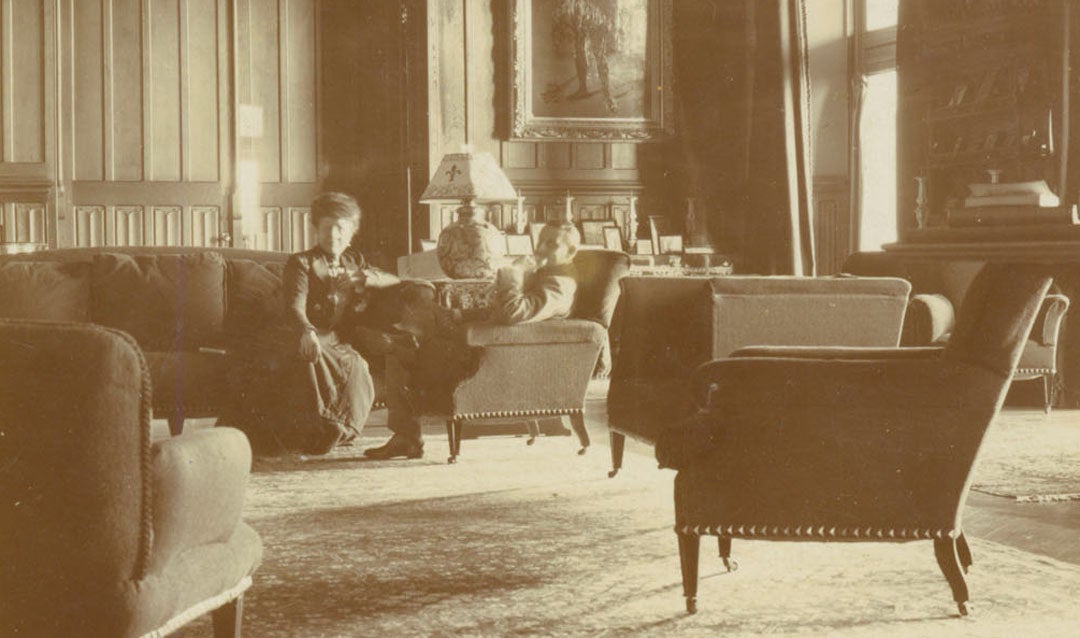
The only photo in the Biltmore collection from the Vanderbilts’ 1901 Christmas celebration. The woman is believed to be Elizabeth “Bessie” Beers-Curtis de Talleyrand-Périgord, Marquise de Talleyrand, an American heiress who married into the French aristocracy. The man is unidentified.
Although George Vanderbilt moved into Biltmore House in October 1895, the house did not officially open to guests until Christmas Eve of that year. Great efforts were made to ensure all (or most!) would be ready by this special day. Since Mr. Vanderbilt was still a bachelor during the first Biltmore Christmas, his mother Maria Louisa presided as hostess.
Correspondence between Mr. Vanderbilt and his staff indicates that planning was intensive and no detail was left unattended. Managers debated which nearby county had the best holly and the most desirable mistletoe, while staff scouted for the perfect candidate for the Banquet Hall Christmas tree.
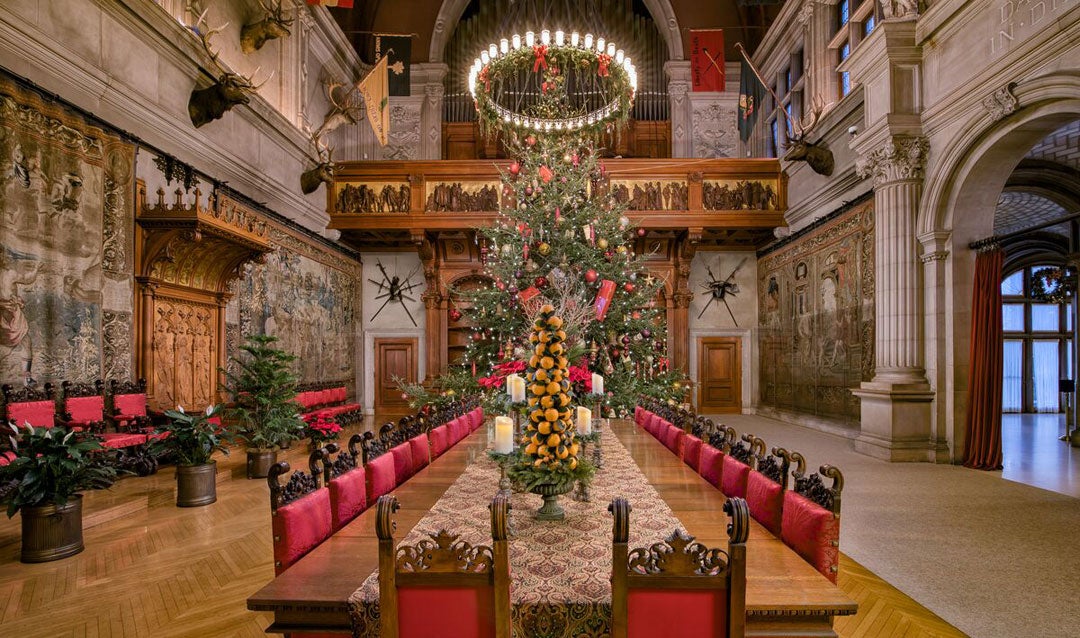
The Banquet Hall Christmas Tree is a favorite holiday tradition
Mr. Chauncey Beadle, estate horticulturalist, wrote estate manager, Mr. Charles McNamee:
“I quite agree with you that we should have a very large tree for this occasion; in fact, I think a twenty foot tree in that large Banquet Hall would be rather dwarfed.”
When Mr. Vanderbilt’s mother, several of his brothers and sisters and their spouses, and assorted nieces and nephews arrived, they were greeted in the Banquet Hall by a splendidly tall tree laden with gifts for estate workers. At the foot of the tree was a table piled high with family gifts. Because of this, the Banquet Hall has always been the focal point for Christmas celebrations in Biltmore House.
A Vanderbilt family gathering
The family and guests gathered around the 40-foot Banquet Hall table for elaborate dinners served both evenings. Mr. Vanderbilt’s niece Gertrude kept a series of Dinner Books in which she recorded the seating arrangements of all of the parties and dinners she attended as a young woman, and she was one of the guests at the first Vanderbilt Christmas dinner in Biltmore House.
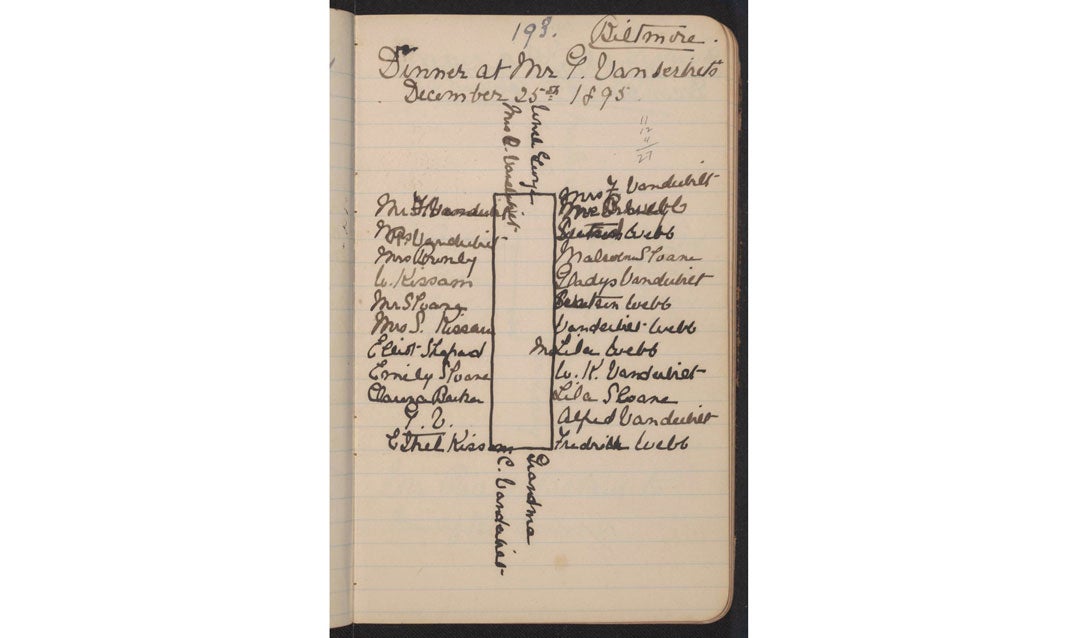
A detailed seating chart of the first Christmas dinner at Biltmore House from the 1895 Dinner Book kept by Gertrude Vanderbilt Whitney. Photo courtesy of Gertrude Vanderbilt Whitney papers, Archives of American Art, Smithsonian Institution. Whitney Museum of American Art, Gertrude Vanderbilt Whitney papers. Gift of Flora Miller Irving.
Gertrude kept two Dinner Books in 1895, and the Christmas meal at Biltmore House was the 193rd formal dinner that she attended that year. In her diagram of the dinner, she listed 27 Vanderbilt family members. It was said to be the largest gathering of the family since the death of George’s father, William Henry Vanderbilt, in 1885.
In addition to the grand meals and festive décor, stockings hung on mantles, plum puddings and mince pies were served, and George’s mother read ‘Twas the Night Before Christmas to the children. It must have been a grand time—one article even stated that the Vanderbilt family exchanged gilded and jeweled Christmas cards!
Christmas meals in Biltmore House, 1904
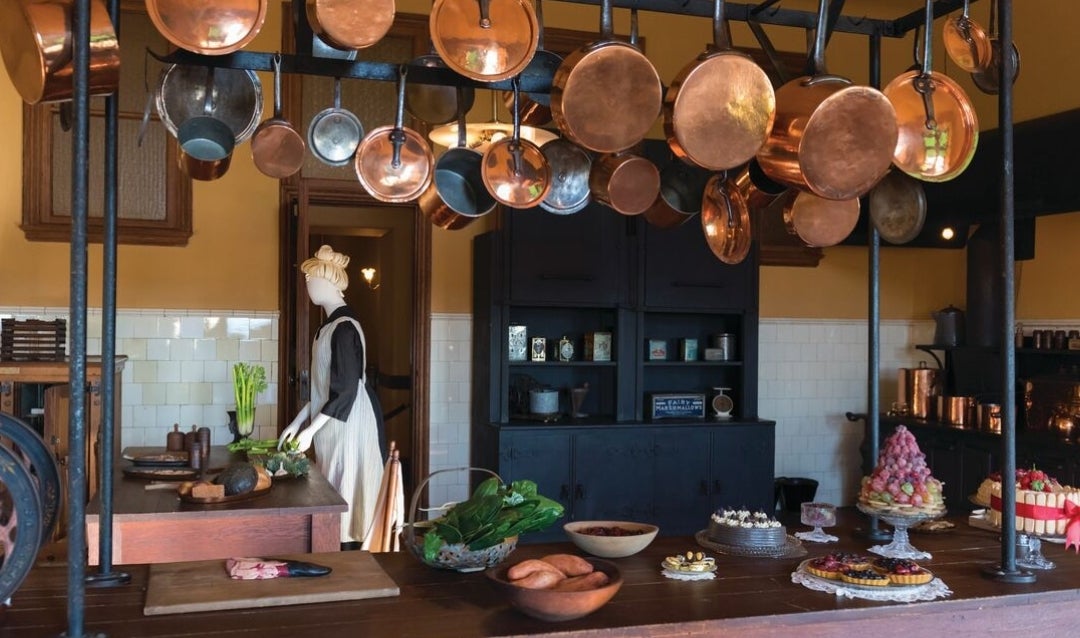
Imagine Biltmore House’s main kitchen abuzz with action in preparation for hosting the first Christmas celebration.
The 1904 Menu Book, kept by cook Esther Anderson, contains luncheon and dinner menus for Christmas Day and New Years Day. Surprisingly, they are not the most elaborate meals included in the book. The 1904 Christmas Day luncheon featured a fairly light menu that began with clear broth, followed by broiled oysters.
The Christmas Day luncheon entrée consisted of venison steak (very likely from the estate deer herd), served with string beans, potatoes and cauliflower. The salad course consisted of roast partridge and salad. Luncheon dessert consisted of apple tart, which is not surprising, since the estate orchards produced more than 20 varieties of apples. Coffee followed dessert and served as a separate course.
Christmas dinner began with Consommé Royale, a clear chicken broth thickened with tapioca and served with a savory garnish made from bullion, egg and herbs, poached in buttered molds, floating in the broth. A fish course of broiled Spanish mackerel accompanied by cucumber salad came next.
The main course featured roast turkey and cranberries, and was served with potatoes, peas, and celery. The Vanderbilts ate turkey in one form or another on average every three days. Mrs. Doris Johnson, whose daughter-in-law, Ellen, was a Biltmore House cook at the turn of the century, recalled that turkey and dressing were Mr. Vanderbilt’s favorite of all the things Ellen cooked, and it is very likely that turkey was indeed one of Mr. Vanderbilt’s favorite foods. A salad of Virginia ham and spinach followed. Christmas dessert consisted of plum pudding, ice cream, and cake.
New Year’s Eve meals
The New Year’s Eve luncheon began with fish cutlets, followed by braised rabbits and lamb chops served with potatoes, beets, and stuffed tomatoes. Chicken salad followed, and dessert consisted of apple tapioca pudding, then coffee. New Year’s Eve dinner began with either purée of chickens or consommé, followed by the fish course consisting of mousse of bass. The mousse was followed by an entrée of mushroom patties, and a relevé consisting of filets of beef with potatoes, spinach, and baked macaroni. Roast partridge accompanied the salad.
New Year’s Eve dessert was Fanchonette, an “old-fashioned French cake, somewhat like a pie made with rough puff pastry and a pastry cream filling baked in a slow oven. After cooling, it is piped with meringue, sprinkled with sugar and baked until brown.” Coffee followed dessert, and midnight toasts no doubt welcomed the New Year!