Chihuly At Biltmore Was On Display From May 17 To October 7, 2018.
Please Enjoy This Archived Content.
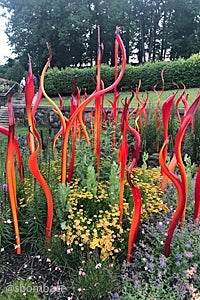
Now through October 7, Biltmore’s Gardens are transformed by the dramatic artworks that compose Chihuly at Biltmore. Installations can be found in the Winter Garden of Biltmore House as well as the Italian Garden, the Walled Garden, and beyond.
But one of the installations—Sky Blue and Cobalt Fiori—is set on the East Terrace of Biltmore House. Let’s take a look at this piece’s perfect backdrop: the magnificent limestone façade of America’s Largest Home®.
crop.jpg)
Sky Blue and Cobalt Fiori by artist Dale Chihuly on the East Terrace
Hallowell Quarry
In selecting the materials used to construct Biltmore House, George Vanderbilt and architect Richard Morris Hunt wanted nothing less than the best available.
While the underlying walls are of the house are brick, the overlay is limestone from the Hallowell Quarry in Indiana. At the time, Hallowell, which also sourced the stone used to construct Chicago’s City Hall in 1885, was the richest quarry in the country.

Workers and steam engine during Biltmore House construction, 1892
Limestone en Route
From February 1891 to February 1892, approximately 287 train cars left Indiana carrying the limestone that would become the façade of Biltmore House.
Once the train cars arrived at the Biltmore Village depot, the stone was transported to the construction site by a narrow-gauge railroad track that was built specifically for that purpose.
The first shipment arrived at the house on March 16, 1891.

Stonemasons’ shed during Biltmore House construction, 1892
Cut, Carved & Crandalled
The limestone blocks were stored in sheds to protect them from the weather until it was time for them to be cut and carved. To achieve the texture seen on the house today, the blocks were tooled by hand through a process called “crandalling.”
Skilled stonemasons cut shallow grooves into the surface of the stone, resulting in a fine, pebble-like surface. The process results in an elegant-looking limestone that reflects light in a more dramatic manner.

Crandalling detail surrounding a brass ring on the house exterior
The crandalled limestone blocks were then lifted into place using wooden derricks powered by hand-drive, geared winches. The first block of stone was put in place in the west garden wall on June 8, 1891.
Adding It All Up
Although there’s no exact final count, estimates indicate that when the construction was complete, around 60,000 cubic feet of limestone—weighing about 5,000 tons—had been used in the project.
The surface as it’s seen today reflects the beautiful effects of aging in the elements for more than 120 years.
Feature image: The Front Door of Biltmore House surrounded by limestone detail




 The Pergola once served as a resting place overlooking a lawn tennis court popular with Edith and Cornelia Vanderbilt and their friends. In 1919, Edith asked Chauncey Beadle, estate superintendent, to convert the original “lawn” court to a clay court; the court was later removed.
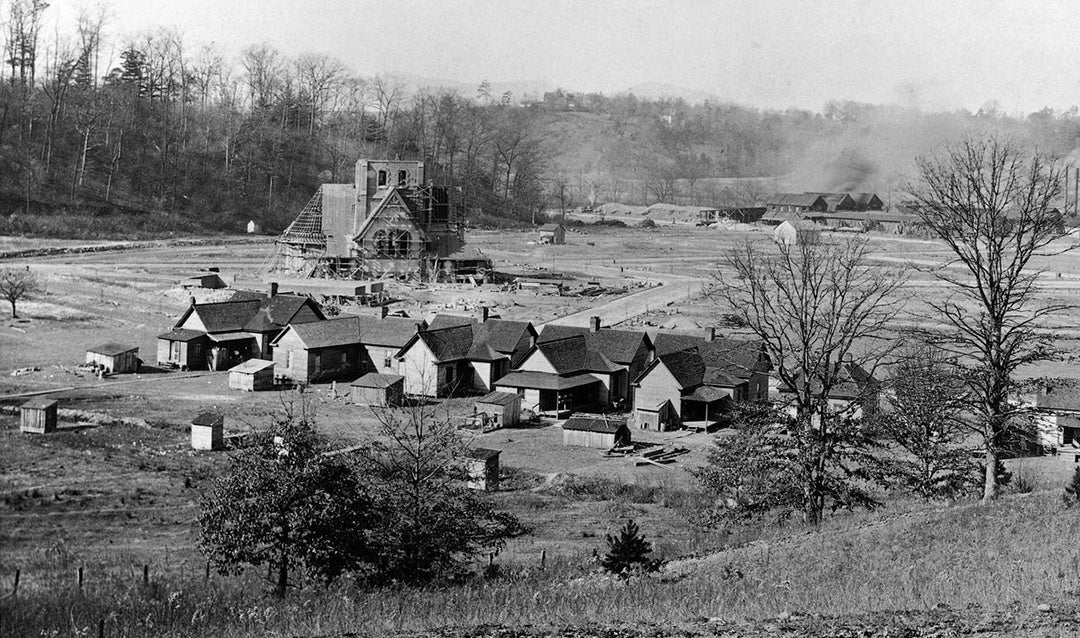
 The Pergola itself dates back to the construction of Biltmore House. Grading and construction began in 1891 under the direction of architect Richard Sharp Smith and landscape architect Frederick Law Olmsted. This archival photo shows the walking paths from the Pergola through the Shrub Garden and Walled Garden completed, with the Pergola underway and, in the distance, the Conservatory under construction.
 Limestone columns and massive wooden rafters form the structure that was originally crowned with ivy. According to Bill Alexander, retired Biltmore landscape and forest historian, Olmsted specified English ivy to be planted at the base of the columns in 1892. “This look of being ‘festooned’ with ivy was typical of Olmsted’s design intent,” Bill said.
  By 1895, wisteria was planted on the South Terrace and trained to grow out over the Pergola through gaps in the limestone wall created for this purpose. Nearly a century later, Biltmore’s landscape team removed the vines from the top to protect the walls from damage caused by roots, resulting in the leafy and peaceful setting enjoyed today.