Fine Linens for Fine Living

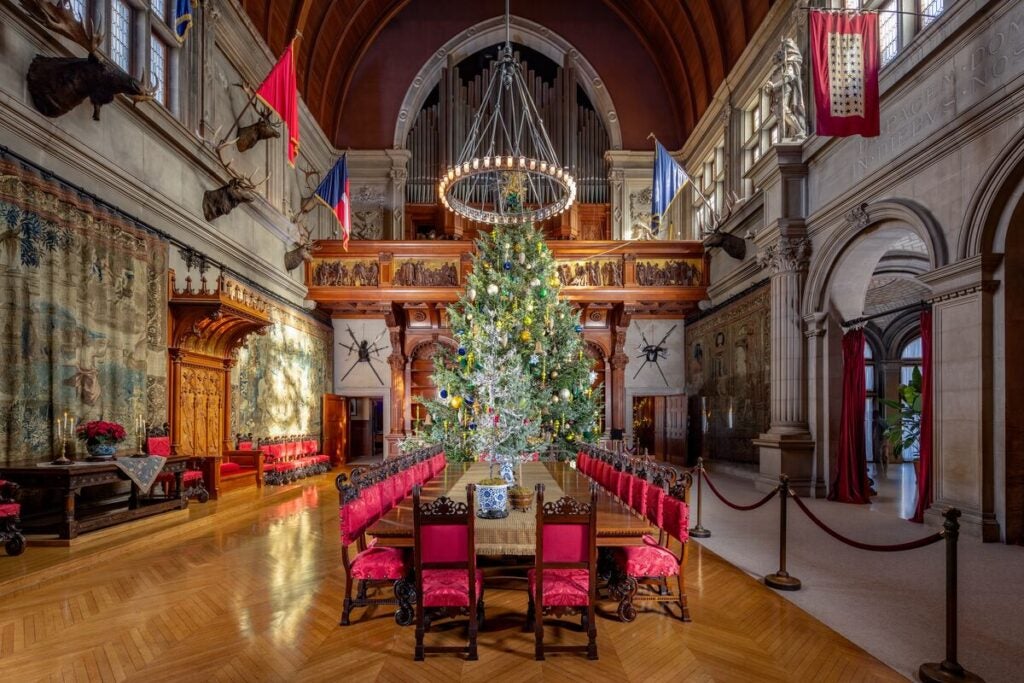
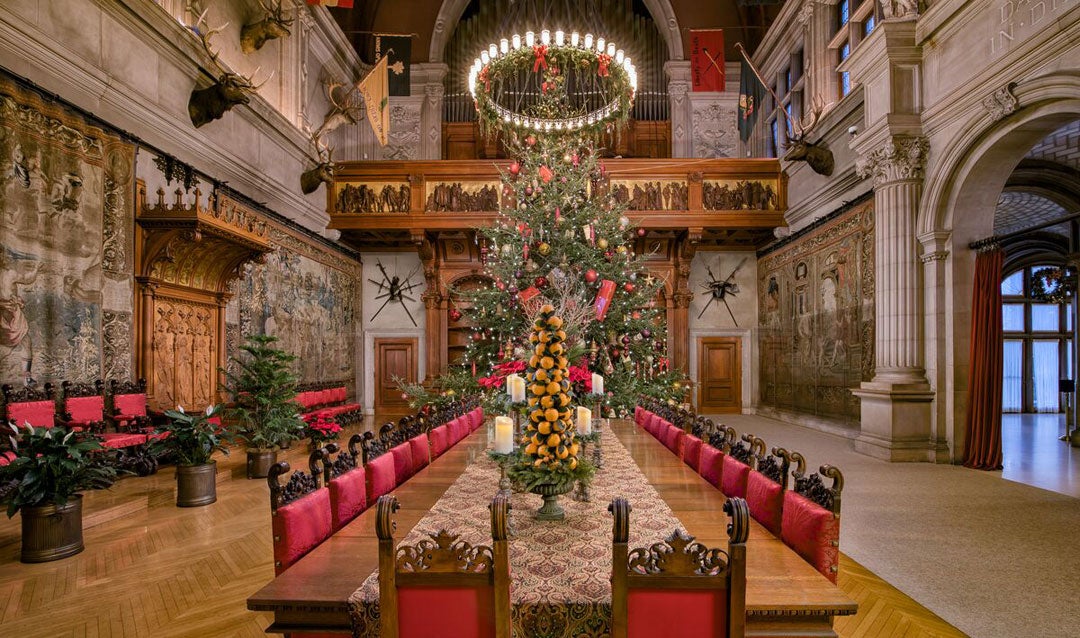
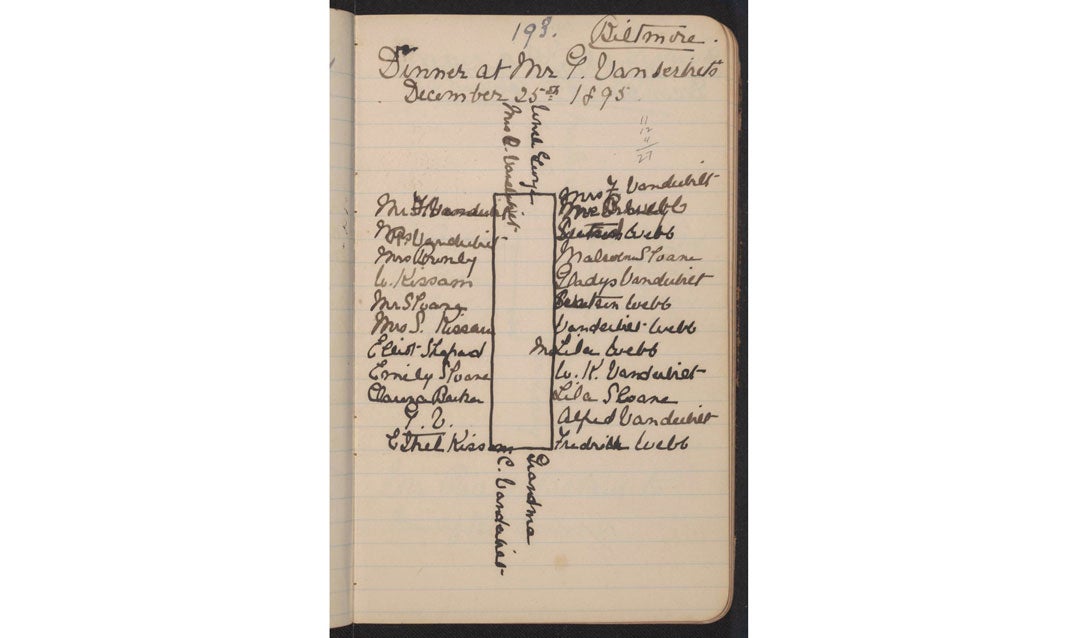
Imagine a dinner in the Banquet Hall with George and Edith Vanderbilt. Your place at the 40-foot-long table might be set with as many as twelve pieces of silverware, three plates, plus a charger as well as cup and saucer made by made by British porcelain manufacturers Minton or Spode-Copeland. Baccarat crystal wine, sherry, and water glasses are set within your reach.

Meals at Biltmore were prepared with the utmost care and that attention to detail extended to the whole dining experience. In George Vanderbilt’s papers, Biltmore archivists found record of a purchase of monogrammed linen napkins from a shop in Paris, dated September 24, 1895. Details such as linens played a big role in the Vanderbilts’ spirit of gracious hospitality, but keeping these delicate items clean, crisp, and perfect required efforts almost unimaginable today.

In her 1903 book, Millionaire Households and Their Domestic Economy: Hints for Fine Living, Mary Elizabeth Carter− former housekeeper to another branch of the Vanderbilt family− gave a behind-the-scenes look at how houses such as Biltmore handled the excess laundry created by guests. “If you’re not prepared for large entertainment,” she warned, “bedlam is let loose below stairs and laundresses are driven almost mad.”

In Carter’s view, a well furnished laundry was essential to cope with the demands of a house designed for entertainment:

“The twentieth century laundry is supplied with a diversity of smoothing irons – heavy ones for house linens, medium weight for lingerie and little ones of various and curious shapes for smoothing out sleeves and to reach tiny places in the smallest and most fairy-like of baby clothes. Its ventilation is perfect and the water supply, both hot and cold, is perfect.…A spacious, sunlighted (sic) finely ventilated laundry amply furnished for the work to be accomplished in the best manner for the workers speaks eloquently for the character of the ruling classes.

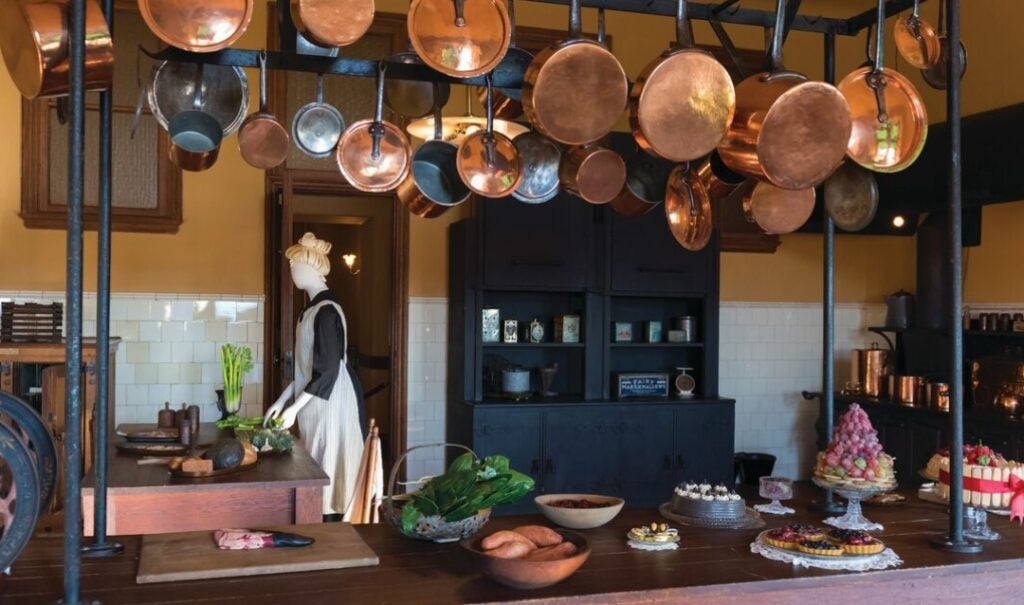
In the Main Laundry and Drying Room at Biltmore, you’ll see a variety of pressing devices as well as a barrel washer operated with leather belts and pulleys and an extractor used to spin excess moisture from laundry. The “ironing mangle” was used to iron large, flat articles such as linens and the innovative system of rolling, wooden racks were used for drying, either by air or electric coils.

Carter went on to say of homes such as Biltmore that “None but skilled hands find employment in the laundry of one of these houses. They handle countless expensive and delicate articles of wearing apparel and house linen and must send all back looking as beautiful as if it had just arrived from Paris.”

As you tour Biltmore House keep an eye out for the little details such as the linens, each of which adds to the sense of being in a place where guests receive an extraordinary welcome.

Exploring George Vanderbilt’s Library

Even in Biltmore House, where so many rooms are filled with amazing collections of beautiful things, the Library still shines as a special place. George Vanderbilt was a remarkable man, and it’s fascinating to learn more about him through the creation of his magnificent and enduring library at Biltmore.

Learn more about George Vanderbilt’s tastes and interests with this look at some noteworthy books that form the Biltmore House Library collection.

An up-close look at leather-bound books in the collection

Logging literary pursuits

When he was 12, George Vanderbilt began recording the names of each book he read in a journal, and he continued that habit throughout his life. If we look at any representative year, we get a sense of the breadth of his intellect. In 1899, Mr. Vanderbilt read a total of 51 books: 31 were novels, including The Two Magies and The Awkward Age by Henry James and Antonia or the Fall of Rome by Wilkie Collins. 

Detailed look at a large bookpress in Library in Biltmore House

A man of many interests

By the time of his death, George Vanderbilt had collected more than 23,000 volumes. Approximately one-third of the volumes were antiquarian purchases, with the oldest appearing to be an Italian work published in 1561. The major strengths of the collection are 19th-century English and American literature, art and architecture; travel, philosophy and religion; history; and French fiction and non-fiction reflecting both his and his wife’s interest in France and their fluency in the French language.

Most of the books George Vanderbilt collected were sent to one of the great bookbinders of the period, such as Riviere, Stikeman, Lortic, or David.  A few months later they would be returned beautifully bound in Moroccan leather, with gilt lettering and decoration, to be placed on the shelves of the Biltmore House Library.

Lithograph from Thomas McKenney and James Hall's History of the Indian Tribes of North America, 1844.
Lithograph from Thomas McKenney and James Hall’s History of the Indian Tribes of North America, 1844.

Rare Biltmore Library collections

The Biltmore House Library contains Thomas McKenney and James Hall’s History of the Indian Tribes of North America. Our volumes are the original large folio edition, published in 1844, and contain a full set of the original 120 hand-colored lithographs, which have remarkably retained their vibrancy despite being 180 years old.

This work is widely regarded as one of the most significant publications on Native Americans ever produced, as well as one of the most important color plate books of the 19th century. It provides a remarkable glimpse into the lives and appearances of Native American leaders during a pivotal time in American history and of Biltmore’s earliest inhabitants.

Tragically, many of Charles Bird King’s original oil paintings, from which these folio prints were created, were destroyed in a fire at the Smithsonian in 1865. The rarity of the original folio printing, combined with its historical significance and the unfortunate destruction of the source material, makes this set an invaluable part of our collection.

Other notable works include the complete set of James Audubon’s The Birds of America and The Quadrapeds of America. The copies are unusual in that they are the smaller octavo edition, not the very large elephant folio edition so prized by print collectors. What makes Biltmore’s set particularly interesting is that they are bound with the original paper wrappers that accompanied each part as Audubon’s publisher issued them.

More Than a Housekeeper: Mrs. King

You may not realize it from her position, but one of the significant figures in Biltmore’s past is Emily Rand King, who served as housekeeper and head of staff for the Vanderbilts from 1897–1914.

Learn about the life of Biltmore’s longtime housekeeper, Mrs. King, in this blog.

Housekeeper's room in Biltmore House.
Housekeeper’s room in Biltmore House.

Three things to know:

  • Although we don’t have photographs of her, there is a great deal of correspondence in the Biltmore archives concerning Mrs. King.
  • She was always referred to as “Mrs.” King, although we believe she was unmarried while working at Biltmore. The title was likely a courtesy used to reflect a level of authority, age, and respect—similar to “Mrs. Hughes,” the head housekeeper in Downton Abbey.
  • Housekeepers of the time were responsible for managing a large staff and keeping track of household expenses in addition to maintaining most aspects of daily life in the home.
Vignette of Mrs. King and Edith Vanderbilt in the Oak Sitting Room as displayed in the 2019 exhibtion,
Vignette of Mrs. King and Edith Vanderbilt in the Oak Sitting Room as displayed in the 2019 exhibition, “A Vanderbilt House Party.”

Early Life & Arrival to Biltmore

Emily King was born December 7, 1853, in the village of Horndon on the Hill, Essex County, England. By her early 20s, she worked as a domestic servant for a London physician.

Sometime prior to August 1897, she traveled to New York on her way to Biltmore, where she joined several English servants on the estate, including the valet, four butlers, a cook, a housemaid, and a coachman. Adding further international flair to the household was an Irish butler, French chef, Swedish laundress, and Italian stable boss.

Biltmore’s archives make it clear Mrs. King was responsible for cleaning the house, caring for the staff, hiring and firing staff members, and also coordinating many aspects of the family’s lives such as meeting with the Vanderbilts each morning to review the chef’s suggested menus and plan for guest activities, then meeting with the Chef and Head Butler to review the plans. She and the Head Butler supervised all staff except for the kitchen staff who worked for the Chef.

During the family’s frequent travels, Mrs. King stayed behind with the Head Butler to ensure the smooth operation of the house, including making arrangements for special guests staying at Biltmore in the family’s absence and preparing the house for their return. She also extended social invitations for Mrs. Vanderbilt, serving as a personal secretary of sorts.

As a high-ranking member of Biltmore’s domestic staff, Mrs. King was provided with horses for her use and was allowed to keep her own dogs in Biltmore House—the dog gate still exists in the Kitchen Hallway that Mrs. Vanderbilt installed to keep the housekeeper’s dogs out.

Detailed view of Mrs. King’s clothing recreation as displayed in “A Vanderbilt House Party” in 2019.

Life After Biltmore

Soon after George Vanderbilt’s death in 1914, Emily King resigned and embarked upon a new life. She met and married W.C. Jones, a widowed farmer from near Raleigh, NC, and moved to Pennsylvania to be near family. Sometime later that year, the couple purchased an orange grove near Apopka, FL. In December 1914, estate superintendent Chauncey Beadle wrote a note of thanks for the box of oranges Mrs. Jones sent to Biltmore for the holidays.

Biltmore curators learned that Emily King Jones purchased and managed a boarding house in Apopka, which she named the Biltmore Inn, and operated it until the early 1920s.

After retiring from a lifetime of serving others, Mrs. Jones returned to Pennsylvania, where she resided until her death in 1926.

From Valet to World Traveler: Wilfred Shackley

The typical duties of a Vanderbilt-era valet included attending to their employer, especially assisting with dressing and preparing for the day, much like a lady’s maid. They would often travel with their employer, arranging for accommodations and transportation and managing luggage.

While we do not have a lot of information about Mr. Vanderbilt’s valets over the years, we do know a bit about one in particular named Wilfred Shackley including:

  • He was employed by George Vanderbilt from around 1900-1906.
  • It is believed that his wife, Madeleine Henry Shackley, was the Mademoiselle Henry that was once Edith Vanderbilt’s lady’s maid.
  • Wilfred Shackley was English and was engaged by Mr. Vanderbilt while abroad in 1899.
  • He spoke German and French fluently, which was highly beneficial given how widely he would travel alongside Mr. Vanderbilt.
Recreation of clothing worn by George Vanderbilt’s valet as it was displayed in
Recreation of clothing worn by George Vanderbilt’s valet as it was displayed in “A Vanderbilt House Party” exhibition in 2019. Over his arm is a driving duster, as if he is assisting George prepare for a drive across his estate.

Fascinating glimpses into the life and times of Mr. Shackley

In researching the domestic staff who worked for the Vanderbilts, our Museum Services team uncovered a 1973 newspaper article in the Hendersonville Times-News about Wilfred George Shackley.

“Few people have been able to cram into their lifetime book of memories as many world trips, as many confrontations with kings and potentates and as much hobnobbing with world celebrities as Wilfred G. Shackley of Flat Rock who celebrated his 98th birthday last week.

“Sleeping in the White House at the invitation of President Theodore Roosevelt, meeting Kaiser Wilhelm of Germany and King Edward of England and traveling around the world with millionaire George Vanderbilt, original owner of Biltmore House are only a few of the highlights of Shackley’s career.

“Born in June 17, 1875 Shackley attended school in England and came to the United States when he was 15 years old. When he came to this country he worked and attended night school and learned accounting, bookkeeping and typing. When he was 19 years old a cotton broker engaged him to go to Shanghai with him.

“He was there eight months and returned to London wearing the white type of clothing usually worn in China.

“When he checked in at the hotel where he usually stayed the clerk greeted him and said ‘You’re just the man we are looking for.’ He added ‘There’s a millionaire here from America looking for someone to travel around the world and keep his records.’

“Shackley says he was introduced to Vanderbilt and when the millionaire learned he spoke several languages he immediately hired him. He said ‘we leave for Paris day after tomorrow.’ Shackley said he told Vanderbilt it would be impossible because all the clothing he had was light clothing he brought from the Orient. Vanderbilt postponed the start of the journey ten days for Shackley’s convenience.

“The Flat Rock retiree spent a number of years traveling with Mr. and Mrs. Vanderbilt, keeping records of their travels, purchases and other details. Among the countries visited were Russia, Germany, France, Holland, Italy, China, Japan, the Philippines and Canada.

“In his travels Vanderbilt was seeking art treasures, tapestries, statuary, works in silver and gold and historic treasures.

“Shackley has also played chess with a set of chessmen which Napoleon used while he was imprisoned at St. Helena. Vanderbilt acquired the set and it is a part of the possessions at Biltmore House.”

George Vanderbilt’s friend James McHenry gifted him a chess set made of natural and red-stained ivory that once belonged to Napoleon Bonaparte, former emperor of France. Photo credit: @Kristen.Maag

Life after Biltmore

After leaving service at Biltmore, Shackley went to work for a Wall Street bond company, later selling bonds in Paris. He served in World War II with the War Department then became vice president of Henry Rump and Sons, a wholesale fruit and vegetable business founded by his father-in-law. The Shackleys ran this business until his retirement in 1966 when he turned 90.

He passed away at the age of 101 in Hendersonville, NC.

Credit: Excerpts from “William [sic] Shackley At Age 98 Has Led A Full Life,” July 23, 1973, Hendersonville News-Times.

National Historic Landmark Designation Illustrates U.S. Heritage

Biltmore in Asheville, North Carolina was officially nominated as a National Historic Landmark on May 23, 1963.

The original landmark designation was based on the theme “Conservation of Natural Resources.” The description for Biltmore was:

At Biltmore, the George W. Vanderbilt estate near Asheville, Gifford Pinchot demonstrated for the first time in the United States that scientific forest management could be profitable and was, thus, good business practice. Another ‘first’ in forestry occurred here in 1898 when the first forestry school in the United States was opened, the Biltmore Forest School, headed by Dr. Carl A. Schenck. Nearly 87,000 acres of the estate’s forest land is now included in Pisgah National Forest. The building in which the school was conducted is owned by the city of Asheville and used today for offices.

Dr. Carl A. Schenck with Biltmore Forest School students, 1900*
Dr. Carl A. Schenck with Biltmore Forest School students, 1900. Image courtesy of National Forests of North Carolina Historic Photographs, D.H. Ramsey Library Special Collections, University of North Carolina Asheville, Asheville, NC.

Beginning in 2000, Biltmore began an effort to expand the landmark designation beyond conservation to include the themes of architecture, landscape architecture, and social history, and to extend the period of significance to 1950 to include the contributions of Chauncey Beadle, estate superintendent, and improvements and significance of the Biltmore Dairy during those years. The Secretary of the Interior approved this expansion on April 5, 2005. 

Estate Superintendent Chauncey Beadle, 1948

Bill Alexander, Biltmore’s former landscape and forest historian and participant in the five-year project of gathering additional documentation for the expanded designation, said that Biltmore has to submit periodic reports to the National Park Service to describe any changes occurring to the property, including natural disasters and damage such as the floods and tree loss caused by Hurricanes Frances and Ivan in 2005. 

He also noted that the building referenced in the original nomination is located in Biltmore Village.

“The office building at 1 Biltmore Plaza was where the Biltmore Forest School held its fall and winter classes for a number of years,” Bill said. “It was the first new, permanent structure completed in Biltmore Village after George Vanderbilt purchased the village in 1894, followed by the passenger train depot in 1895 and All Souls Church in 1896, all designed by architect Richard Morris Hunt.”

1 Biltmore Plaza in Biltmore Village, 1895

“Biltmore sold the office building to the City of Asheville in 1929, and leased the downstairs for corporate offices while the upstairs was used as a substation of the Asheville Fire Department.”

Biltmore eventually repurchased the building and currently uses it for office space.

The National Park Service lists more than 2,500 historic properties “that illustrate the heritage of the United States.” National Historic Landmarks include historic buildings, sites, structures, objects, and districts, with each landmark representing an outstanding aspect of American history and culture.

Plan your visit to Biltmore today and enjoy the splendor of this National Historic Landmark.

Wedding gifts befitting a Vanderbilt

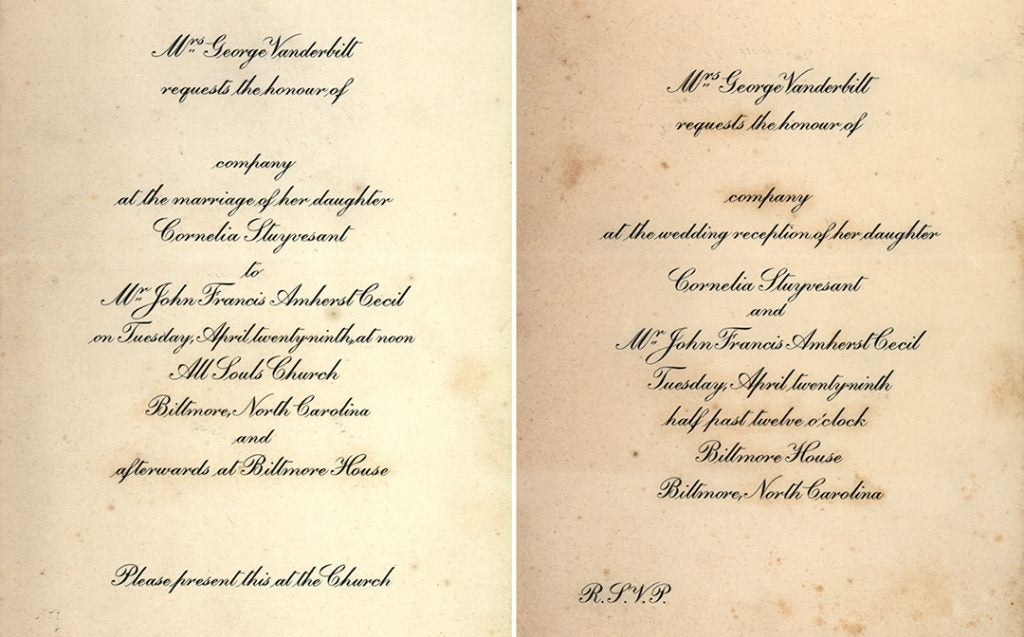
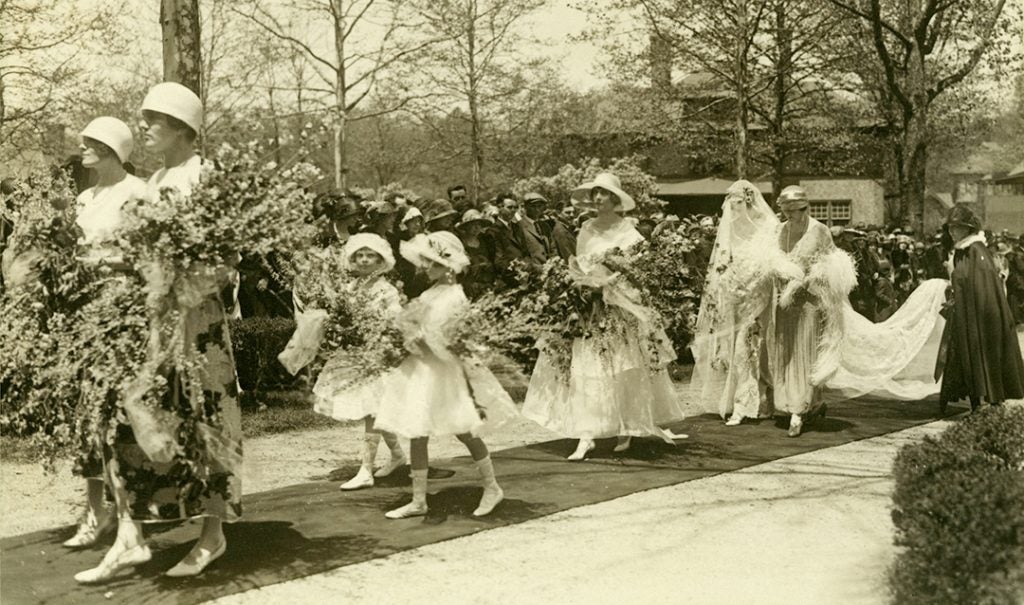
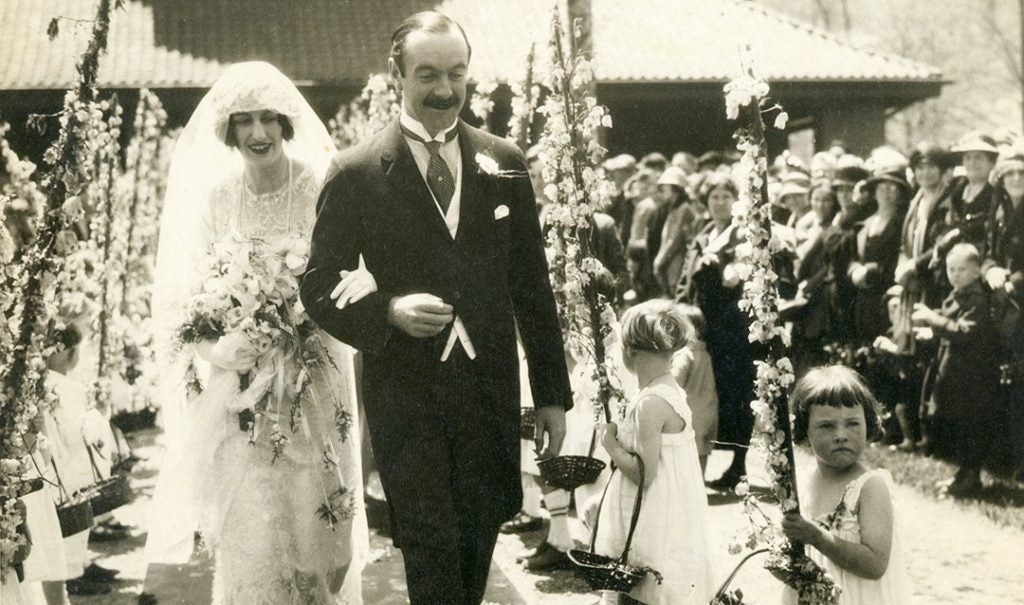
The April 29, 1924 wedding of Cornelia Vanderbilt and the Honorable John Francis Amherst Cecil drew guests from around the world, who brought with them lavish gifts from their home countries.

Gifts given with meaning

Many of the gifts had personal significance to the couple. Her mother, Edith Vanderbilt, gifted a cocktail shaker and brooch to John Cecil, while John Cecil’s father gave a diamond and sapphire horseshoe-shaped brooch to Cornelia to celebrate her skill with horses. Cornelia’s maid-of-honor gifted her with a distinctive marabou feathered throw along with other bedding, still part of Biltmore’s collection. Sir Esme Howard, British Ambassador, gifted the couple with Essays of Bacon, honoring John Cecil’s homeland and the couples’ intellectual interests.

Not all of John and Cornelia’s wedding gifts were given by those with fabulous wealth. The servants of Biltmore House, coordinated by butlers Arthur Hopkins, William Donahue, and Herbert Noble, pooled funds to give the couple a china breakfast set. Gifts from other residents of the estate included baskets, brooms, door stops, kumquat marmalade, and a puppy! Even more meaningful than gifts, estate employees gathered outside the house the night before the wedding with noisemakers and a band to celebrate Cornelia on the eve of her special day.

Below are photos of several notable wedding gifts, which can be seen at The Vanderbilts at Home and Abroad exhibition in Antler Hill Village.

Expand
Cupid and Psyche figurine, late 19th century, French bisque porcelain and ormolu.
Expand
Hatpin, ca. 1924 from Cartier, New York. Made of carved jadeite, sapphire, diamond, and platinum with original case.
Expand
Vanity case with attached lipstick and cigarette holder, ca. 1924 from Cartier. Made of gold, enamel, carved jadeite, platinum, diamond, and onyx, in the original box. The case opens to reveal a mirror, powder compartment, and powder puff.
Expand
Shoulder brooch for Scottish plaids, Henry Tatton, Edinburgh, Scotland, 1919. Featuring cairngorm (smoky quartz) and sterling silver. And Amethyst pendant, ca. 1924.

Uncovering a life—based on a coat

Recently, Biltmore’s Lenore Hardin, Associate Collections Manager, was cataloguing a servant’s livery coat from the Biltmore House collection when she discovered a label inside. It read, “S. Patrick… Mrs. Geo. Vanderbilt… Nov. 12 1921.”

Since the Museum Services staff was unaware of a servant by that name who had worked at Biltmore House, they dug a little deeper. Through research both in the Biltmore archives as well as in birth, death, census and transatlantic passenger records, they were able to piece together the sad tale of an interesting man.Servant livery coat worn by footman Sefton Patrick, 1921

Like many other footmen who worked at Biltmore, Sefton Patrick was an Englishman trained in domestic service recruited to work at Biltmore. He first appears on a passenger list from Southampton, England to New York in 1913. He was 29 years old, single, and his profession was listed as “steward.”

Soon thereafter he was hired by George Vanderbilt’s sister, as he shows up on the 1920 U.S. Census as a servant working in the New York home of William Seward and Lila Webb.

In 1921 Sefton Patrick began work at Biltmore House as a footman, or underbutler. It appears by all accounts that he was a hardworking, devoted member of the domestic ranks. In February 1922, however, he became ill with tuberculosis. At first he was cared for by a local doctor, and correspondence in the archives indicates that Edith Vanderbilt helped support Patrick by sending him monthly checks.

He recovered enough to come back to work in the fall of 1923, but he had a second “breakdown” in February 1924 and was admitted to the Stonehedge Sanitarium in Asheville. His condition was serious enough that estate superintendent Chauncey Beadle helped Patrick get a disability insurance policy. Biltmore continued to pay for his doctor’s bills and as well room and board at three different sanitariums.

monogrammed buttonMrs. Vanderbilt planned to employ Patrick “to take charge of her garden and grounds around her new home” once his condition improved. Patrick wrote to Mrs. Vanderbilt:
“I must thank you for your kind offers, received through Mr. Hopkins. It is really thoughtful that you should so consider my future… Am glad to say that I continue to feel well and hold my weight, so there is every reason to believe that I am making good progress and will eventually overcome it permanently. I am more than sorry that there seems little chance of me starting work in December but if I continue to improve I hope that I will be well enough in the spring… I sincerely feel that is my duty both to you, for giving me such an opportunity, and to Dr. Dunn who takes a personal interest in my care… I must thank you for your continued interest, it is a tremendous help, and a continual incentive for me to do my very best to get well and make a real cure.”

Sadly, Patrick’s condition did not improve. In 1926, he moved to New Mexico, where thousands of tuberculosis patients had traveled to seek treatment with its dry climate, high elevation, and sunshine.

In November 1927, Patrick wrote to Mrs. Vanderbilt’s secretary, William Ashby: “Glad to say I’m going on pretty well. Haven’t made such rapid progress as I had hoped but am getting over the danger period (Dr. Peters noticed that I slipped periodically) but have steadily improved so can feel encouraged that am on the way to permanent cure.”

A few months later, Patrick wrote to Beadle about some insurance matters. He noted, “I have more than a suspicion that Dr. Peters considers me a ‘chronic’ case though I refuse to look at it in that light myself. My argument is that if one can change for the worse—one can also for the better! I know it is a question whether I can recover sufficiently to return to my old occupation or any kind of physical work. That is the reason I now spend my mornings at school—I feel bookkeeping etc. should be handy in whatever line I may happen to work in the future.”crest button

Patrick continued to correspond with Beadle and Ashby throughout the year, always giving reports on his health in an upbeat manner and expressing confidence in an eventual cure. In a letter dated April 8, 1927, however, Patrick conceded: “My mother is 73 years old. Up until the time of my sickness I had visited her often. I had just returned from England previous to coming to Mrs. Gerry six years ago. I am glad to say she is in wonderful health but should anything happen it would be necessary for me to go and needless to say I would like to be with her before. . . . . . It is an event that I cannot contemplate but of course has been in my mind since this ‘curing’ has taken so long.”

By 1928 it is clear that Patrick’s health had deteriorated even more. In one of his last letters, he wrote, “Glad to say am pretty well though I’m 20 pounds lighter than when I got here and at present don’t walk. I feel once I can regain my appetite though I’ll pick up again.”

Death records indicate that Sefton Patrick died on December 26, 1928. He was laid to rest in Albuquerque, New Mexico.

Photos

Top right: Servant livery coat worn by footman Sefton Patrick, 1921.

Center: Close up of coat button showing George Washington Vanderbilt's monogram.

Bottom right: Close up of coat button showing the Cecil family crest.

Etched in stone: the façade of Biltmore House

George Vanderbilt and his architect Richard Morris Hunt put careful consideration into each material used to construct Biltmore House. While the underlying walls are brick, the architect chose to add a striking warm stone façade of the house: a layer of limestone from the Hallowell Quarry in Indiana, the country’s richest quarry at the time and the same source for the stone used in Chicago’s 1885 City Hall.

Between February 1891 and February 1892, 287 train cars left Indiana carrying the limestone that would become Biltmore’s façade. Once it came into the depot in Biltmore Village, the stone was transported to the construction site by a narrow-gauge railroad track built specifically for that purpose. The first shipment arrived at the house on March 16, 1891.

Limestone blocks were stored in sheds and protected from the weather until they were ready to be cut and carved. To achieve the texture seen on the house today, the blocks were tooled by hand through a  process called crandalling. Skilled stonecutters cut shallow grooves into the surface of the stone, resulting in a fine, pebble-like surface that looks more elegant and reflects light more dramatically than unaltered limestone.

Once ready, the limestone blocks were lifted into place using wooden derricks powered by hand-drive, geared winches. The first block of stone was put in place in the west garden wall on June 8, 1891.

Although there’s no exact final count, estimates indicate that when the construction was complete, around 60,000 cubic feet of limestone adding up to 5,000 tons had been used in the project. The surface as it’s seen today reflects the beautiful effects of aging in the elements for more than 120 years.

Archival photo of some of the workers and a steam engine that built America's Largest Home

Top: Stonemasons’ shed, 1892, with Biltmore House under construction in the background.

Bottom: Workers and a steam engine on the Esplanade, 1892. Indiana limestone was shipped by rail directly to the Biltmore House building site.

A special bond

Chauncey Delos Beadle began working at Biltmore as nursery supervisor under the direction of Frederick Law Olmsted in 1890—five years before Biltmore House and its surrounding gardens were completed. Beadle, who said he came to Biltmore for a month and stayed for a lifetime, lovingly supervised the estate grounds until 1950.

Chauncey Beadle, ca. 1906

Ten years after arriving at Biltmore, Beadle and the other staff members helped George and Edith Vanderbilt welcome the arrival of their only child—a daughter named Cornelia Stuyvesant Vanderbilt. Later that same year, a cucumber magnolia tree (Magnolia acuminate) was planted in the child’s honor in the area of the estate that would come to be known as the Azalea Garden. According to one newspaper account,

The spot selected is in a beautiful grassy dell near Biltmore House. The tree itself, now but a sapling of twelve feet in height, is expected to be 60 feet above the ground when little Cornelia reaches the age of 20 years. A few years after that event, it is expected that it will reach a height of 100 feet. It lives centuries, and is one of the prides of our beautiful southern forests. 

A special bond

As a young girl, Cornelia developed a special bond with Beadle. He had become estate superintendent and was now responsible for the overall business management of the estate, as well as many of the Vanderbilts’ personal affairs—but he was also a trained botanist and horticulturalist who encouraged Cornelia to take an interest in plants and flowers from a very young age. Together, they undertook such activities as planting a flower garden for the child to tend.

When Cornelia was away travelling with her parents, Beadle wrote letters detailing the garden’s growth and often included pressed flowers for her enjoyment.

Here are excerpts from the charming letters Beadle wrote to Cornelia just before her sixth and seventh birthdays:

August 17, 1906 – To Cornelia in Paris, France:

“I promised you just as you were leaving Biltmore to send you some pressed flowers from your garden, that you may see some of the results of the seeds we planted last spring. Almost all of the seeds grew and thrived and, in particular, I wish you could have seen some large double sunflowers as large as breakfast plates … They were so large that I could not press them and I fear that before your return they will have faded and gone. The little package which I am sending you, however, contains some of the smaller flowers that were easily pressed and, perhaps, before your home-coming, I can send you another lot so that you may be able to enjoy the garden even though you were in Europe…”

August 14, 1907 – To Cornelia at Point D’ Acadie, the Vanderbilt’s home in Bar Harbor, Maine:

“I have sent you by mail a package containing a number of pressed flowers from your garden which you painstakingly planted and watered. Very many of the plants have made a splendid showing… In the package you will find handsome Larkspurs of various shades and mottled colors… and several other flowers that were in blossom…. You will find the names of the flowers written on the inside of the sheets of paper which contain them, and I am very sure that you will soon know them all by name and will be able to recognize them wherever you may see them growing…”

Keeping up a correspondence

George Vanderbilt passed away unexpectedly in 1914, and Edith and Cornelia began spending more time in Washington, DC where Cornelia attended The Madeira School. Beadle continued corresponding with the pair through the years, bringing Edith up-to-date on estate business and describing the gardens in great detail so both ladies could enjoy them even when they were far from home.

In a letter dated April 14, 1922, Beadle wrote to Cornelia,

“The tulips in the walled garden are so glorious that we are trying out an experiment of sending you a box today by express for Easter. We shall hope they will bring you something of their original beauty and charm to make Easter even more wonderful. Spring is very much advanced here, even the yellow rambler roses are opening.”

Beadle’s gift

In 1923, Cornelia met the Honorable John Francis Amherst Cecil, a British diplomat who had been transferred to Washington, DC after posts in Egypt, Spain and Czechoslovakia. John Cecil came from a very prominent British family, and was a direct descendant of William Cecil, the first Lord Burghley, who served Queen Elizabeth I of England.

Cornelia and John announced their engagement later that year, and set a wedding date for April 29, 1924. Although Beadle was in Florida and unable to return for their wedding, he sent a very special gift that commemorated their mutual love of the natural world: fresh orange blossoms from his own garden. Our archival records indicate that Cornelia placed some of the fragrant flowers on her veil and also decorated the toe of each of her wedding slippers with a single, perfect blossom.

Cornelia Vanderbilt’s wedding portrait upon her marriage to John Francis Amherst Cecil, April 1924

Images

Top: Chauncey Beadle at Biltmore in 1906

Middle: Cornelia Vanderbilt photograph; 1904

Bottom: Cornelia in her wedding dress at the bottom of the Grand Staircase in Biltmore House

A fashionable lady

From her debutante days onward, Edith Vanderbilt was a fashionable lady who enjoyed wearing some of the most elegant styles designed by the exclusive fashion houses of the era.

Standing portrait of Edith(Right) Standing portrait

In the late 1800s, standing portraits like this one were popular because a standing pose allowed a lady to display all the details of her beautiful costume to best advantage! Note the extraordinary length of lace falling from the delicate floral trim at Edith's shoulders (the floral design is also echoed in her sweeping skirt) and the height of her feathered hair ornament.

Young Edith

(Left) 1900

As a young mother, Edith Vanderbilt's style of dress reflected a bit more restraint than her glamorous debutante and engagement gowns, but there were still rich layers of details to keep the style engaging. Notice the striking combination of Edith's elegant sleeves layered in stripes and dots, the lavish lace bow at her throat, and the dangling brooch pinned to her bodice.

Edith wearing a locally created suit

(Right) March 1907

On this date, the New York Times featured a front-page story on Edith Vanderbilt wearing a gown of mountain homespun cloth woven by artisans who worked for Biltmore Industries–a business the Vanderbilts developed to provide economic support for local crafters in the community. Edith Vanderbilt always chose examples of current styles to flatter her tall, slim figure, and this sleek suit is no exception. In addition to enjoying the elegant ensemble, Edith used it as an attractive tool to help influence her social connections and push sales of Biltmore Industries merchandise.

Edith in 20s fashion

(Left) A fashionable lady

Throughout her life, Edith Vanderbilt would continue to be celebrateded for her fashion sense and good taste. 

(Top) Featured blog image 

A 1911 portrait of Edith Vanderbilt painted by Italian artist Giovanni Boldini, known for his glamorous renderings of notable members of society. This portrait hangs in the Tapestry Gallery at Biltmore House, just outside the entrance to the Library.