Biltmore becomes a “Port authority”

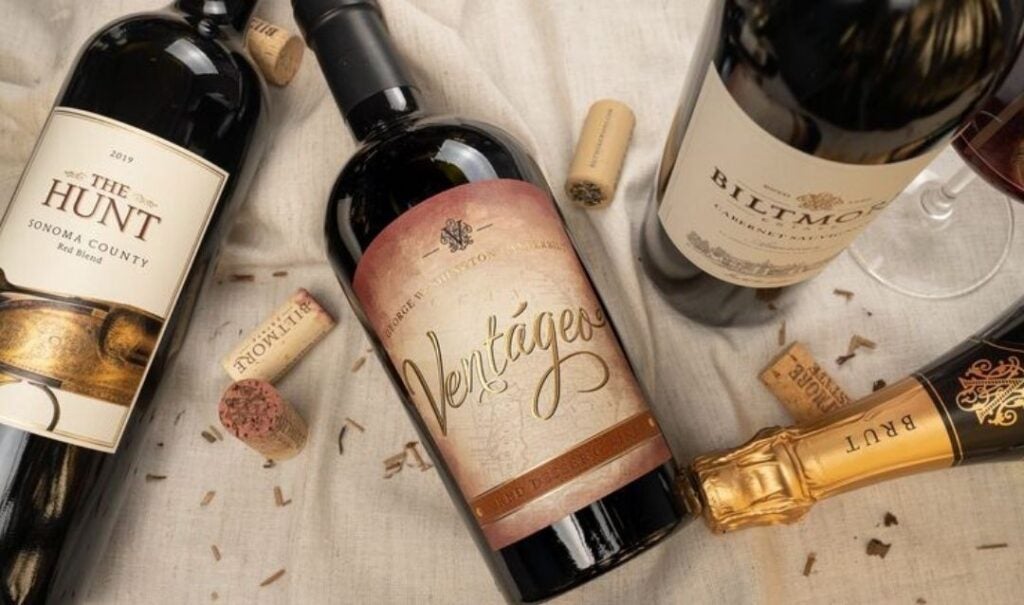
With Ventágeo Red Dessert Wine, Biltmore first became a “port authority” in 2016. Learn more about the process, including the origin of Port wines.

The origin of Port wines

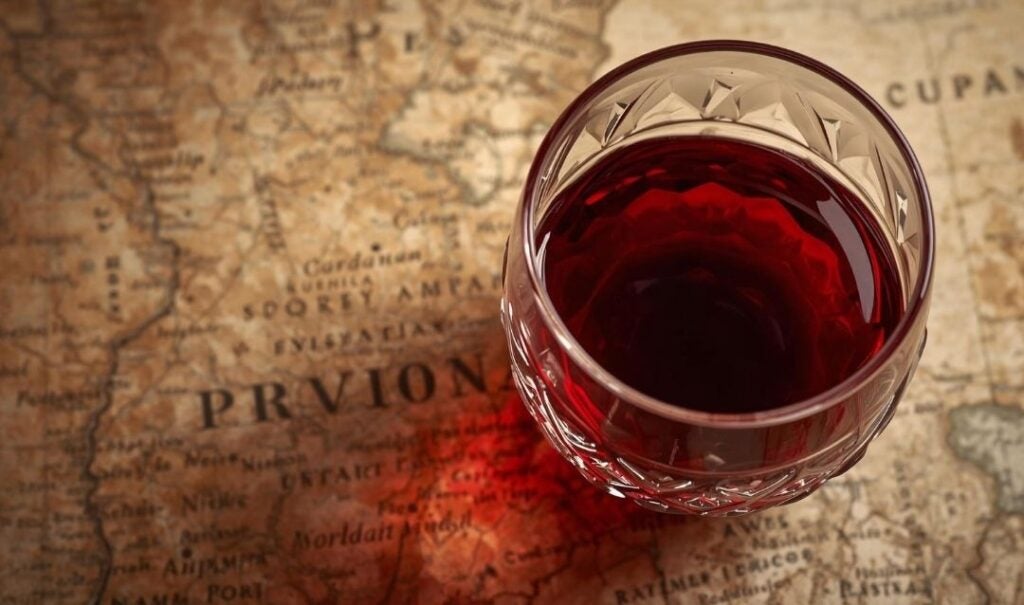
Glass of red wine over an antique map of Portugal.
Port wines originated in Portugal, and the name reflects the protected designation of origin.

As the name suggests, Porto or Port originated in Portugal—a country with a long grape-growing and wine-producing history. Port is a type of fortified wine, similar in some respects to sherry, Madeira, Marsala, or vermouth.

While most fortified wines are created by adding some type of distilled spirit (such as brandy) after fermentation, distilled spirit is added to Port wines during fermentation, which effectively kills the actively fermenting yeast. Without yeast to consume it, residual sugar levels in the wine remain high, providing Port with its characteristically sweet flavor.

As with Champagnes and wines of other protected designations of origin, Port can only be labeled such if it originates in the Douro River region of Portugal.

Biltmore becomes a “Port authority”

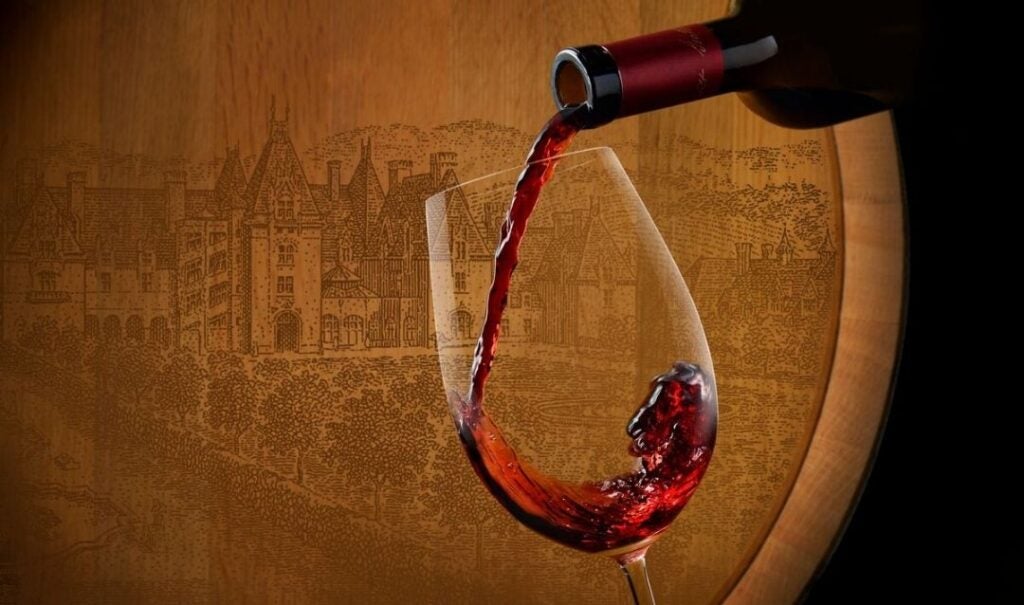
Red wine poured into a glass in front of a barrel with an image of Biltmore House.
Creating a port-style red dessert wine was a lengthy process, but the results are delicious!

In 2016, when our winemakers first began the lengthy process of crafting this style of wine at Biltmore, they knew it would have to be labeled “dessert-style,” which is the legal wording for Ports that are not from the Douro region.

They carefully selected varietals from some of the same West Coast vineyard partners who also supply outstanding fruit for many Biltmore wines.

“Although this new port-type wine could not be labeled Port,” said Sharon Fenchak, Executive Winemaker, “it is handcrafted here at Biltmore from a rich blend of red varietals that give it a similar taste profile to the the traditional Portuguese grapes that would be grown in the Douro region.”

Discover Ventágeo and other fine Biltmore wines

“With Ventágeo, we’ve created a wonderful red dessert-style wine that is barrel-aged, deepening the rich notes of nuts and caramel that you’d expect to taste in a mature port,” Sharon said.

The Ventágeo name combines elements of the Portuguese word for wind with the first letters of George Vanderbilt’s name to create a word that suggests voyage and travel.

Ventágeo honors George Vanderbilt’s journeys around the globe and the treasures—including fine wines—he carefully chose for his private estate. Intense, handcrafted flavor featuring rich layers of sun-dried stone fruit drizzled with hints of caramel and ripe berries makes Ventágeo a stunning finish for any meal or special moment.

Discover all our award-winning Biltmore wines in estate shops, online, or close to home with our Wine Finder.

A Romantic Legacy

William Amherst Vanderbilt Cecil, the younger son of Cornelia and John F. A. Cecil, was born at Biltmore in 1928. He attended schools in England and Switzerland before serving in the British Navy. After earning a bachelor’s degree from Harvard University, William worked as a banker in the international department of Chase Manhattan Bank in New York City.

It was there that he met his future wife Mary “Mimi” Lee Ryan, daughter of textile manufacturer John J. Ryan, Jr., and granddaughter of prominent New York banker, lawyer, and builder James T. Lee. Mimi received her undergraduate degree from Vassar College and her law degree from the University of Michigan. Prior to her marriage, she was an attorney with the Manhattan firm of Cadwalader, Wickersham, and Taft.

A romantic beginning

The Cecils married on October 5, 1957, at St. Vincent Ferrer’s Roman Catholic Church in New York City. The bride wore a gown of white satin with a fitted bodice and a full skirt forming a cathedral train. She carried a lush bouquet of white roses, stephanotis, and English ivy. Her veil was a family heirloom originally worn in 1903 by her maternal grandmother, Margaret Merritt Lee, and also worn by her first cousin, Jacqueline Lee Bouvier, at her 1953 wedding to future U.S. President John F. Kennedy. After the ceremony, a reception was held at the elegant River Club in the city.

In 1959, the Cecils moved to Asheville, North Carolina to manage Biltmore, the grand country estate created by Mr. Cecil’s grandfather George Vanderbilt. Their two children grew up in the family business whose mission is preserving Biltmore as a privately owned, profitable working estate. Today, William Cecil, Jr. serves as Biltmore’s CEO and Diana “Dini” Cecil Pickering is president of the Family Office.

The Biltmore Legacy

Today, estate guests have an opportunity to visit The Biltmore Legacy located in Antler Hill Village and view our Fashionable Romance exhibition featuring family wedding history and heirlooms, including Mrs. Cecil’s beautiful wedding gown, subsequently worn by her daughter-in-law Virginia Cecil and her daughter Dini Pickering.

The Lee Family Veil is also displayed in the exhibition along with a stunning recreation of the gown worn by Mr. Cecil’s mother Cornelia Vanderbilt Cecil and her original satin slippers. This outstanding collection of wedding-related fashion offers a rare glimpse into the lives of the fascinating family that has preserved Biltmore for generations to come.

Biltmore’s Winery: A Tradition of Evolution

Biltmore’s Winery is the most visited in the country, producing about 150,000 cases of wine annually. Our award-winning wines are available on the estate and also distributed across the country and even online.

Let’s take a moment to reflect on how we got here. And as it turns out, the Winery’s tradition of evolution is even older than the Winery itself.

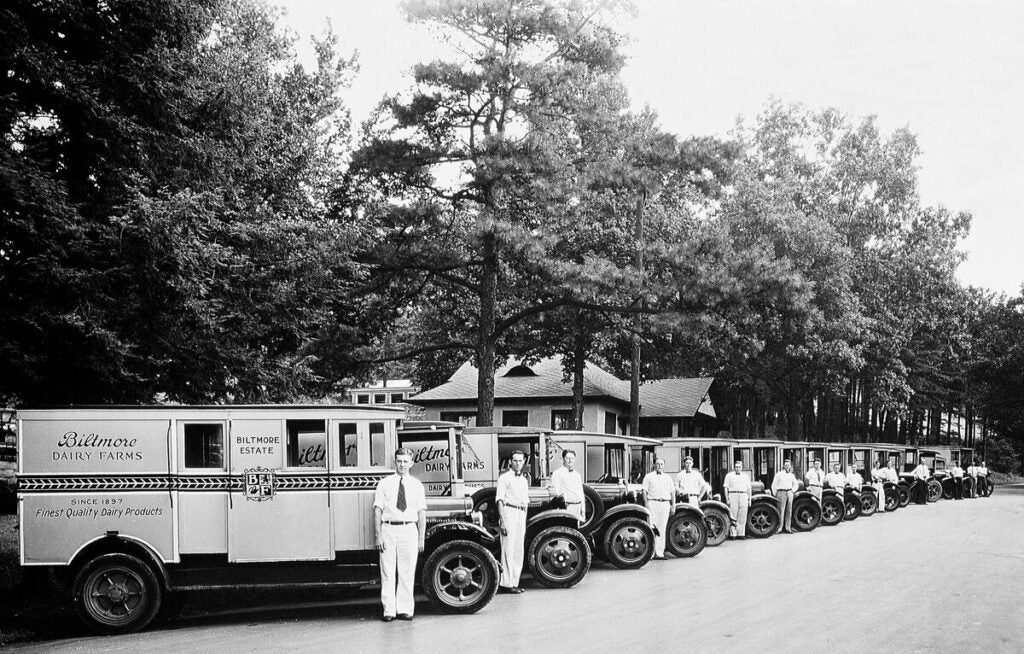
Biltmore Dairy milkman and delivery truck, 1930-1940s

The Days of Biltmore Dairy

Before it became the Winery in Antler Hill Village, the century-old structure was the main dairy barn for Biltmore Dairy. Designed by Richard Howland Hunt, son of Biltmore architect Richard Morris Hunt, and farm manager George Weston, the barn accommodated 140 cows for one of the largest dairy operations in the Southeast.

Biltmore Dairy was the most successful of all of Biltmore’s enterprises, providing the estate with a financial cushion that would see it through George Vanderbilt’s death, two world wars, the Great Depression, and beyond.

After Biltmore House opened to the public in 1930, guests could view the milking rooms and processing areas in the dairy barn, sample the milk, and buy ice cream. Biltmore Dairy was so successful and its products were so well-known that it became an attraction in its own right for estate visitors.

It was around this time that the dairy’s delivery wagons were replaced with trucks and the fleet grew from 30 vehicles to over 400 in just 15 years.

Unfortunately, the market gradually shifted and, like many other smaller, family-run businesses at the time, Biltmore Dairy became unable to compete with larger commercial operations. With the advent of chain grocery stores came a cheaper, more convenient option for consumers to purchase milk, eventually making door-to-door dairy delivery obsolete. In April of 1985, Biltmore Dairy was sold to Pet, Inc.

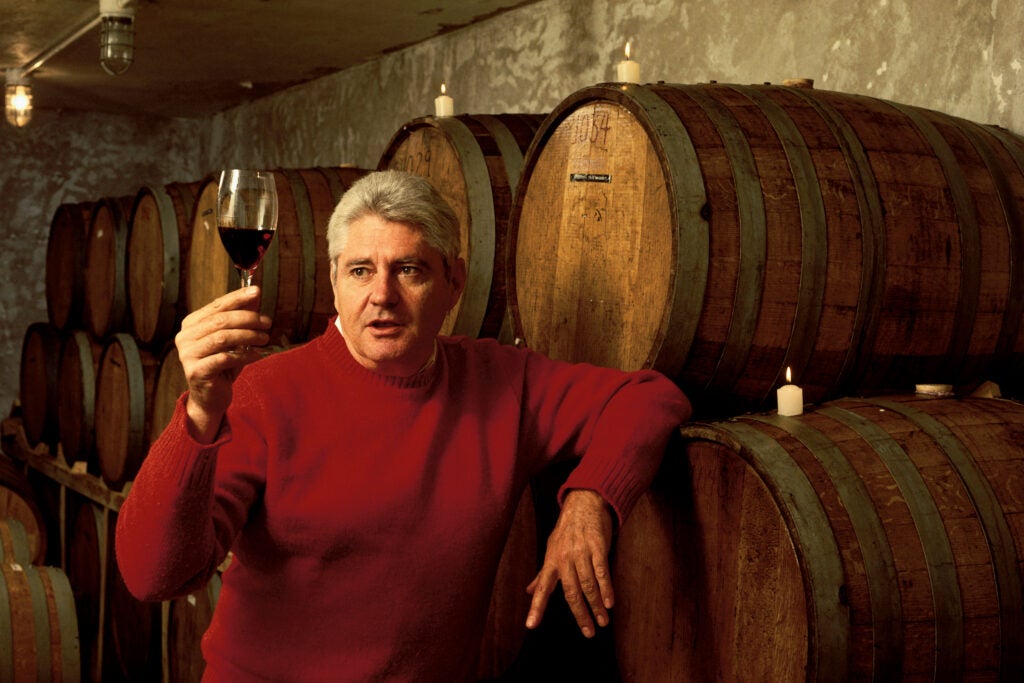
Philippe Jourdain, Biltmore’s first Winemaster

A New Drink, A New Day

Even before Biltmore Dairy was sold, George Vanderbilt’s grandson and Biltmore’s owner, William A.V. Cecil, was asking: “What’s more appropriate for a French château than vineyards and a winery?”

In the early 1970s, he planted the first vines on the property, just below Biltmore House, and bottled the inaugural vintage in the Conservatory basement.

Less than pleased with the product, Mr. Cecil traveled to France in search of expertise. He returned with Philippe Jourdain, Biltmore’s first Winemaster. Together, the pair moved the vineyards to their current location on the west side of the estate and established Biltmore Estate Wine Company.

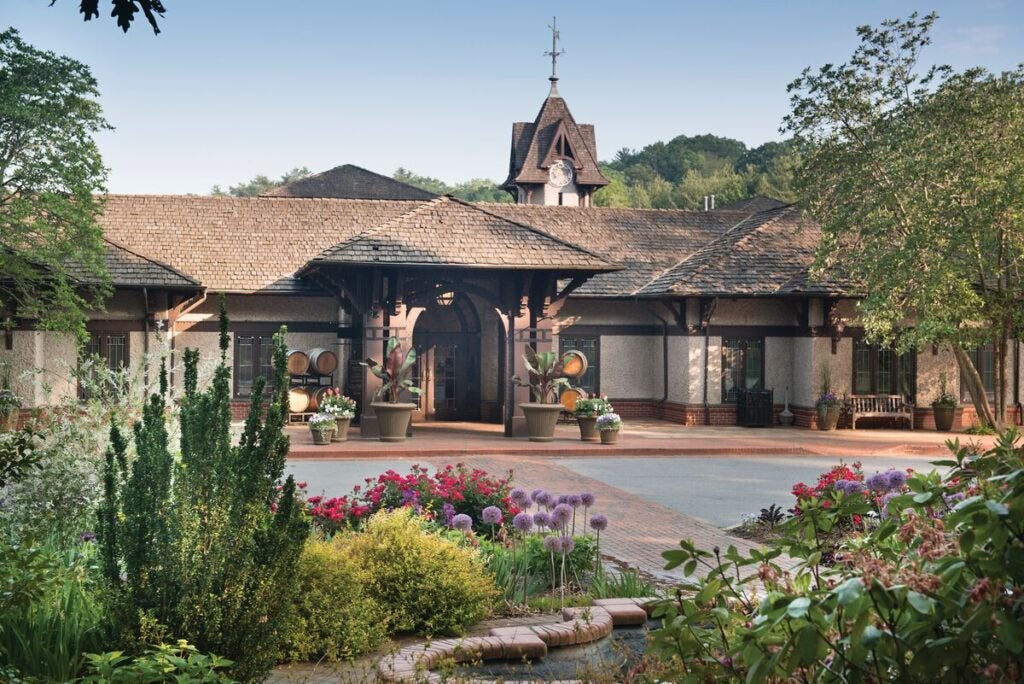
Biltmore’s Winery in Antler Hill Village

Opening Biltmore’s Winery

The conversion of the dairy barn into a state-of-the-art winery began in 1983. Mr. Cecil’s son and Biltmore’s current CEO, Bill Cecil, assumed the leadership role in overseeing the renovation.

In 1985, the Winery opened to the public in what Mr. Cecil called, “the most historic event since my grandfather had opened his estate to his family on Christmas Day ninety years earlier.”

Since the opening of the Winery in Antler Hill Village, we’ve celebrated the release of new Biltmore Wines, expanded our Tasting Room, opened a Wine Bar, and developed tours featuring the Winery’s production facility and wine tastings.

Biltmore’s Winemaker, Sharon Fenchak

The Evolution Continues

French native Bernard Delille joined Biltmore as an assistant winemaker in 1986—making this year his 30th anniversary with Biltmore Estate Wine Company. Bernard was promoted to Winemaster and Vice President of the Winery when Philippe retired in 1995.

Sharon Fenchak joined the team a few years later and now serves as Biltmore’s Winemaker. Her research in grape-growing technology and wine production methods in combination with Bernard’s traditional and artistic perspective proved to be a perfect combination for the Winery. Sales have continued to grow and retail distribution has since expanded.

Indeed, the evolution continues, while at the same time, throughout the dynamic history of the Winery, Biltmore’s winemaking philosophy holds: “To keep each wine true to varietal character, food-friendly, and consistent from vintage to vintage.” 

We invite you to enjoy the fruits of our labors by visiting our estate winery during your next visit, shopping for our award-winning wines online, or finding a retailer near you that carries Biltmore Wines.

Looking Back at the Flood of 1916

While many of the events in Biltmore’s long history are joyous, some are solemn occasions that have shaped the estate and our community

On September 27, 2024, heavy rain and high winds from Tropical Storm Helene swept through Western North Carolina, causing record-level flooding throughout the region. This natural disaster echoes the Asheville flood of July 16, 1916, when water reached historic levels far beyond the banks of the Swannanoa and French Broad Rivers, causing widespread damage at Biltmore and throughout the western end of the state.

As we reflect on the historic flood of 1916, we invite you to discover the stories that have shaped our history and inspire our resilience today.

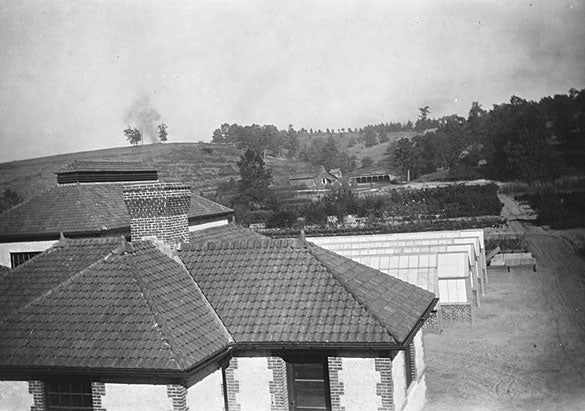
Archival image of Biltmore greenhouses during the 1916 flood.
Biltmore Greenhouses, 1916. Courtesy of the National Park Service, Frederick Law Olmsted National Historic Site.

The End of an Era

Prior to the flood of 1916, Biltmore’s Nursery was one of the top nurseries in North America. Founded in 1889, it was established to supply the wide variety of trees, shrubs, and other ornamental plants that Frederick Law Olmsted required to complete the estate’s industrious landscape design.

It grew to be a beacon within the horticultural world as it opened to public buyers and supplied customers across the United States with unsurpassed variety, quantity, and quality of ornamental plants. The nursery also contributed to George Vanderbilt’s vision of a self-sustaining estate, and provided income at a time when the estate was still under construction.

Archival image of people looking at a flooded field at Biltmore.
Swannanoa River cutting off Biltmore from Asheville, 1916. North Carolina Collection, Pack Memorial Public Library, Asheville, North Carolina.
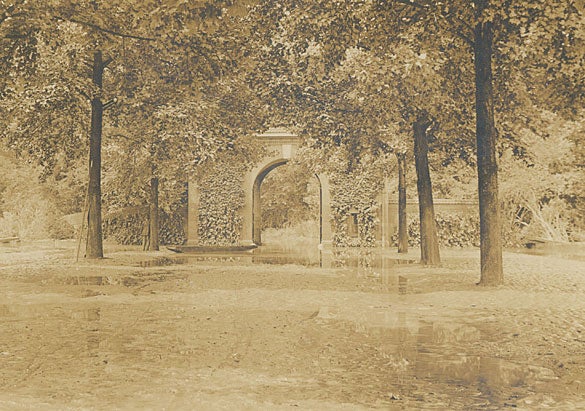
Archival image of the Lodge Gate at Biltmore.
Biltmore’s Lodge Gate, 1916. North Carolina Collection, Pack Memorial Public Library, Asheville, North Carolina.

Uncontrollable changes

On March 6, 1914, the estate experienced a crushing loss with the untimely death of George Vanderbilt. Left with a large estate to manage, Mrs. Vanderbilt was already considering downsizing various estate operations, including the nursery. She was also pondering the donation of the Biltmore Herbarium, a subsidiary of the nursery, to a small local educational institution.

However, before decisions could be made and implemented, the flood of 1916 provided the last word. 

The ruin from the flood was so massive that it closed the doors of the nursery’s large-scale commercial operation, destroyed three-fourths of the Biltmore Herbarium, and ruined many rare botanical volumes that were part of the estate’s botanical library. 

Chauncey Beadle, estate superintendent and head of the Biltmore Nursery, wrote after the flood that “We are heavy losers, something like 85% of our nursery stock having been destroyed.”

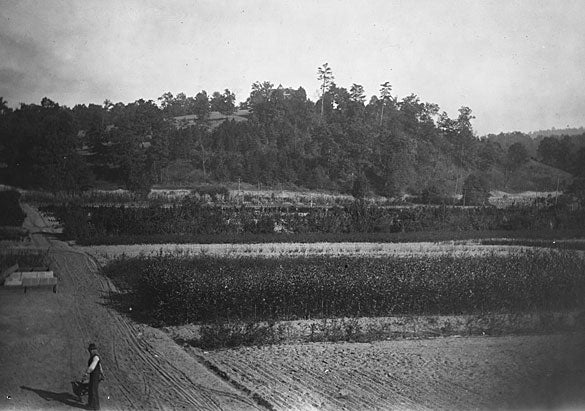
Archival image of the 1916 flood at Biltmore.
Flooded field, 1916. Courtesy of the National Park Service, Frederick Law Olmsted National Historic Site.

A Legacy withstanding the test of time

While the flood’s damage was permanent, the legacy of the Biltmore Nursery was timeless. The specimens grown at Biltmore before the flood found homes on the estate’s grounds and outside of Biltmore’s gates thanks to the nursery’s commercial success. 

In particular, the North Carolina Governor’s mansion in Raleigh received a donation of various shrubs and plants in 1898 for the beautification of the Executive Mansion Square. Then in 1908, a shipment of roses and sequoia trees were delivered to Dr. Booker T. Washington at what is now Tuskegee University.

Various plants and trees were shipped across the country and overseas before the flood, and continue to thrive at botanic gardens, public parks, universities, and private landscapes. Beadle and Edith Vanderbilt arranged for the surviving parts of the Biltmore Herbarium and botanical library to be salvaged and donated to the Smithsonian Institution.

While the flood may have ended the business side of the nursery, the landscapes at Biltmore and beyond serve as a living testament to the vision and business acumen of Frederick Law Olmsted, Chauncey Beadle, and George Vanderbilt.

Best-kept secrets: Biltmore’s alley gardens

With acres of vivid colors and lush plantings, the gardens of Biltmore are so breathtaking that some guests never venture inside the Conservatory during the summer months. According to Jordana Chalnick, Conservatory Horticulturist, however, those who stay outside are missing out on some very special displays in the “back alleys” of the Conservatory.

A working conservatory

“Biltmore’s Conservatory was originally designed to be a functional workspace for growing and nurturing plants as well as an indoor garden space for guests,” said Jordana. “We continue to use it for both purposes today, and we also create intriguing displays that draw visitors through the Conservatory and into the alleys behind it.”

Jordana has been with Biltmore since 2006, putting her horticulture degree to use first in the Azalea Garden and then in the Conservatory. She became Conservatory Horticulturalist in 2013 and has been instrumental in creating the displays that make the Conservatory a must-see during any Biltmore visit.

Alleys of the Conservatory

“In the mid-1990s, there were just a few hanging baskets and some of the larger trees in the alleys,” Jordana said. “Gradually, the staff began lining the alley walls with plants and then over the years adding under-plantings to the larger pots. The alleys have definitely evolved from what they were initially to the more designed and elaborate displays we do today.”

Heating up and keeping cool

Jordana noted that there are actually two alleys—one between the cool room and the sitting room and one between the hot room and the sitting room.

This year, the cool alley, which was designed by Conservatory Gardener Kathryn Marsh, features fragrant plants that create a shady respite from the sun during the hot summer months. Having all the different fragrances makes it a nice space in which to take break and relax for a while.

The hot alley features water plants using dwarf versions of many of the species in the Italian Garden.

“I’ve always liked the idea of displaying the water plants in a way that guests can have closer access to them than they do in the Italian pools,” Jordana said. “I took lots of inspiration from pictures of gardens in Bali and Thailand where they incorporate water plants seamlessly into the landscape as opposed to having a special area for them.”

Alley installation

As far as installing the alleys, the Conservatory crew does as much as possible ahead of time. They received most of the cool alley’s fragrant plants from Florida in March, and the dwarf lotus plants for the hot alley were stored in the Italian Garden pools until early June.

Lotus Flower in Italian Garden Pool

“We already have a general idea of which plants will go in which alley, so we will generally load up a truck load for one alley, haul it up and unload it,” said Jordana. “We have one reserve worker who helps us and we definitely get a lot of help from everyone in Historic Gardens, since our crew is pretty small and installing the alleys is a huge project.”

Visit now

Hibiscus Flower

Now that the alley plantings are installed, the Conservatory crew will maintain them throughout the summer, watering, grooming and deadheading as needed. The alleys will stay in until around mid-September when the plants need to start transitioning back to the greenhouses for winter.

“I love my job,” Jordana said, “because I get to use my creativity in designing displays as well as using all of my horticultural knowledge to keep plants happy and healthy.”

6 Biltmore Rooms Named After Artists

Vanderbilt was an avid print collector who purchased more than 1,400 prints in his lifetime. Not only did he have personal friendships with leading artists of the era, he even named some of the rooms in his home after artists where their work was on display. Below are just a few of the rooms inside Biltmore House with names inspired by artists and how guests can see these on their tour.

Claude Room

This room was named after one of George Vanderbilt’s favorite artists, the French painter Claude Lorrain. One of the masters of 17th-century landscape painting, Claude presented nature as harmonious, serene, and often majestic. The prints on this room’s walls are after Claude Lorrain’s paintings. (See it on the winter tour rotation.)

The striking wallpaper in the Claude Room, reproduced from the original, is the same pattern that is used in the Damask Room, but in a different color palette.

Earlom Room

This room was named for the English engraver Richard Earlom. Vanderbilt purchased most of the prints in this room and in his collection from H. Wunderlich and Company in New York. (See it on the Upstairs-Downstairs tour.)

Raphael Room

Highly detailed engravings after the Italian Renaissance artist Raphael Sanzio d’Urbino add interest to the room’s understated décor. (See it on the Upstairs-Downstairs tour.)

Morland Room

Named for the English painter George Morland, this bedroom attracts attention with exotic Indian-style fabrics. The bed draperies are exact reproductions of hand-painted originals that adorned the Italian villa where George and Edith Vanderbilt honeymooned in 1898. (See it on the summer tour rotation.)

Van Dyck Room

Decorated in the Colonial revival style of the late 19th century, this room features prints after paintings by the 17th-century artist Anthony Van Dyck. (See it on the summer tour rotation.)

Watson Room

This room was named for the engraver James Watson. A close-up of his 1769 mezzotint after a painting by Francis Cotesand is the top photo in this blog. Fun fact: This room is the only bedroom with twin beds. (See it on the summer tour rotation.)

Top 10 Tips for Custom Framing & Preserving Special Photographs

It’s wedding season—the perfect time to consider custom framing your beautiful photographs so you can enjoy them for years to come. From glass recommendations to matting and moulding, we’ve got the Top 10 framing tips (thanks to Larson-Juhl framing experts) to help you preserve and present your special memories!

Top 10 Framing Tips

1. Choose the right mat
Many people today look at mats as an opportunity to add color to the frame design, but originally mats were neutral in color and used to provide visual relief between the art and its surroundings. Regardless of color, think big: More generous mat borders enable you to focus on the art much more easily. And make sure to use acid-free mat board.

2. Consider wider frame moulding
If a frame design doesn’t include a mat, the frame size may need to make up for it. A wider frame may still be smaller than the overall picture size would have been with a mat, but it helps art look more interesting and important.

3. Use conservation-grade glass or acrylic
Conservation-grade glazing protects art from most of damage caused by harmful UV light rays. By investing a bit more in protective glazing, you will maintain the integrity of your framed art and increase its longevity.

4. Double or triple mat layers all can be the same color
Many people just assume if there are multiple layers of matting used, each layer needs to be a different color. Actually, using the same color for all layers can simplify the design and keep attention focused on the art.

5. Use clear glass for bold images and non-glare glass for muted images
Clear finish (shiny) glass or acrylic helps to maintain sharp lines and shapes, bold colors and fine details. For soft, muted images, use non-glare glass or acrylic. Non-glare (also called Reflection Control) glass has a soft finish that diffuses details and colors. It looks great when the art itself seems intentionally soft in focus or muted in color.

6. Be creative
Many pieces of art look great when framed in a moulding style that’s unexpected. Some types of contemporary art look good in a traditional or rustic frame, and an ornate frame sometimes can add just the right finishing touch to a piece of folk art.

7. Pick the right contrast
Black and white provide the highest degree of contrast of any colors, so a black-and-white photo looks best with a high-contrast frame design. Images with softer colors and contrast look best in lower-contrast frame and mat combinations.

8. Consider bottom-weighting a mat
A bottom-weighted mat is one where the border below the art is wider than the borders on top and sides. Logical reasons to bottom-weight include when the lower half of the art is darker or contains larger shapes or patterns than the upper half. You may also choose it for a classic look or for valued art that you do not want to cut down.

9. Group images
When placing more than one picture in a frame, a multiple opening mat provides the means to bring them together. It is common to use a wider border around the outer edges than the amount of space used between images. When working with more than a few pieces, it can add interest to use different mat opening shapes.

10. Add depth and variety
Special details like extra-deep, 8-ply mat boards and narrow, ornamental frames called fillets that work inside the primary frame add layers, making certain designs more dynamic and memorable.

Explore Our Favorite Outdoor Rooms

Every season offers a wonderful reason to explore our favorite outdoor rooms at Biltmore, but summer is an especially perfect time to do so.

Frederick Law Olmsted

Known as the “father of American landscape architecture,” Frederick Law Olmsted had definitive ideas about landscape design.

You can see many of his innovative ideas in New York City’s Central Park and here at Biltmore, which was his last professional project before his death in 1903.

Enjoy the outdoors, by design

View of the Approach Road in spring
The Approach Road, which Olmsted designed to achieve a “sensation passing through the remote depths of a deep forest,” only to have “the view of the Residence, with its orderly dependencies, to break suddenly, fully upon one.” Photo credit: The Biltmore Company.

For the magnificent estates he landscaped, Olmsted preferred longer-than-usual approach drives and separate garden spaces or “outdoor rooms” that were distinct from one another with no blending of styles.

The methods Olmsted used for creating special spaces are very noticeable in spring and when the gardens and grounds begin to bloom with color.

Explore our favorite outdoor rooms

When Biltmore employees were asked to share their favorite outdoor rooms around the estate, their answers were a tribute to all that Olmsted envisioned to enchant the Vanderbilts and their guests more than a century ago.

Italian Garden

Italian Garden at Biltmore
The Italian Garden is spectacular in summer

Parker Andes, Director of Horticulture, has a favorite spot tucked away in the Italian Garden.

“There’s a terra cotta cherub fountain in the last little turf area near the end of the garden,” said Parker. “Most people miss this treasure because they don’t walk all the way down there.”

Spring Garden

The Spring Garden at Biltmore
Some of the earliest blooms at Biltmore appear in the sheltered Spring Garden

Cathy Barnhardt, former Floral Displays Manager for Biltmore, is now retired and enjoying the estate as an Annual Passholder.

“The Spring Garden is like a little valley that opens up off the beaten path. The grass gets green there first and flowers bloom early,” said Cathy. “It’s a great place to spend time with your family.”

Azalea Garden

Kids in Biltmore's Azalea Garden
Guests of all ages love discovering Biltmore’s “outdoor rooms” like the Azalea Garden

Another special location mentioned by several staff members is a bench at the top of the Spring Garden. From this vantage point, you can look down into the Azalea Garden and also have a view of the distant mountains.

Another not-to-be-missed favorite outdoor room is the Azalea Garden with all its varieties, colors, and sweet fragrances of azalea to enjoy.

Explore our favorite outdoor rooms
Stone steps in the Azalea Garden invite further exploration

“Although the Azalea Garden wasn’t part of Olmsted’s original plan, it makes perfect use of a wooded space,” noted Parker. “The blooms are spectacular in late spring, so be sure to take time to walk down the stone steps—another technique Olmsted used to divide outdoor rooms—and stroll down the path there, noticing the stream lined with wild flowers and unusual conifers.”

Bass Pond Boat House

Boat House at the Bass Pond is a hidden gem of Biltmore
The view of the Bass Pond from the Boat House is worth the walk!

Below the Azalea Garden, Hope Wright of A Gardener’s Place–one of the charming shops on the estate–loves walking down the path to the Bass Pond.

“I stop on the bridge going toward the Boat House and sit on the bench,” Hope said. “This is a favorite spot of mine in the spring and summer as I look back upon the stunning beauty I have just witnessed.”

Plan your getaway today!

Family activities at Biltmore
Explore our glorious gardens and grounds all year long!

Ready to explore our favorite outdoor rooms and discover which ones you like best?

Consider becoming an Annual Passholder so you can return and discover something new in every season.

Solving a Mystery in the Kitchen Pantry

Solving a mystery in the Kitchen Pantry at Biltmore took some detective work, but our Museum Services staff finally cracked the case!

“Among the many place settings of china in the Biltmore collection, one set had remained a mystery for many years,” said Lori Garst, Curatorial Assistant.

Solving a mystery in the Kitchen Pantry
A cup, saucer, and plate from the collection of unidentified china

While the set was often referred to as “the Christmas china” because it was used during a 1931 holiday party, or “the employee china” because it was later used by staff members, the origin of the china—and its original purpose in Biltmore House—remained unclear.

Cup, saucer, and teapot featuring George Vanderbilt's monogram
George Vanderbilt’s elegant white china with burgundy and gold trim. It was manufactured by Minton and Spode-Copeland, and used for everyday occasions.

“Most of the china in Biltmore House was chosen by George Vanderbilt,” Lori said. “He selected an elegant white china with a burgundy and gold pattern, manufactured by both Minton and Spode-Copeland. It features his monogram and was used every day for family and guest meals.”

Cornelia Vanderbilt’s china matches her father’s pattern but includes her own CSV monogram.

China featuring Cornelia Vanderbilt's monogram
While Cornelia Vanderbilt’s china closely matches the pattern her father selected for use in Biltmore House, their monograms distinguish one set from another

“We know that Edith Vanderbilt ordered Cornelia’s china in 1923,” said Lori. “And Mrs. Vanderbilt requested that Cornelia’s monogram be in the same style as her father’s.  I think it is sweet that her service blended in with the style her father had chosen.”

But what of the mysterious china collection on the shelves of the Kitchen Pantry in the Basement?

Museum Services began to look for clues about its history. While not as fine as the monogrammed Vanderbilt china, the gold-trimmed white pattern rimmed in crisp navy was definitely elegant and the amount of it suggested it had been purchased with a large number of people in mind.

Solving a mystery in the Kitchen Pantry of Biltmore House
Trimmed in gold and rimmed in navy, this china is elegant, but more sturdy than the monogrammed family china in the collection

“We began with the manufacturer’s mark on the bottom of each piece,” said Lori. “Kniffen & Demarest Co. manufactured hotel and steam ship supplies, so the china was well-made and rather sturdy to stand up to use by guests and passengers in public settings.”

Biltmore conservator shows manufacturer's mark on the bottom of a china saucer
A conservator shows the Kniffen & Demarest Co. name on a piece of the so-called mystery china

While Museum Services was researching details for our Fashionable Romance: Wedding Gowns in Film exhibition, they finally discovered written references to the china in conjunction with Cornelia Vanderbilt Cecil’s wedding. 

“This set was also sometimes referred to as ‘the wedding china,’ but we never knew which of its three names was correct until recently,” said Lori. “The pieces came together at last, and we realized that this was the china that had been ordered for the buffet at Cornelia Vanderbilt and John Cecil’s wedding breakfast.”

After the ceremony at All Souls Church in Biltmore Village, the wedding guests and additional reception guests (500 people were invited to the ceremony and reception; another 2500 were invited only to the reception) arrived at Biltmore House.

John and Cornelia Cecil wedding party at breakfast in the Winter Garden of Biltmore House
John and Cornelia Cecil and their attendants at the wedding breakfast in the Winter Garden of Biltmore House

The newlyweds and their attendants were served at a table in the Winter Garden, and all the other guests enjoyed a buffet in the Banquet Hall, which featured this china.

As the years passed, the Kniffen & Demarest china was still used, but its original purpose was forgotten.

Today, it’s stored in the Kitchen Pantry where it receives the same care and attention as all the other china in Biltmore’s collection.

Enjoy your own Vanderbilt-inspired china

China pattern based on an original Sèvres set used by the Vanderbilt family.
Porcelain tea set from the Vanderbilt Service

Whether you prefer a tea service or an entire place setting, this beautiful porcelain serveware is based on a Sevres pattern, circa 1888, that the Vanderbilt family once used at Biltmore. The original is on display in the Oak Sitting Room, but you can now enjoy the reproduction set in your own home.

Carrying on a Wedding Tradition: The Lee Family Veil

Please enjoy this archived content. Our Fashionable Romance exhibition was on display from February 2016 through July 2016.

Text panel photos of Jackie Onassis and John F Kennedy wedding and Mary Lee Ryan and William Cecile wedding; both women wore the same veil. On exhibition in Legacy in Antler Hill Village.

A Family Heirloom

The story begins in 1903, when Margaret Merritt Lee wore the exquisite rose point lace veil when she married James T. Lee, a prominent New Yorker. Some 50 years later, her granddaughters Jacqueline Lee Bouvier and Mary Lee Ryan continued the tradition at their own weddings.

In 1953, Jacqueline Bouvier married then-Senator John F. Kennedy; her first cousin, Mary Ryan, wore the veil in 1957 when she wed William A.V. Cecil, grandson of George Vanderbilt. The original veil will be on display February 12–July 4, 2016 as part of the Fashionable Romance exhibition at The Biltmore Legacy in Antler Hill Village & Winery.

Wedding gown and veil of Mary Lee Ryan Cecil.

The future first lady and fashion icon’s wedding gown had a tremendous impact on bridal fashion. InStyle magazine ranked Jacqueline Bouvier 6th on a list of best-dressed celebrity brides of all time for her “super-romantic ensemble.” Her intricate ivory silk taffeta gown featured a portrait neckline, fitted bodice, and bouffant skirt embellished with bands of 50 yards of flounces. A tiara of lace and orange blossoms anchored the Lee family veil.

Text panel in Legacy at Antler Hill Village with archival photo of Cornelia Vanderbilt's wedding.
Text panel in Legacy at Antler Hill Village with archival photo of Cornelia Vanderbilt’s wedding.

Edith & Cornelia’s Shared Veil

There’s also another wedding veil with Vanderbilt family connections. Edith Stuyvesant Dresser wore her mother’s Brussels rose point lace veil at her 1898 wedding to George Vanderbilt; the veil was also worn by her three sisters at their ceremonies. In 1924, the same veil was part of Cornelia Vanderbilt’s bridal attire when she wed the Honorable John Francis Amherst Cecil. You can see a reproduction of Edith and Cornelia’s veil on display in The Biltmore Legacy as part of the Fashionable Romance exhibition.

As for the Lee veil, brides in the extended family continue to keep the tradition by wearing it at their weddings, including Mary Lee Ryan Cecil’s daughter and daughter-in-law.

Recreating Cornelia Vanderbilt’s Wedding Dress

Go behind the scenes with the talented designers of Cosprop London as they recreate Cornelia Vanderbilt’s wedding dress to be displayed for this special exhibition at Biltmore.