Exploring the Butler’s Pantry

Welcome to the central nervous system of Biltmore House: The Butler’s Pantry. As its name suggests, this space was the main work area for the Biltmore House butler and his staff of footmen and it played a critical role in each and every meal enjoyed by the Vanderbilts and their guests.

Tip: As part of The Biltmore House Backstairs Tour, guests can enjoy the Butler’s Pantry, along with other rarely seen domestic-staff areas throughout Biltmore House.
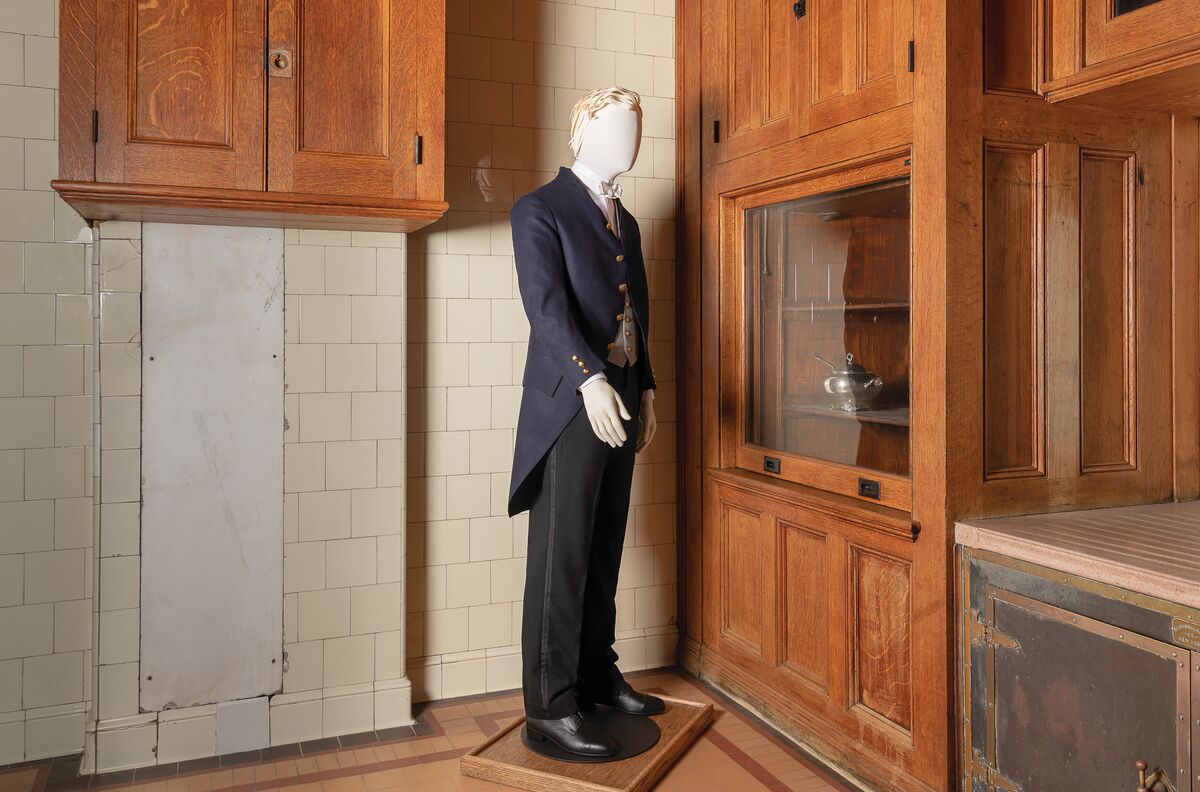
Biltmore House footman
A footman stands by the Butler Patry dumbwaiter as displayed in Biltmore’s 2019 exhibition, “A Vanderbilt House Party.”

At Your Service

It was the primary responsibility of the Biltmore’s butler to ensure that all meals, including afternoon tea, were served smoothly and effortlessly, as the performance of the head butler and his staff was a direct reflection of the Vanderbilts.

Strategically located on the first floor between the Kitchen and the Breakfast Room and directly above the basement kitchen, the Butler’s Pantry is a room that was constantly abuzz with staff activity. Meals were prepared in the kitchen and would arrive in the Butler’s Pantry via dumbwaiters and floor maids, ready to be plated and delivered to the family and guests.
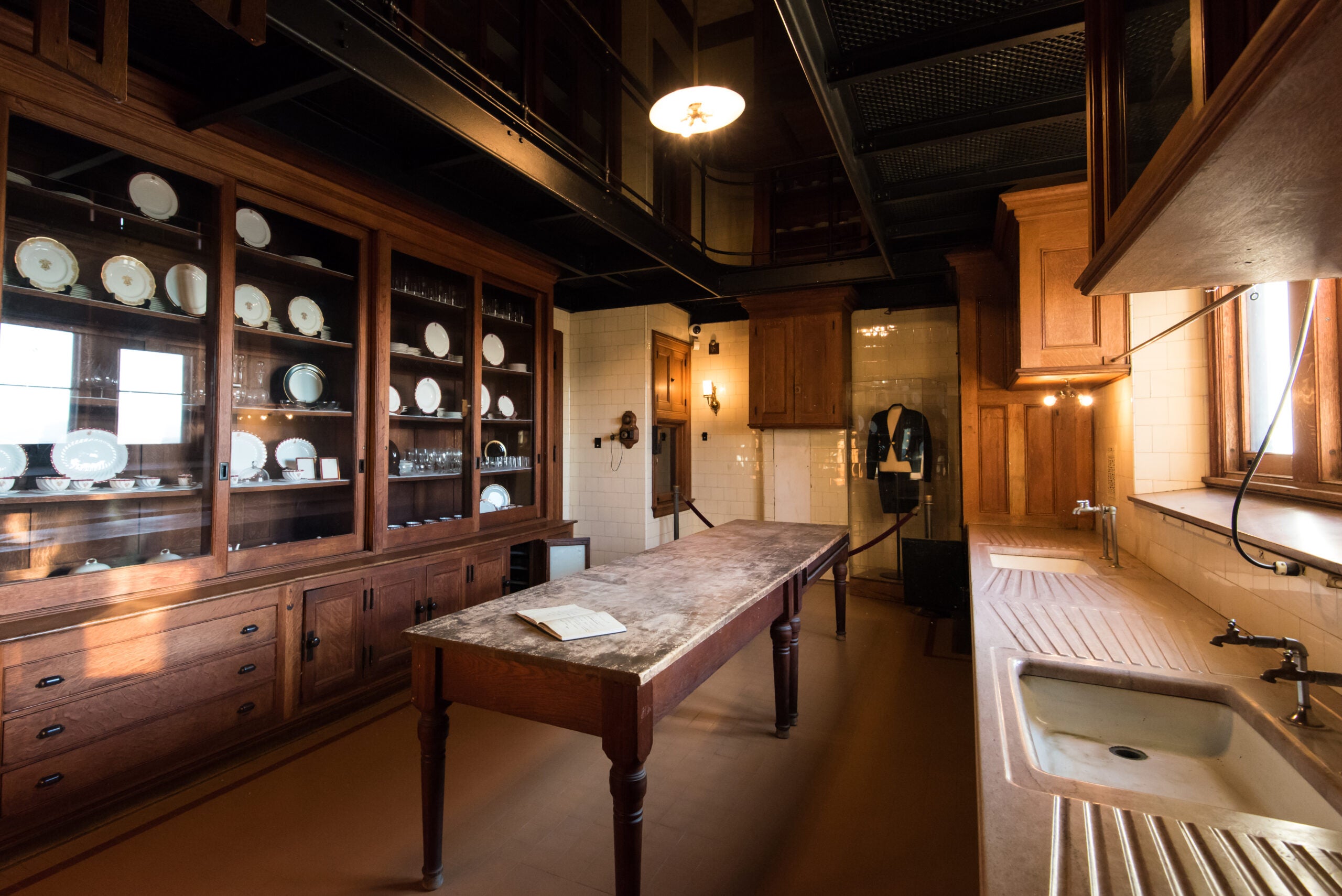
The Butler’s Pantry, as seen on The Biltmore House Backstairs Tour
A look inside the Butler’s Pantry of America’s Largest Home.

Not only was the Butler’s Pantry the central hub for meal preparations, it was also the primary point of contact between the butler and guests.

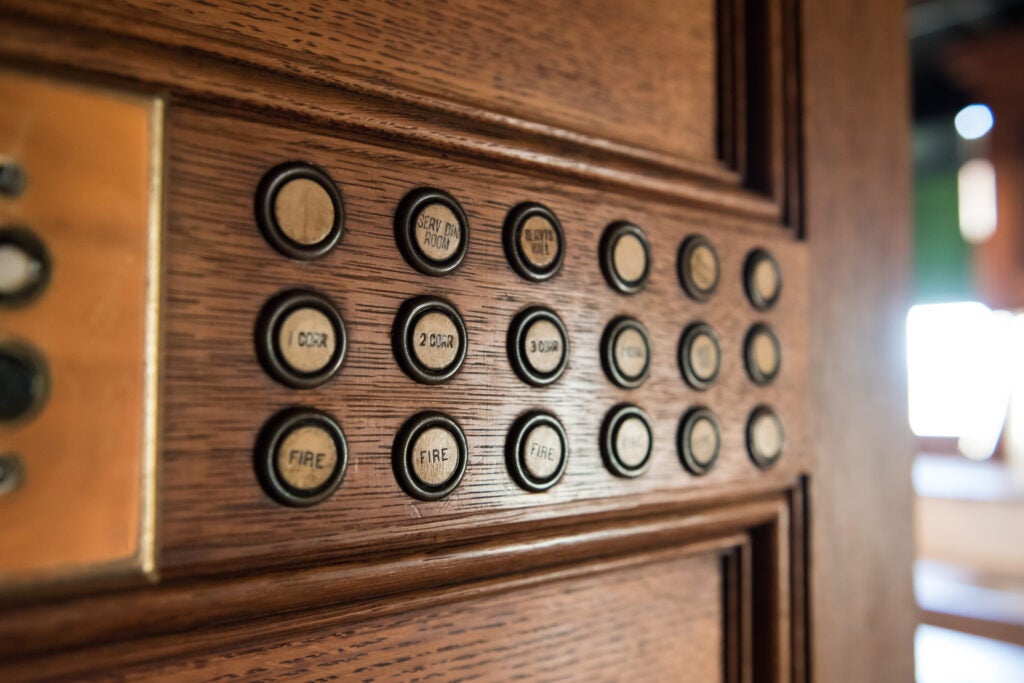
A visit to Biltmore offered guests anything their hearts desired, all at the push of a button. When a guest had a request, they simply pressed a button in their room, and a bell would ring on the state-of-the-art annunciator outside the Butler’s Pantry. The butler or a servant on duty in the Butler’s Pantry would attend to the guest themselves, send a nearby servant, or call a servant on the appropriate floor to see what is needed, then call down to the Butler’s Pantry so that the task could be delegated to the appropriate person. Like a well-oiled machine, the request would be fulfilled and the butler would be on to the next. 

Expand
Detailed view of call buttons in the Butler’s Pantry
Expand
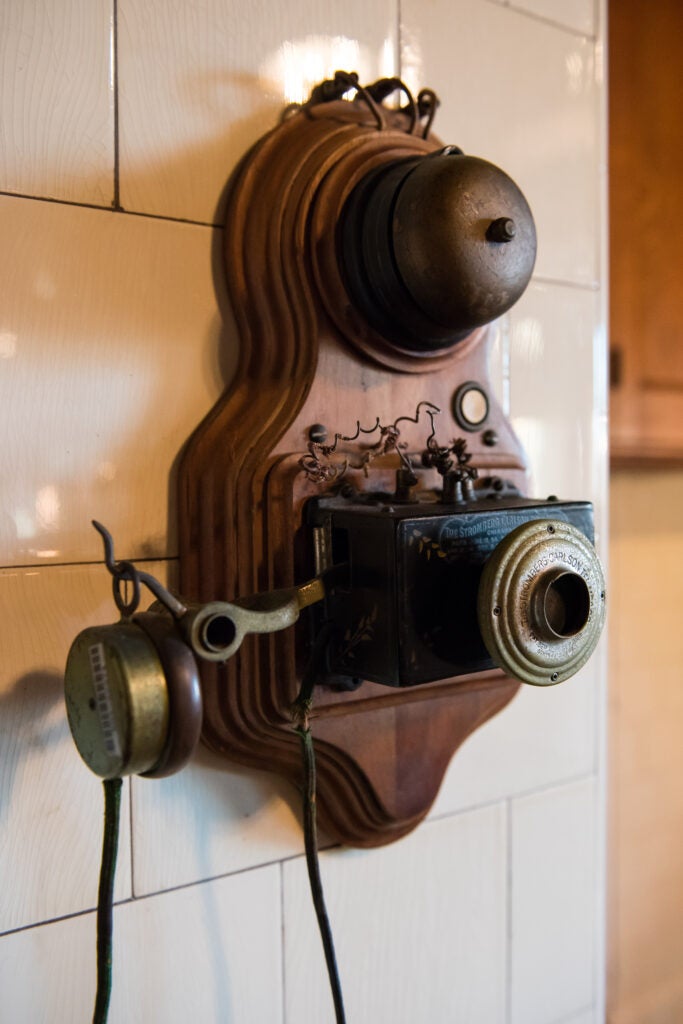
Detailed view of the telephone in the Butler’s Pantry
Expand
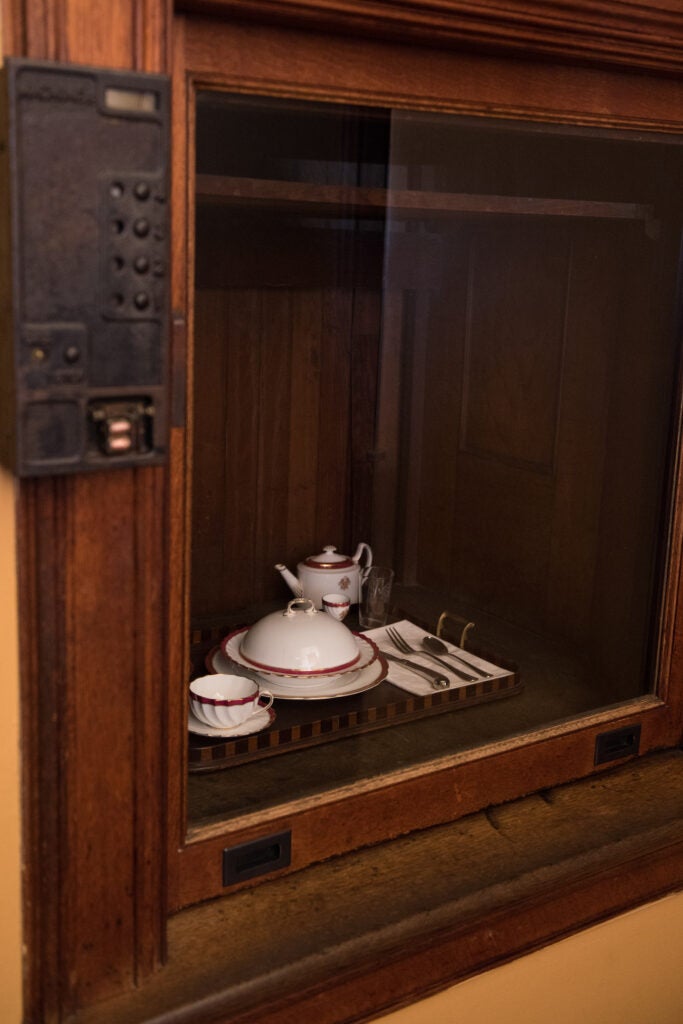
Detailed view of a dumbwaiter in the Butler’s Pantry

Technology in the Butler’s Pantry

Managing a Gilded Age mansion the size of Biltmore was no easy task, and the house featured the most cutting-edge technology of the time to assist the domestic staff in their daily duties. In many ways, Biltmore functioned like a luxury hotel, and these technological features helped ensure that all operations ran smoothly and quickly.

Below are some of the Biltmore House’s most notable technologies:

  • Annunciator System: The Annunciator System (or servant call bell system) allowed staff to respond to guest calls from virtually any room in Biltmore House. Service was literally available at the push of a button.
  • Dumbwaiters: The Butler’s Pantry features two dumbwaiters used to deliver food from the basement kitchen and pantry: one electric and one manual. (The electric dumbwaiter had a lifting capacity of 250 pounds and an operating speed of 100 feet per minute.)
  • Refrigerators: In addition to the cold storage refrigerators in the basement, the Butler’s Pantry housed small refrigerators to keep milk, butter, and other dairy products cool until served.
  • Warming oven: Conversely, an electric warming oven was used to heat plates and serving dishes, as well as keep small portions of food warm prior to serving.
  • Telephone: The telephone was part of Biltmore’s in-house communication system manufactured by Stromberg-Carlson Telephone Manufacturing Company in Chicago.

Take a Look Around:

Click play and drag your mouse for a 360-degree view of the Biltmore House Butler’s Pantry main level.

(Please note: 360-degree video format is not currently supported by Internet Explorer or Safari. For best results, please view in Google Chrome or on your mobile device. We apologize for any inconvenience.)

Biltmore’s Landscape and Forest Historian

Bill Alexander, Biltmore’s Landscape and Forest Historian, retired in 2018 after 40 years in the fields and forests at surrounding America’s Largest HomeÂŽ.

He assures us, however, that he’s never more than a phone call away and he continues to work on projects that will keep him returning to Biltmore Estate and its magnificent Blue Ridge Mountain “backyard!”

Bill Alexander examines leaves at BiltmoreBill Alexander amidst the landscape Frederick Law Olmsted designed for Biltmore

Early experience with Biltmore

His love of Biltmore Estate, located in Asheville, NC, began in childhood, growing up close to the main entrance of the property. Some of his earliest memories are of seeing deer in the surrounding woods and visiting Biltmore’s calf barns.

“As a child, I didn’t know that Frederick Law Olmsted designed the landscape, but it had me from the start,” Bill said. “I loved the wilder areas. It’s where I developed my interest in trees and flowers.”

Bill Alexander unrolls a copy of Frederick Law Olmsted's map

Bill keeps a copy of an original Olmsted map with him on the estate for reference

Becoming a landscape and forest historian

In 1978, Bill met Biltmore’s general manager who encouraged him to consider the estate as a career option. After completing his forestry and wildlife management degree, Bill became one of two education horticulturists for Biltmore.

He rose to become the Conservatory and Walled Garden manager. Later, he also oversaw landscape and forest management, and eventually became the estate’s landscape curator and historian.

Bill Alexander indicates a possible house site at Biltmore

The possible location of an original house site near the Bass Pond

The importance of Olmsted

Bill also developed a deeper appreciation for Olmsted, which led to research trips to study the landscape architect’s work and papers at other locations—and a lot of sifting through materials in Biltmore’s archives.

Bass Pond dam and spillway at BiltmoreOlmsted’s design for the Bass Pond dam and spillway are still functional today

“The more I researched Olmsted the more I realized how important Biltmore was in his life. We needed his notes and plans to help others understand how to stay true to his designs for Biltmore, so I helped develop guidelines that we use today,” said Bill.

Future projects

Although he’s enjoying spending more time with his family—which now includes eight grandchildren—Bill is still working on several book ideas related to Biltmore’s history.

“After completing a book on the story of George Vanderbilt’s Pisgah Forest as the cradle of forestry in this country,” said Bill, “I’m focusing on another project regarding documented accounts of the early settlers, farmers, and landowners prior to Vanderbilt’s purchase of the acreage that would become part of his private estate.”

Through his research, Bill has learned that much of the land encompassed by Biltmore is strongly connected to the early history of Western North Carolina, including an ancient Native American trade route that came through what it is now Biltmore’s Lodge Gate on its way to Tennessee and Ohio. In addition, a village existed 1500–1800 years ago adjacent to that long-ago highway.

Bill Alexander with Biltmore's Bass Pond bridge behind himTwo Biltmore icons: Bill Alexander and the Bass Pond bridge
“God willing and granted that my health holds,” Bill said, “I will continue to document and write about the fascinating history of this region. I don’t think there’s another historian who’s had this unique opportunity and experience I have had.”

Featured blog image: Bill Alexander on the wooden bridge over the Bass Pond dam at Biltmore

10 fast facts about Biltmore Estate

Set in the picturesque Blue Ridge Mountains of Asheville, North Carolina, Biltmore House is the largest privately owned home in the United States and was the Gilded Age vision of George Washington Vanderbilt. Surrounding the grand home is a magnificent 8,000-acre estate.

Get to know the estate and prepare for your visit with this list of ten fast Biltmore facts!

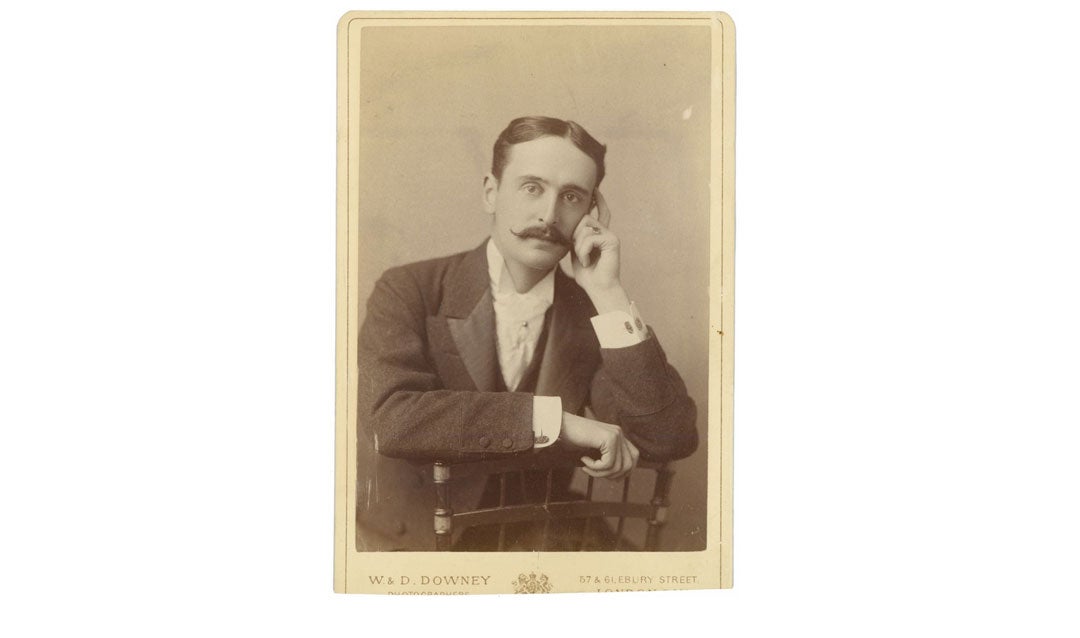
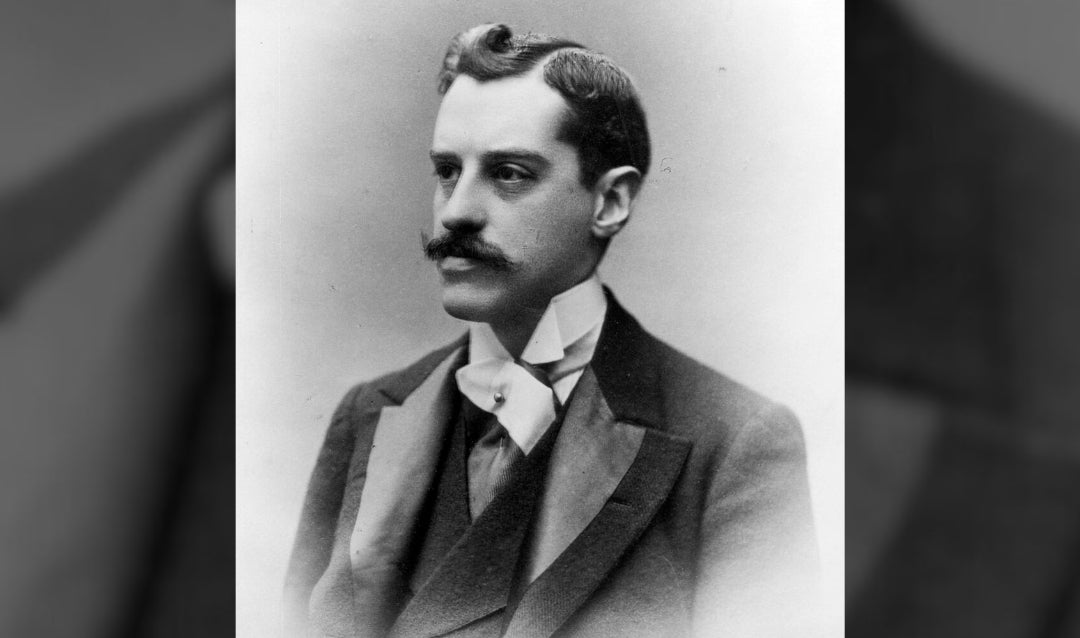
Photograph of George Vanderbilt, a scholar, collector, and patron of the arts who came of age during America’s Gilded Age

10 Fast Facts About Biltmore Estate

  1. George Vanderbilt was born in 1862 in Staten Island, New York. 👶
    He was the grandson of famed industrialist Cornelius “Commodore” Vanderbilt, who established the Vanderbilt family’s immense wealth during the mid-1800s through shipping and railroad monopolies.

  2. Construction of Biltmore House took approximately 6 years. 🚧
    After visiting Asheville, North Carolina, in 1888 with his mother, George Vanderbilt began the process of building his country home. Construction began in 1889 and after 6 years, Biltmore House was first opened to friends and family on Christmas Eve, 1895.

  3. Biltmore House is America’s Largest Home. 🏰
    Biltmore House was designed by architect Richard Morris Hunt and spans 175,000 square feet, which is more than four acres of floor space. The 250-room French Renaissance chateau includes 35 bedrooms, 43 bathrooms, and 65 fireplaces.

  4. Biltmore’s art collection includes works by Monet, Renoir, and more. 🎨
    Showcased inside Biltmore House is the Vanderbilt family’s original collection, fine art, architectural drawings, furniture, and more, with objects spanning over 92,000 items. With an emphasis on preservation, it’s no surprise Biltmore prides itself on having an in-house conservation department!

  5. Biltmore Estate features 75 acres of gardens. 🌷
    Adjacent to Biltmore House are acres of formal and informal gardens designed by renowned American landscape architect, Frederick Law Olmsted

  6. George Vanderbilt married Edith Stuyvesant Dresser in Paris in 1898. 💍
    Their only child, Cornelia Vanderbilt, was born in the Louis XV Room of Biltmore House in 1900. George passed away unexpectedly following an appendectomy in 1914, leaving the responsibility of managing and preserving of Biltmore Estate to his widow and young daughter.

  7. Since 1895, Biltmore has been a pioneer in sustainable land use practices. 🌲
    Biltmore is credited as the Birthplace of American Forestry. Today, Biltmore continues to honor George Vanderbilt’s legacy of preserving the land and protecting the environment through many ecological, recycling, alternative energy programs, and has long operated its farm and field-to-table program.

  8. Biltmore Estate is currently 8,000 acres but was around 125,000 acres during Vanderbilt’s lifetime. 🗺️
    While the current acreage of Biltmore Estate is approximately 8,000 acres, the acreage during George Vanderbilt’s lifetime was approximately 125,000 acres and included property later sold to the federal government to create Pisgah National Forest, one of the first national forests east of the Mississippi.

  9. Biltmore’s modern guests can enjoy outdoor exploration on this private estate. 🚴‍♀️
    With 8,000 acres of Blue Ridge Mountain estate to discover, today’s guests enjoy Biltmore’s scenic backyard with outdoor activities like biking, carriage rides, hiking, horseback riding, and more. The private estate grounds feature over 22 miles of trails to explore.

  10. Biltmore has an award-winning winery on the estate. 🍾
    George Vanderbilt’s grandson, William A.V. Cecil, began planting grapevines in the early 1970s, paving the way for the establishment of Biltmore’s Winery in 1985. Today, our winery is an integral part of a Biltmore visit and is America’s most visited winery. Biltmore’s award-winning wines are available for purchase at estate shops, on shop.biltmore.com, and in select retailers nationwide.

Biltmore Estate remains owned, operated, and preserved by George and Edith Vanderbilt’s descendants.

A mission of preservation

Today, Biltmore remains family-owned and operated under George Vanderbilt’s mission of preservation through self-sufficiency – a philosophy embraced before the first stone was ever placed.

Over the years, Biltmore has grown to include Antler Hill Village & Winery, which includes Antler Hill Farm; overnight accommodations, including The Inn on Biltmore Estate–our Forbes Four-Star property, Village Hotel on Biltmore Estate, and our historic Cottages on Biltmore Estate; Equestrian Center; numerous restaurants; event and meeting venues; and a licensed products division.

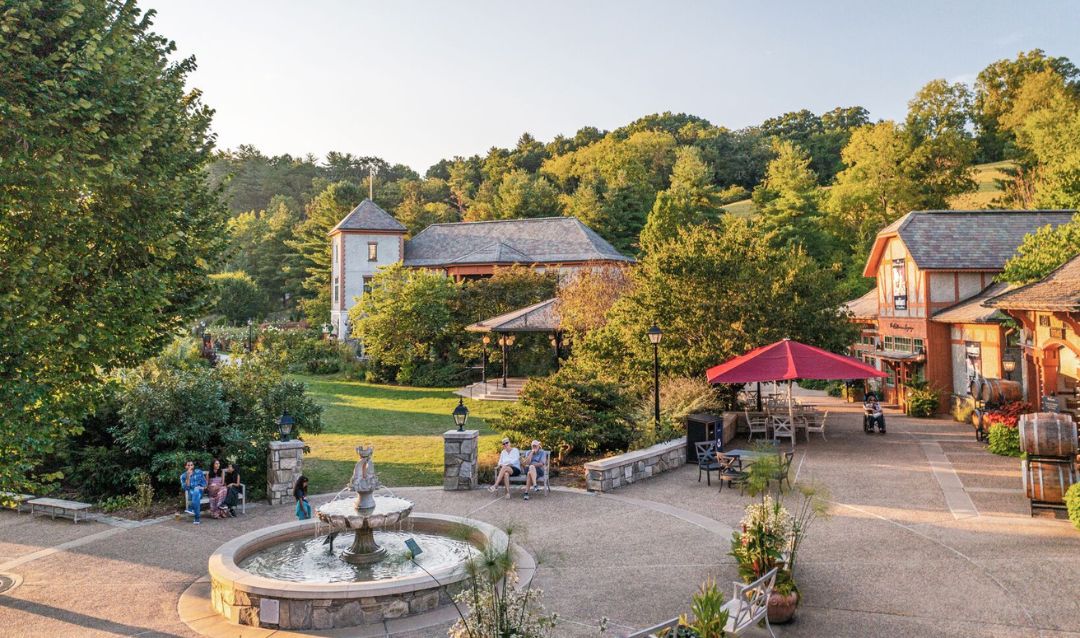
Antler Hill Village offers a charming, European-inspired experience surrounded by Biltmore’s working farms and fields.

Ready to see it for yourself?

Since 1895, Biltmore has welcomed guests from all over the world to experience the splendor of George Vanderbilt’s visionary estate. No matter the season, an awe-inspiring 8,000-acre mountain getaway awaits you.

From historic gardens and grounds to outdoor adventure, behind-the-scenes tours, new exhibitions and events, distinctive restaurants, shopping, and an award-winning winery, there is something for everyone at Biltmore Estate in Asheville, NC.

Time Travel: George Vanderbilt’s Visit to Japan

Time travel with us to explore George Vanderbilt’s visit to Japan that began on September 1, 1892.

George Vanderbilt’s visit to Japan

Just as visitors do today, Vanderbilt and his cousin, Clarence Barker, toured countless temples and other cultural sites during their visit to Japan. But they apparently worked in some shopping as well, as Biltmore’s archives indicate.

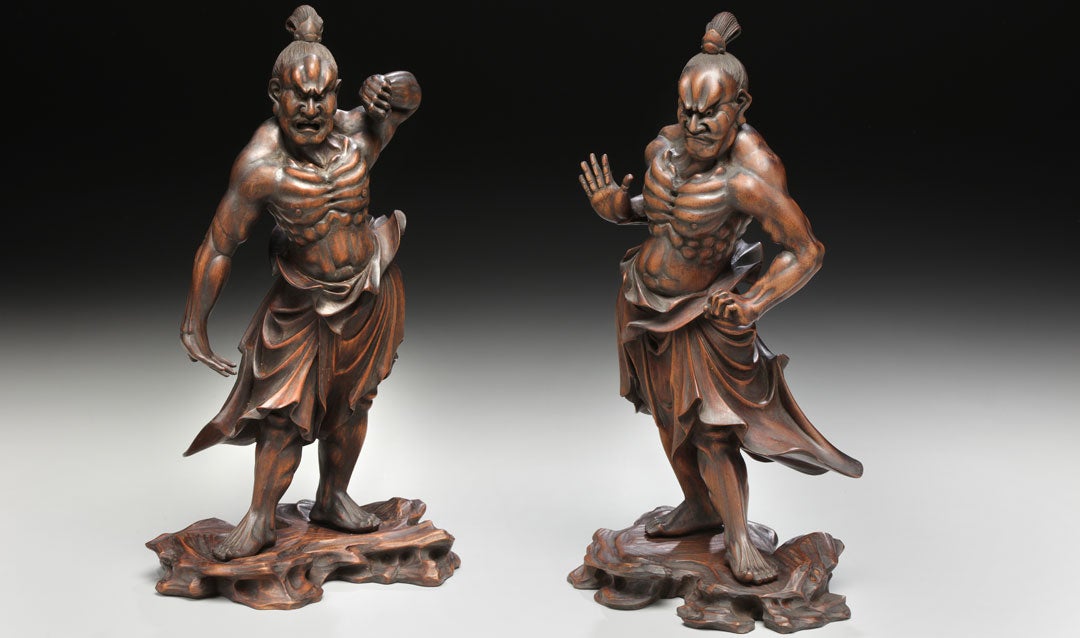
Ni-o guardians, carved wood. Edo period (1603-1868).

Like most of us, George Vanderbilt purchased souvenirs to remind him of the fascinating places he visited. Unlike us, however, he had a 250-room home under construction with plenty of space for accessories!

Perceptions of other places

Time Travel: George Vanderbilt's Visit to Japan
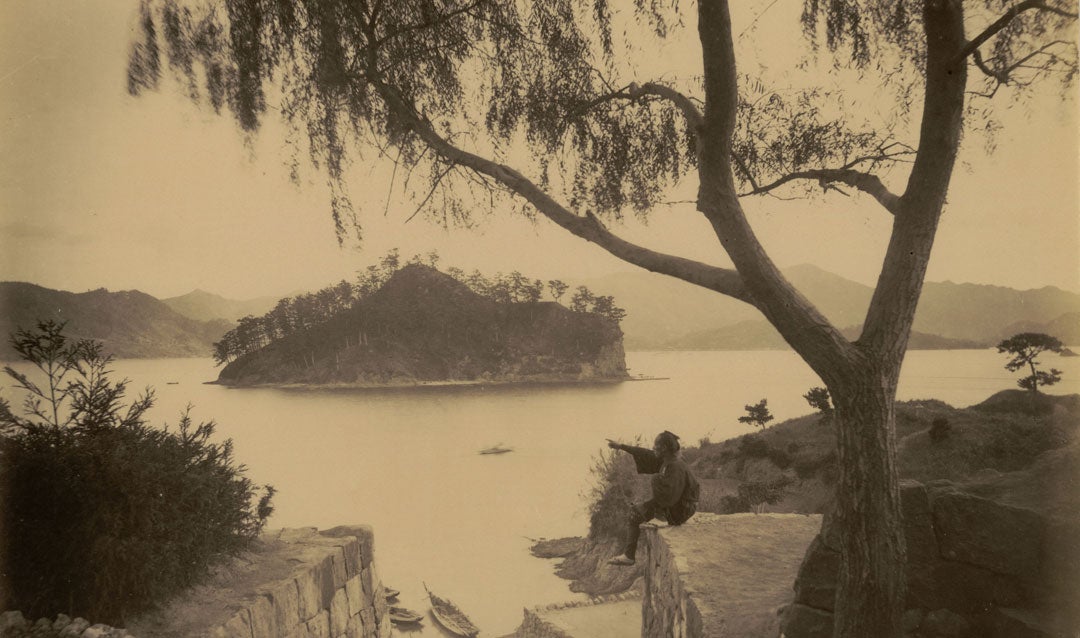
Nagasaki, Takabato Island. Photo purchased by George Vanderbilt, 1892.

Today, it’s hard to imagine how “foreign” Japan seemed to Americans at the end of the 1800s. The country had been closed to most Westerners for 200 years, only opening somewhat to trade beginning in the 1850s.

In Vanderbilt’s time, Japan was viewed as a place untouched by the west’s industrialization and modernization. Popular literature of the time evoked a far-off land where feudal traditions persisted and its people lived a simpler life.

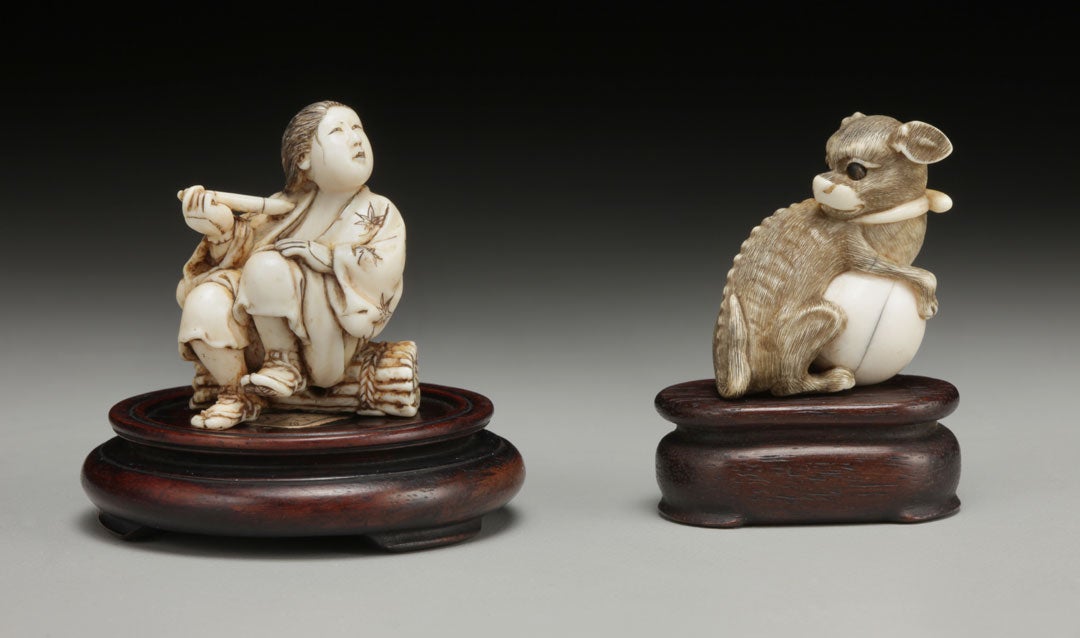
Netsuke souvenirs from George Vanderbilt's trip to Japan
Carved netsuke, originally used as toggles on kimonos

To many Americans, Japan and its culture was exotic and rooted in tradition, offering a blend of spirituality and aesthetic beauty. To George Vanderbilt, deeply interested in history, the arts, and collecting, the allure must have been irresistible.

A far-east adventure

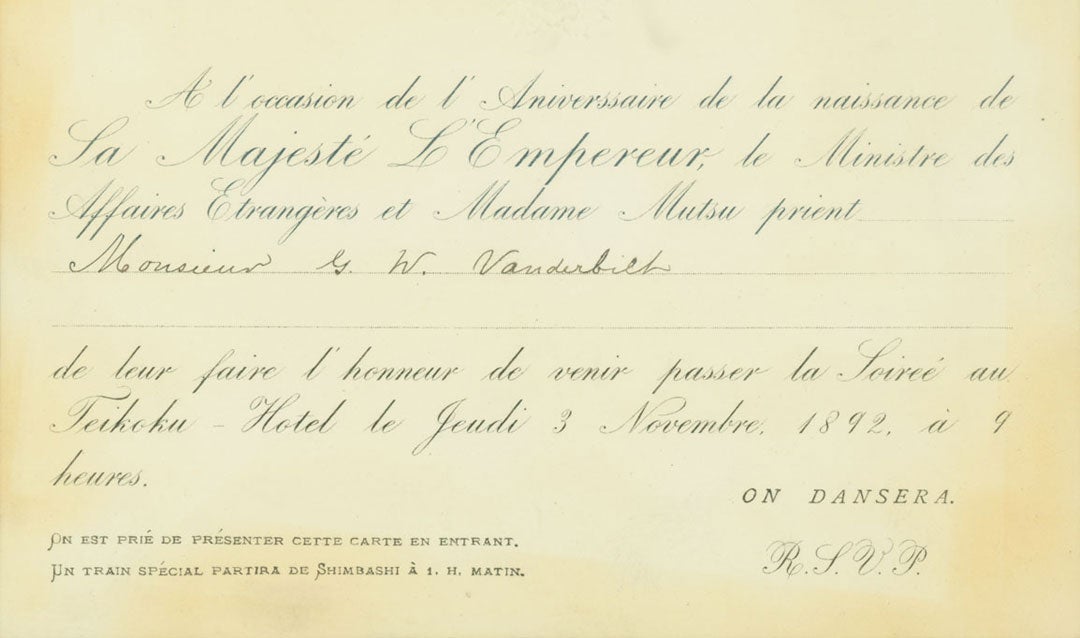
Invitation to Emperor of Japan's birthday celebration, 1892.
Invitation to Emperor of Japan’s birthday celebration, 1892

The trip itself was an adventure. Vanderbilt and Barker—one of his favorite traveling companions—had just returned from Spain when an invitation arrived to attend the Emperor of Japan’s birthday celebration. Soon after, they packed their trunks and, on September 1, 1892, embarked on the first leg of a 10-week itinerary.

First, they accompanied Biltmore architect Richard Morris Hunt to Chicago to see his preliminary work on the World’s Columbian Exposition.

Photo of George Vanderbilt's cousin Clarence Barker
Clarence Barker, George Vanderbilt’s cousin and frequent travel companion, ca. 1890

From there, the pair continued westward, stopping in Yellowstone National Park at the Mammoth Hot Springs hotel. Upon reaching San Francisco, they boarded ship for the week-long journey to Yokohama to begin their exploration of Japanese culture and customs—and evidently, quite a bit of shopping!

Shopping for souvenirs

Time Travel: George Vanderbilt's Visit to Japan
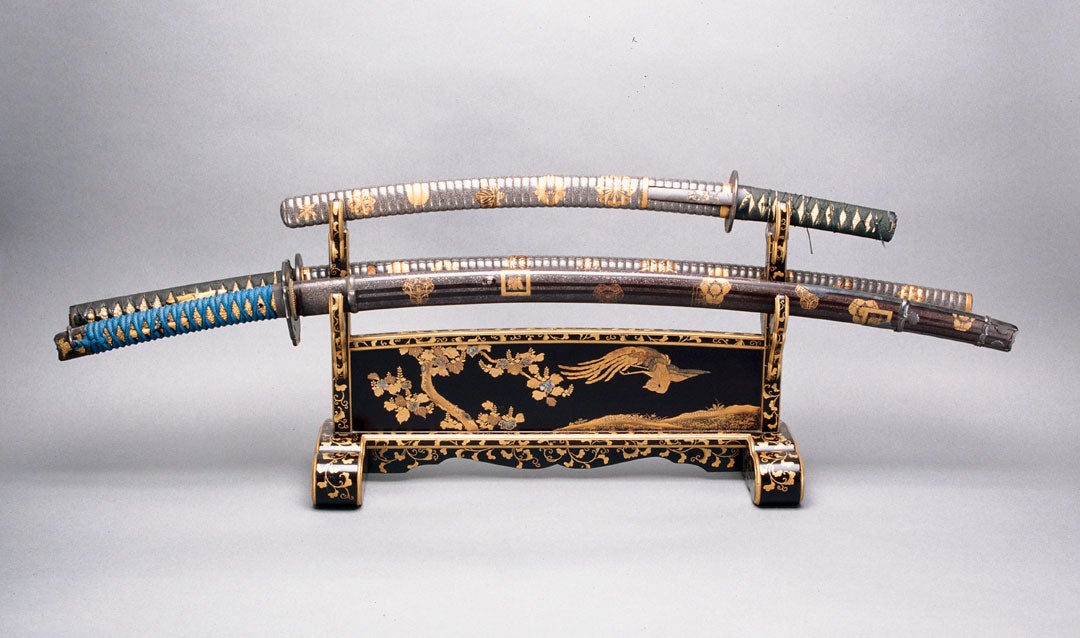
Ceremonial samurai swords with decorative display stand

Antiques shops and art dealers were obviously part of the itinerary, as Vanderbilt eventually shipped 32 cases of art and decorative objects back to America. Among his purchases were:

  • Satsuma ceramics, including a koro or ceremonial incense burner, for $85—a significant sum 122 years ago
  • Two suits of samurai armor along with spears and swords
  • Netsuke—miniature sculptures originally used as kimono toggles
  • Bronze sculptures
  • Lacquer boxes and sculptures
  • Varied screens and fans
  • Bamboo curtains
  • 1,000 festive paper lanterns

Time travel today at Biltmore

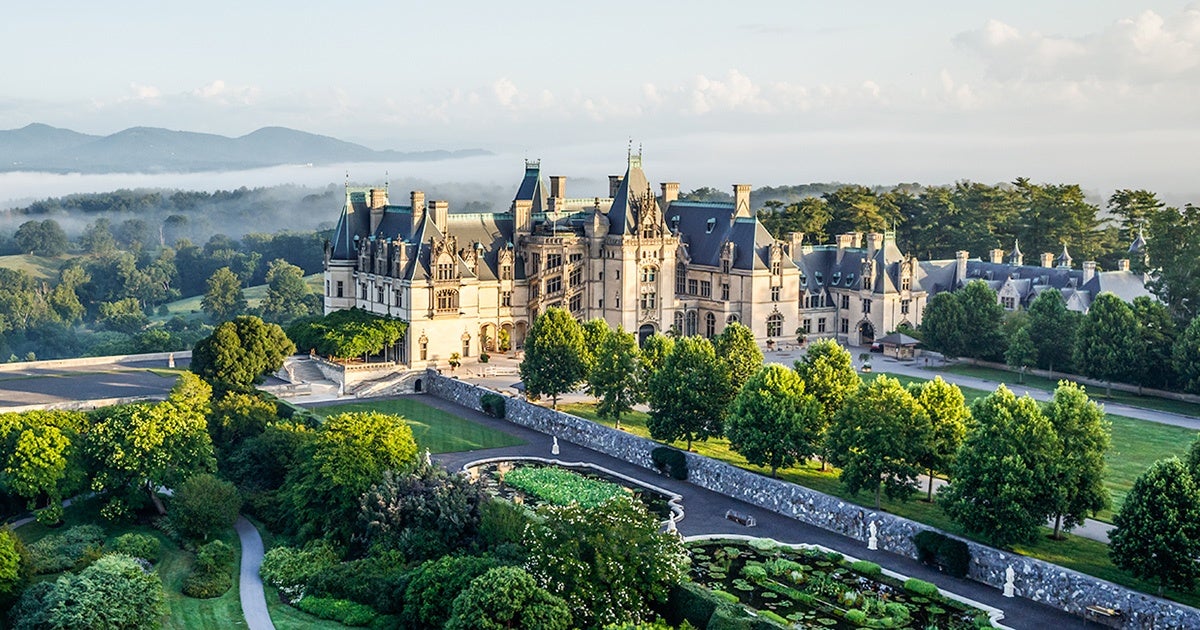
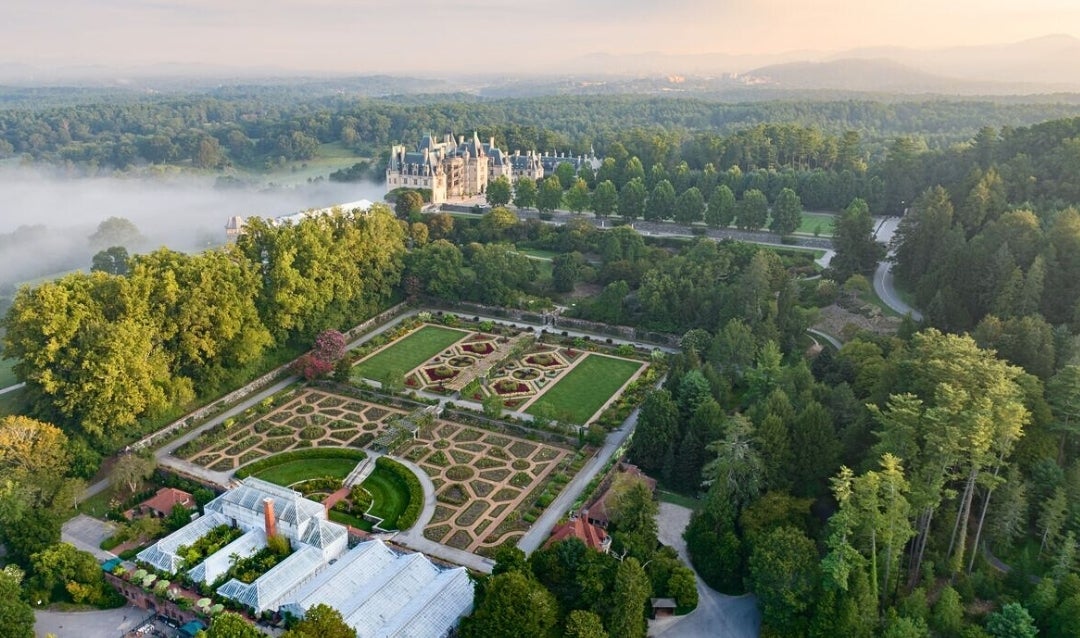
Aerial view of Biltmore House
Aerial view of Biltmore House and the Italian Garden

We hope you’ll consider Biltmore in your current and future plans. It’s an excellent place to “time travel” into our storied past!

If you’d prefer to visit without leaving the comfort of home, be sure to enjoy virtual tours of the estate, or indulge in a bit of shopping in our online store.

Featured image: Pagoda at Horinja-Nana. Photo purchased by George Vanderbilt, 1892

Richard Sharp Smith: A Western North Carolina Legacy

Biltmore House architect Richard Morris Hunt collaborated with Richard Sharp Smith to create America’s Largest Home® as well as other buildings on the estate and in the surrounding area.

Among others, Smith remained in the Asheville area and contributed their talents to many homes and buildings around the region. Let’s take a look at Smith’s work in the Asheville and Western North Carolina.

After receiving architectural training in England, Richard Sharp Smith came to America in 1882, joining Richard Morris Hunt’s New York office in 1886. A pivotal point in his career came when he was assigned as Biltmore’s supervising architect, responsible for overseeing construction onsite. Following Hunt’s death in August 1895, Smith became Vanderbilt’s lead architect.

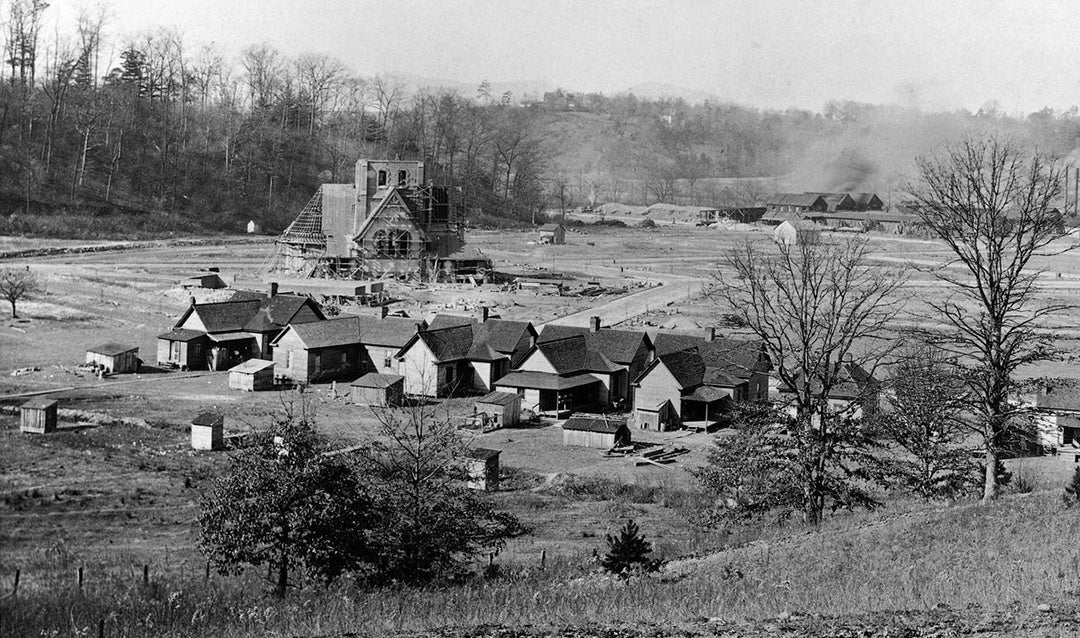
All Souls’ Church, designed by Richard Morris Hunt with construction overseen by Richard Sharp Smith, ca. late 1895–early 1896

Once this major project was completed, Richard Sharp Smith started his own firm in Asheville, raising a family and becoming one of the area’s most popular architects until his death in 1924. At the time of his passing, the Asheville Citizen said:

“After long years of residence in Asheville, Smith has done more than any other person to beautify the city. He came to Asheville just at a time when he was needed, and was really a pioneer architect in the community…

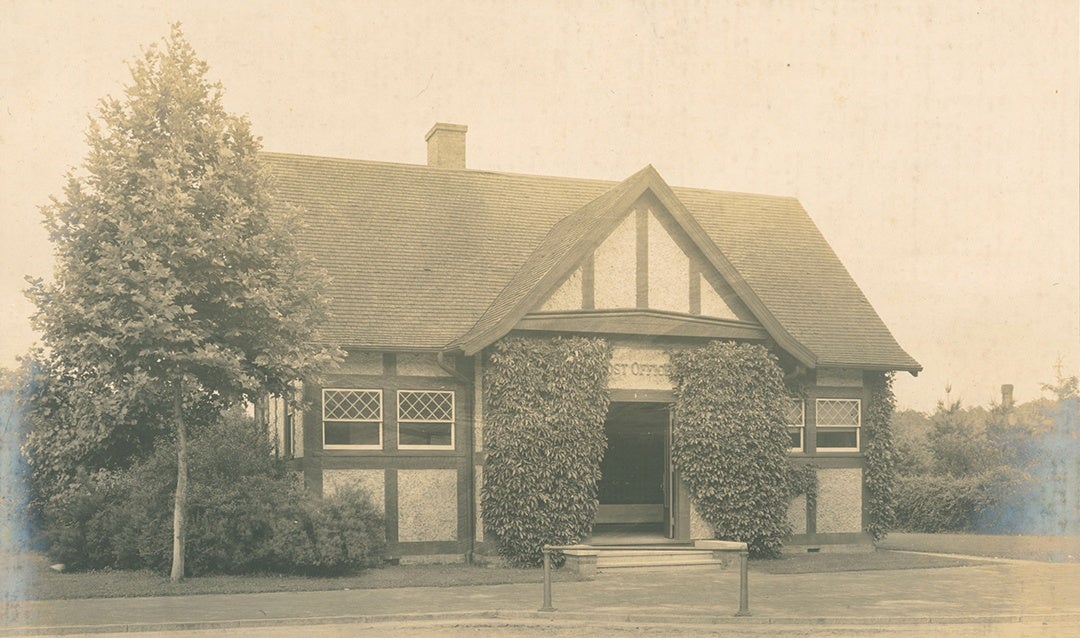
Smith worked in styles ranging from Arts and Crafts to Tudor to Colonial Revival. And not surprisingly, many of these homes and buildings are reminiscent of Biltmore House and other structures on the estate.

Biltmore Village Post Office, designed by Richard Sharp Smith, ca. 1903

“Two beautiful examples of Richard Sharp Smith’s residential style—the Annie West House at 189 Chestnut Street in Chestnut Hill and the Charles Jordan House at 296 Montford Avenue—include pebbledash stucco, archways, and rooflines, much like his buildings in Biltmore Village,” said Leslie Klingner, Biltmore’s Curator of Interpretation.

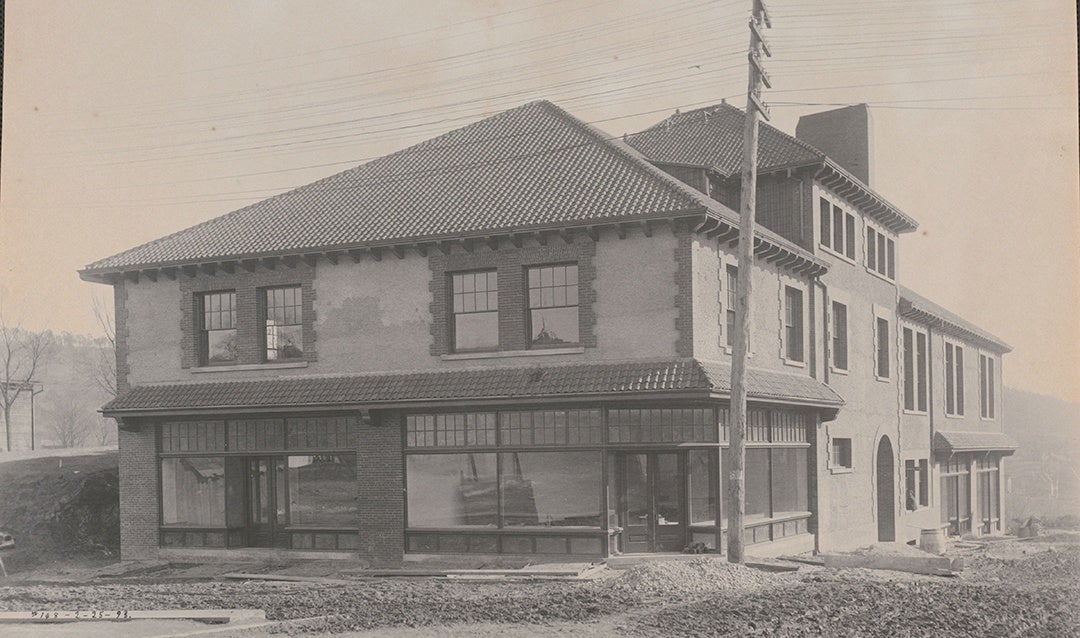
In downtown Asheville, Smith was the architect for the E.W. Grove Office at 324 Charlotte Street, the Elks Home—also known as Hotel Asheville—at 55 Haywood Street, and the Young Men’s Institute on Eagle Street. Saint Mary’s Episcopal Church on Charlotte Street, Grace Episcopal on Merrimon Avenue, and All Souls’ Church in Biltmore Village are also his creations.

Young Men’s Institute in downtown Asheville, designed by Richard Sharp Smith, ca. 1893

Smith’s work is evident throughout Western North Carolina, including homes in Flat Rock and courthouses for Henderson, Jackson, and Madison counties.

“Many of the buildings that define Asheville today were designed by Richard Sharp Smith,” said Leslie. “It’s enjoyable to see these structures and worth taking the time to notice the arches, tile work, pebbledash, and architectural features that relate to Biltmore House.”

Restoring Our Roots, One Tree at a Time

When George Vanderbilt first visited Asheville, North Carolina, in 1888 and began envisioning his private estate, the wooded slopes of the surrounding Blue Ridge Mountains included vast numbers of American chestnut trees.

The edible nut of the chestnut tree in its spiny burr covering

Seeds from one of Biltmore’s hybrid chestnuts encased in a spiny, protective “burr”

History of the American chestnut tree

Known as an all-purpose tree, American chestnuts grew quickly to great size. The wood was strong and resistant to rotting, making it a prized material for foundations, fencing, and railroad ties while the edible nut was an important source of food for cattle, hogs, and wildlife.

Around the turn of the 20th century, a blight (Cryphonectria parasitica) struck the American chestnut tree, effectively destroying the species as a source of food and lumber. The blight doesn’t kill the tree’s underground root system, but once an American chestnut sprouts from an existing stump, it succumbs to blight before it matures into a tree.

​​Scaly, thickened bark on this branch shows evidence of chestnut blight

Restoring our roots

In 1997, Biltmore partnered with the American Chestnut Foundation (AFC) to provide a test site for hybrid chestnuts as part of the AFC’s work to restore this heritage tree. The AFC collected pollen and seeds from the estate and crossed the genetic material with blight-resistant Chinese chestnut trees. The seedlings were planted on a sunny slope near Deerpark Restaurant.

“In a way, we’re restoring our roots,” said Jason Mull, Landscaping Supervisor for many of the outlying historic areas of the estate, including the Approach Road and the chestnut plantings. “This project has a natural tie to the importance Vanderbilt and Olmsted placed on landscaping and managed forestry.

Jason Mull points out one of three original hybrid chestnut trees at Biltmore

Jason Mull indicates one of the original hybrid chestnut trees planted at Biltmore in 1997

The project continues

Jason has been involved with the chestnut project since the beginning and has now cared for several generations of trees. The test site includes a mix of American-Chinese hybrids plus full Chinese chestnuts that act as a control group.

“There are only three hybrid chestnuts left from the original planting,” Jason said. “They’ve grown pretty well in the last 20 years. They do show effects from the blight, but it hasn’t killed them.”

According to Jason, some of the more recent plantings carry a much higher percentage of American chestnut DNA than the originals because the hybrids have served their purpose in helping increase resistance to the blight.

Students from a local charter school help plant new hybrid chestnuts at Biltmore in 2013

Planting a legacy

“We’re continuing to work with the AFC to establish another planting site on the estate—preferably in the kind of wooded area that chestnuts tend to prefer,” Jason said. “If our trees continue to do well over time, that’s a wonderful legacy to leave for future generations.”

Featured blog image: Jason Mull and a student from a local charter school plant a hybrid chestnut tree near Deerpark Restaurant in 2013

George Vanderbilt: A Modern Art Collector

From a young age, George Vanderbilt inherited his father’s passion for admiring and collecting art. While George was inspired by the earlier artists his father admired, he also supported more modern, progressive artists who embraced contemporary themes and new technologies.

Let’s take a look at a few of the pieces in the Biltmore House collection that speak to George Vanderbilt’s love of ground-breaking artists and their work.

1. Ignacio Zuloaga’s “Rosita”
Rosita

On display in the Louis XV Hallway

​Painter Ignacio Zuloaga drew from folklife and long-founded elements of Spanish painting—for instance, Rosita is lounging on a divan draped with a mantón de manila, an integral part of the costume worn by flamenco dancers. However, Zuloaga was also influenced by the philosophy and art of the French symbolists to explore different modes of expressing character and energy and encouraging personal interpretation. In this, the character and energy of Rosita is distinct; she is confident: a model at ease with being an object of beauty.

2. Pierre-Auguste Renoir’s “Young Algerian Woman” and “Young Boy with an Orange”
Young Algerian Woman

On display in the Breakfast Room

Renoir painted alongside fellow artists Monet and others to create a wholly new style concerned with capturing light, movement, and other optical effects. This Impressionistic approach to handling light, as well as Renoir’s unique style of composition, his use of underlying foundations and free brushwork, and his informal, intimate subject matter were all ground-breaking developments—represented in both Young Algerian Woman (above) and Young Boy with an Orange (feature image).

Fun fact: The Renoir paintings in the Biltmore House collection were likely among the first of his works in America!

3. Maxime Maufra’s “Vue du Port” (“View of the Harbor in Sunset”)
Vue du Port

On display in the Breakfast Room

Frenchman Maxmie Maufra travelled to England as a young man and devoted time to study the Romantic landscapes of Constable and Turner. While their dramatic skies and turbulent seas were impactful, his work clearly shows the influence of the Impressionist and Post-Impressionist schools in his handling of light and color.

4. Constantin Emile Meunier’s “Anvers” (“Antwerp”)
Anvers

Not currently on display

Inspired by his travels and exposure to the industrial region of Belgium, Meunier made an important contribution to the development of modern art by elevating the image of the industrial worker, dock worker, and miner to an icon of modernity. While he certainly wasn’t the first to explore the theme of workers and industry, his portrayal of labor and laborers in forthright, heroic fashion was an altogether new approach.

Fabulous Fashion Find Yields Titanic Results

With our new exhibition Glamour on Board: Fashion from Titanic the Movie, we are celebrating not only the 20th anniversary of the iconic film that won 11 Oscars®, including Best Picture and Best Costume Design, but also the elegant wardrobes favored by transatlantic travelers in the early 1900s. On display in Biltmore House February 9–May 13, 2018, this exhibition is the first large-scale display of the original Titanic costumes and will showcase the exquisite detail meticulously recreated for these award-winning fashions. Just as portrayed in the movie, long days at sea fostered friendships and romances, including George Vanderbilt’s courtship of Edith Stuyvesant Dresser.


Planning the exhibition

In planning the exhibition, members of our Museum Services team wanted to ensure that guests understood the historical significance of Edwardian fashion as it pertained to Biltmore and the Vanderbilt family.

Leslie Klingner, Curator of Interpretation, conducted specific research related to the costume designers who created the glamorous gowns and dashing suits worn by the principal actors–as well as the extraordinary number of extras–in Titanic. Leslie learned that many of the costumes were original fashions from the era purchased for use in the film; others were created using original elements to make them look and feel as close as possible to authentic clothing of the era.

“While researching, I came across information indicating that the memorable striped ‘arrival suit’ worn by Kate Winslet’s character Rose as she boards Titanic for the first time was a direct reproduction from the January 1912 issue of Les Modes magazine,” said Leslie. “Knowing that Les Modes was a popular fashion magazine of the period, I wondered if we could find another institution that held that particular issue in order to reproduce the original fashion plate for comparison with the costume.”

January 1912 Les Modes fashion magazine features a costume later used in the film Titanic
A fabulously fashionable discovery

Leslie asked Lauren Henry, Associate Curator, for assistance with the search, and that’s when Lauren made a fabulous fashion find: Edith Vanderbilt not only read Les Modes, she kept a number of issues that are still in our archives–including the January 1912 edition!

“The magazines themselves are gorgeous,” Leslie said. “The covers are printed using a very refined technique called pochoir. This specialized process used a stencil-based method of printing that produced crisp lines and brilliant colors and was often used to illustrate fashion magazines like Les Modes,” explained Leslie. “The issues in our archives have metallic gold highlights on the covers and are in remarkable condition. Many look just as lovely as they would have when they were new!”

Fashion spread featuring five dresses in the April 1911 issue of Les Modes
Titanic
connections

We’ve always known that Edith Vanderbilt was considered a trendsetter when it came to fashion, but with the discovery of this treasure trove of magazines, we now know one of the ways she kept up with the latest Parisian styles on a monthly basis. In fact, she may have looked at the very dress in 1912 that would be used to express the height of haute couture more than a century later in the film Titanic. In another twist of fate, George and Edith Vanderbilt would make plans to travel aboard the ill-fated ship just a few months later, and though their personal arrangements were changed before Titanic sailed, a member of their household staff was lost in the tragedy.

Discover The Vanderbilts at Home and Abroad

Opening in March 2018, The Vanderbilts at Home and Abroad exhibit, located in The Biltmore Legacy in Antler Hill Village, will further showcase the lives of the Vanderbilts as well as treasures collected during their world travels.

Featured image: (L-R) April 1912 and February 1913 covers of Les Modes magazines from Biltmore’s archives

First image: Leslie Klinger displays the large striped hat that accompanies the ‘arrival suit’ worn by Kate Winslet’s character Rose in Titanic

Second image: January 1912 Les Modes photograph featuring original design which inspired the ‘arrival dress’ used in the film Titanic (magazine from Biltmore archives)

Third image: April 1911 Les Modes fashion spread featuring five original gowns from the time period in which Titanic is set (magazine from Biltmore archives)

Olmsted’s Groundbreaking Work: Gardens and Glass

Chihuly At Biltmore Was On Display From May 17 To October 7, 2018.
Please Enjoy This Archived Content.

Long known as the father of American landscape architecture, Frederick Law Olmsted reached the pinnacle of his professional career with his landscape design for Biltmore–George Vanderbilt’s magnificent private estate.

Portrait of Olmsted by John Singer SargentA vision for the future

In addition to developing the extensive plans for Biltmore, Olmsted was a true visionary–looking ahead more than a century to understand how his designs would mature to create a stunning setting for America’s Largest Home® that future generations would continue to preserve.

From gardens filled with glorious blooms to carefully managed forest lands, Olmsted’s genius is recognized around the world and his contributions to the art and science of landscaping continue to be celebrated.

First in Forestry plaque with Gifford PinchotThe success of Olmsted’s protĂŠgĂŠes is also directly attributable to his mentorship, from Biltmore’s first forest manager Gifford Pinchot’s who went on to serve as the first chief of the U.S. Department of Agriculture Forest Service to Chauncey Beadle, Biltmore’s estate supervisor who managed and nurtured Olmsted’s designs for more than 50 years.

Masterpieces in gardens and glass
From May 17–October 7, 2018, Biltmore will host Chihuly at Biltmore, the first-ever art exhibition in our historic gardens. This exhibition features the works of globally-renowned artist Dale Chihuly set in the living backdrop of gardens that remain true to Frederick Law Olmsted’s design intent.

Just as Olmsted is known as a leader in the development of landscape architecture, Chihuly is leader in the development of glass as a fine art and he is celebrated for amazing architectural installations combining brilliant colors and striking forms that have entranced viewers worldwide. Chihuly at Biltmore features awe-inspiring artworks in both Biltmore House & Gardens and Antler Hill Village.

Dazzling by daytime, the exhibition sparkles during Chihuly Nights at Biltmore, when the sculptures are illuminated to showcase their spectacular colors and shapes.

The Conservatory at BiltmorePlan your visit now

Chihuly at Biltmore is included in your estate admission. The dramatic experience of Chihuly Nights at Biltmore requires a separate ticket purchase and is offered on select evenings by reservation only.

Featured blog image: Biltmore’s Walled Garden
— First image: Frederick Law Olmsted portrait by John Singer Sargent, located in Second Floor Living Hall of Biltmore House
— Second image: First in Forestry plaque at Biltmore, featuring Gifford Pinchot
— Third image: The Conservatory at Biltmore, which will feature several of Chihuly’s
Chandeliers during the exhibition

Remembering Mrs. Mary “Mimi” Ryan Cecil

Mary “Mimi” Ryan Cecil died on Friday, November 17, 2017 in Asheville, NC. Mrs. Cecil and her late husband, William A.V. Cecil, were active members of the Asheville, NC community as owners of the historic estate, Biltmore.

Born Mary Lee Ryan on December 11, 1931, she was the daughter of textile manufacturer John J. Ryan, Jr., and granddaughter of the prominent New York banker, lawyer, and builder James T. Lee.

She graduated with a B.A. in English from Vassar College in 1953. Notably, she was in the first class of female graduates from the University of Michigan Law School. She was elected to the Law Review in 1956 and was a partner in the Wall Street firm of Cadwalader, Wickersham & Taft.

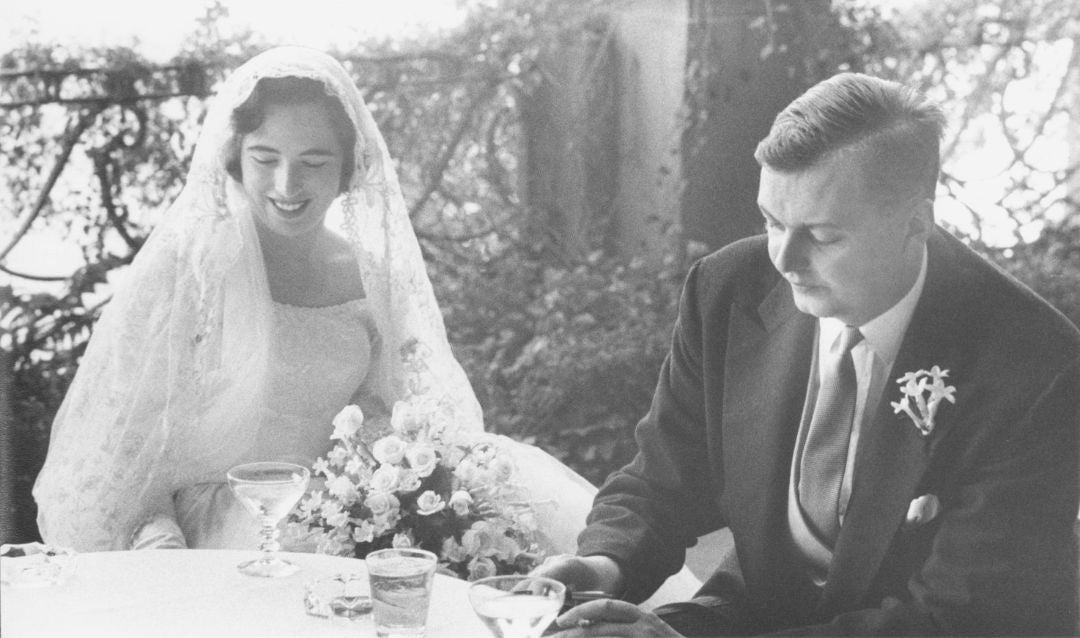
William A.V. Cecil and Mary
Mimi and William A.V. Cecil at the reception following their wedding.

In 1957, she married William A.V. Cecil at St. Vincent Ferrer’s Roman Catholic Church in New York City. In 1960, the Cecils moved to Asheville, NC to raise their family and to oversee the management and preservation of Biltmore, which was created by his grandfather George W. Vanderbilt. Upon their return, Biltmore was transformed into a privately owned, profitable, working estate that was named a National Historic Landmark in 1963.

While supporting her family’s endeavors at Biltmore, Mrs. Mary Cecil became a legend in her own right within the community. Known for her relaxed and approachable manner, she was a familiar figure in the world of non-profit leadership, and devoted her life to making a difference in the areas of education, social inequities, the environment, and the arts.

She was a trustee and served 14 years as Chair for North Carolina Environmental Defense. In 1995, in recognition of her devotion and support of the organization, the Board of Trustees and Staff elected her Chair Emeritus, expressing their deep and lasting appreciation, respect, and love for her dedication to the welfare of the organization and her lifelong efforts to insure the overall betterment of North Carolina.

Mrs. Mary Cecil was a founding board member of the Nature Conservancy and Friends of the Smokies, and was recognized for 20 years of stewardship by the National Park Service for her work with Friends of the Smokies. She also served on the Board for the North Carolina Zoological Society.

In 2007, The French Broad River Garden Club and The Garden Club of America presented the Zone Conservation Award to Mrs. Cecil for her inspiring dedication to the conservation of our environment, natural resources, and mountain heritage.

She served as Chairman of the Community Foundation of North Carolina board for a decade, and was Chair of the Warren Wilson College Board of Trustees from 1998–2005.

Mrs. Mary Cecil was a supporter of the Asheville Symphony and Guild, the Asheville Art Museum, the Health Adventure, the United Way, and the National Forest Foundation. She was also active with the Buncombe County Board of Education, Hospitality House, John C. Campbell Folk School, and the National Parks Conservation Association.

She volunteered with the Mission Health System for 20 years and was a long-time member of The Biltmore Company’s Board of Directors.

Mrs. Cecil in South Georgia, Antarctica, 2004.

Mrs. Cecil was devoted to her family, sharing her love of travel, especially with her five grandchildren. As each grandchild reached the age of ten, they were able to pick a travel experience to share with her, creating a memorable tradition that spanned generations.

In the book Lady on the Hill, Mr. Cecil (1928–2017) recognized Mimi Cecil for her integral part in Biltmore’s success story and in supporting those efforts for more than 45 years. “She has been a wonderful wife and mother and has offered her considerable gifts, skills, and abilities to our community, our mountains, and our country. I am profoundly in her debt,” he stated.

Mrs. Cecil is survived by her son, William A.V. “Bill” Cecil Jr., and daughter-in-law Virginia “Ginger” Cecil; her daughter, Diana “Dini” Cecil Pickering and son-in-law George “Chuck” Pickering II, brother John J. Ryan III, and sister-in-law Jacqueline Ryan; five grandchildren; and two great-grandchildren.