Our newest exhibition, Glamour on Board: Fashion from Titanic the Movie, features costumes from the iconic production, which holds the record for the most Academy Award® nominations and the record for the most Oscars® won by a single film.
The 1997 movie was nominated for 14 Academy Awards, tying All About Eve (1950) for the most Oscar nominations. Additionally, it won 11 of those awards, tying Ben Hur (1959)—and later matched by The Lord of the Rings: The Return of the King (2003)—for having won the most Oscars.
Titanic’s Academy Awards include:
Best Picture
Best Director
Best Art Direction
Best Cinematography
Best Costume Design
Best Film Editing
Best Original Dramatic Score
Best Original Song
Best Sound
Best Sound Effects Editing
Best Visual Effects
Needless to say, the award we’re most excited about is “Best Costume Design”—which means that each and every costume on display in our exhibition is a true Academy Award-winner!
While key costumes from the film have been shown in other places, this is the first large-scale display—including outfits of background characters, shoes, accessories, and more.
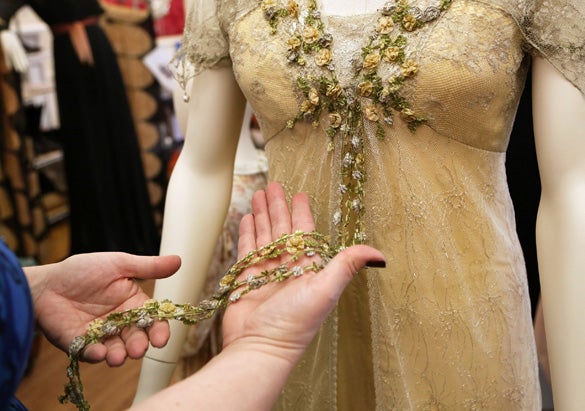
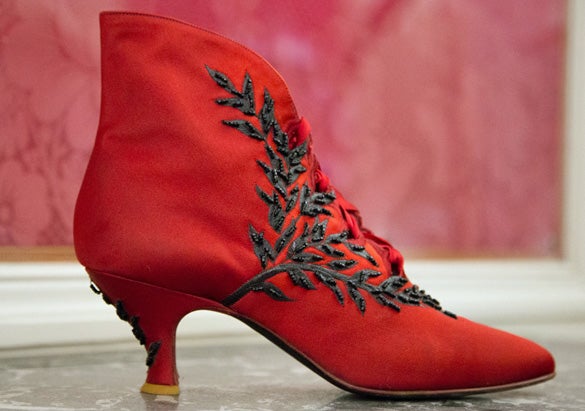
Here’s a sneak peek at the detailing on a few of those fabulous pieces that’ll be displayed during Glamour on Board.
1. Rose DeWitt Bukater’s Yellow Breakfast Dress will be on display in the Oak Sitting Room during Glamour on Board.
2. Rose’s red shoes, along with the famed Jump Dress, will be on display in the Library during Glamour on Board.
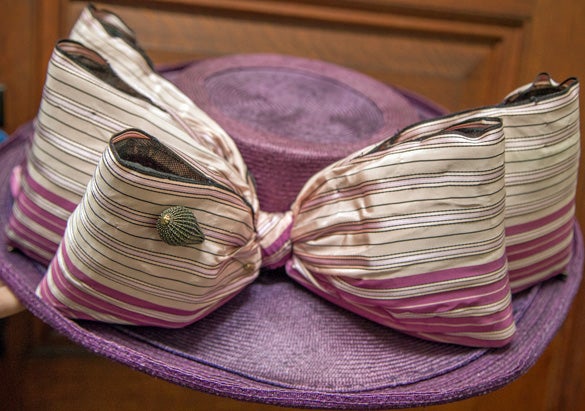
3. Rose’s iconic Boarding Hat from the start of thefilm will be on display near the Winter Garden during Glamour on Board.
Join us for the exhibition beginning on February 9, 2018 until May 13, 2018. Also, be sure to ask about our limited-time Glamour on Board Premium Guided Tour. In this 90-minute tour, you’ll learn captivating stories behind the costumes’ creation, and get fascinating insights into the elegance of the era’s fashions, culture of the times, costume design, and making of the film.
After almost two years of planning, Biltmore’s newest costume exhibition, Glamour on Board: Fashion from Titanic the Movie, is beginning to come to life.
While key costumes from the film have been shown in other places, this is the first large-scale display—including outfits of background characters, shoes, accessories, and more.
All that’s to say, Leslie Klingner, Biltmore’s Curator of Interpretation; Anne Battram, our Upholstery and Textile Conservator; and Janey Abbott, Costume Specialist, have been hard at work. Anne and Janey began dressing mannequins back in May and they’ll be the first to admit: There’s more to the task than meets the eye.
1. Outlining the exhibition
Before the costumes were chosen at Fox Studios, Leslie worked with other members of our Museum Services team to map out the storyline of the exhibition, which informs where the costumes will be placed throughout Biltmore House.
“This plan shifted a bit as we saw what costumes were available,” said Leslie. “Some were so striking that it was clear immediately in what room they could best be showcased.”
As Titanic is set in the early 1910s, many of the period-specific costumes paired easily with the interior of America’s Largest Home®—but others required some judgment calls.
For instance, one costume in the film’s collection is a beautifully intricate maritime officer’s uniform.
“The artistry of the piece is truly incredible,” Leslie said, “and the Captain’s story is an important one, but that outfit simply doesn’t make sense just anywhere in Biltmore House. In the end, we decided that it made the most sense in the Banquet Hall, knowing that when the Vanderbilts’ travelled, they would have often been invited to dine at the Captain’s table. We wanted to convey a sense of that through this exhibition.”
2. Documenting the costumes of Glamour on Board
Not long after the flow of the exhibition is outlined, the costumes begin to arrive. At this point, Leslie and Janey must photograph each of the 511 items to document their condition and arrangement upon arrival.
“The process is far more involved than dressing a retail mannequin,” explains Leslie. “These costumes are iconic and hold cultural and historical value, so we have to pay attention to the details of every single piece.”
The team then creates an inventory sheet for each costume, identifying all of the pieces included as well as a film still showing the costume on its character.
3. Dressing the mannequins
Before actually dressing the mannequins, Leslie and Anne pair the costumes with the most appropriate mannequin.
“Our mannequins are custom made,” explained Leslie, “and as styles change with the times, it’s important for each to reflect the style of dress from that era. We pad out mannequins to best support the textiles while they are on display and also try to reflect the form of the actor who originally wore the outfit.”
“For some costumes, we need mannequins whose poses can accentuate certain accessories, such as shoes or a fan, while still appearing anatomically correct,” added Janey.
Finally, Anne and Janey put the costumes on the mannequins and Leslie checks to see what may need adjusting to make the pieces as authentic as possible—which can be anything from needing extra padding to create a certain shape to finding creative ways to resolve issues that arise.
They then take the costume off, make the adjustments, put the costume back on, and check their work.
“No matter how well we plan, there is always something that didn’t fit quite how we expected,” said Leslie. “Anne and Janey have come up with countless ways to mask small gaps between buttons or to create the illusion of a lengthened hem. It’s an art!”
“It really is a challenge in 3D thinking,” says Janey. “We’re essentially creating form from the inside out.”
In the last few months of dressing, this team will be adding wigs custom-made of watercolor paper and jewelry for a final touch. Meanwhile, our Floral team is planning complementary décor for the rooms and our Engineering and Conservation teams plan for lighting, object movement, and installation.
Join us for the exhibition and see how all of the hard work pays off. Also, be sure to ask about our limited-time Glamour on Board Premium Guided Tour. In this 90-minute tour, you’ll learn captivating stories behind the costumes’ creation, and get fascinating insights into the elegance of the era’s fashions, culture of the times, costume design, and making of the film.
From a young age, George Vanderbilt inherited his father’s passion for admiring and collecting art. While George was inspired by the earlier artists his father admired, he also supported more modern, progressive artists who embraced contemporary themes and new technologies.
Let’s take a look at a few of the pieces in the Biltmore House collection that speak to George Vanderbilt’s love of ground-breaking artists and their work.
1. Ignacio Zuloaga’s “Rosita”
On display in the Louis XV Hallway
Painter Ignacio Zuloaga drew from folklife and long-founded elements of Spanish painting—for instance, Rosita is lounging on a divan draped with a mantón de manila, an integral part of the costume worn by flamenco dancers. However, Zuloaga was also influenced by the philosophy and art of the French symbolists to explore different modes of expressing character and energy and encouraging personal interpretation. In this, the character and energy of Rosita is distinct; she is confident: a model at ease with being an object of beauty.
2. Pierre-Auguste Renoir’s “Young Algerian Woman” and “Young Boy with an Orange”
On display in the Breakfast Room
Renoir painted alongside fellow artists Monet and others to create a wholly new style concerned with capturing light, movement, and other optical effects. This Impressionistic approach to handling light, as well as Renoir’s unique style of composition, his use of underlying foundations and free brushwork, and his informal, intimate subject matter were all ground-breaking developments—represented in both Young Algerian Woman (above) and Young Boy with an Orange (feature image).
Fun fact: The Renoir paintings in the Biltmore House collection were likely among the first of his works in America!
3. Maxime Maufra’s “Vue du Port” (“View of the Harbor in Sunset”)
On display in the Breakfast Room
Frenchman Maxmie Maufra travelled to England as a young man and devoted time to study the Romantic landscapes of Constable and Turner. While their dramatic skies and turbulent seas were impactful, his work clearly shows the influence of the Impressionist and Post-Impressionist schools in his handling of light and color.
4. Constantin Emile Meunier’s “Anvers” (“Antwerp”)
Not currently on display
Inspired by his travels and exposure to the industrial region of Belgium, Meunier made an important contribution to the development of modern art by elevating the image of the industrial worker, dock worker, and miner to an icon of modernity. While he certainly wasn’t the first to explore the theme of workers and industry, his portrayal of labor and laborers in forthright, heroic fashion was an altogether new approach.
With our new exhibition Glamour on Board: Fashion fromTitanicthe Movie, we are celebrating not only the 20th anniversary of the iconic film that won 11 Oscars®, including Best Picture and Best Costume Design, but also the elegant wardrobes favored by transatlantic travelers in the early 1900s. On display in Biltmore House February 9–May 13, 2018, this exhibition is the first large-scale display of the original Titanic costumes and will showcase the exquisite detail meticulously recreated for these award-winning fashions. Just as portrayed in the movie, long days at sea fostered friendships and romances, including George Vanderbilt’s courtship of Edith Stuyvesant Dresser.
Planning the exhibition
In planning the exhibition, members of our Museum Services team wanted to ensure that guests understood the historical significance of Edwardian fashion as it pertained to Biltmore and the Vanderbilt family.
Leslie Klingner, Curator of Interpretation, conducted specific research related to the costume designers who created the glamorous gowns and dashing suits worn by the principal actors–as well as the extraordinary number of extras–in Titanic. Leslie learned that many of the costumes were original fashions from the era purchased for use in the film; others were created using original elements to make them look and feel as close as possible to authentic clothing of the era.
“While researching, I came across information indicating that the memorable striped ‘arrival suit’ worn by Kate Winslet’s character Rose as she boards Titanic for the first time was a direct reproduction from the January 1912 issue of Les Modes magazine,” said Leslie. “Knowing that Les Modes was a popular fashion magazine of the period, I wondered if we could find another institution that held that particular issue in order to reproduce the original fashion plate for comparison with the costume.”
A fabulously fashionable discovery
Leslie asked Lauren Henry, Associate Curator, for assistance with the search, and that’s when Lauren made a fabulous fashion find: Edith Vanderbilt not only read Les Modes, she kept a number of issues that are still in our archives–including the January 1912 edition!
“The magazines themselves are gorgeous,” Leslie said. “The covers are printed using a very refined technique called pochoir. This specialized process used a stencil-based method of printing that produced crisp lines and brilliant colors and was often used to illustrate fashion magazines like Les Modes,” explained Leslie. “The issues in our archives have metallic gold highlights on the covers and are in remarkable condition. Many look just as lovely as they would have when they were new!”
Titanic connections
We’ve always known that Edith Vanderbilt was considered a trendsetter when it came to fashion, but with the discovery of this treasure trove of magazines, we now know one of the ways she kept up with the latest Parisian styles on a monthly basis. In fact, she may have looked at the very dress in 1912 that would be used to express the height of haute couture more than a century later in the film Titanic. In another twist of fate, George and Edith Vanderbilt would make plans to travel aboard the ill-fated ship just a few months later, and though their personal arrangements were changed before Titanic sailed, a member of their household staff was lost in the tragedy.
Discover The Vanderbilts at Home and Abroad
Opening in March 2018, The Vanderbilts at Home and Abroad exhibit, located in The Biltmore Legacy in Antler Hill Village, will further showcase the lives of the Vanderbilts as well as treasures collected during their world travels.
Featured image: (L-R) April 1912 and February 1913 covers of Les Modes magazines from Biltmore’s archives
First image: Leslie Klinger displays the large striped hat that accompanies the ‘arrival suit’ worn by Kate Winslet’s character Rose in Titanic
Second image: January 1912 Les Modes photograph featuring original design which inspired the ‘arrival dress’ used in the film Titanic (magazine from Biltmore archives)
Third image: April 1911 Les Modes fashion spread featuring five original gowns from the time period in which Titanic is set (magazine from Biltmore archives)
Chihuly At Biltmore Was On Display From May 17 To October 7, 2018.
Please Enjoy This Archived Content.
Long known as the father of American landscape architecture, Frederick Law Olmsted reached the pinnacle of his professional career with his landscape design for Biltmore–George Vanderbilt’s magnificent private estate.
A vision for the future
In addition to developing the extensive plans for Biltmore, Olmsted was a true visionary–looking ahead more than a century to understand how his designs would mature to create a stunning setting for America’s Largest Home® that future generations would continue to preserve.
From gardens filled with glorious blooms to carefully managed forest lands, Olmsted’s genius is recognized around the world and his contributions to the art and science of landscaping continue to be celebrated.
The success of Olmsted’s protégées is also directly attributable to his mentorship, from Biltmore’s first forest manager Gifford Pinchot’s who went on to serve as the first chief of the U.S. Department of Agriculture Forest Service to Chauncey Beadle, Biltmore’s estate supervisor who managed and nurtured Olmsted’s designs for more than 50 years.
Masterpieces in gardens and glass
From May 17–October 7, 2018, Biltmore will host Chihuly at Biltmore, the first-ever art exhibition in our historic gardens. This exhibition features the works of globally-renowned artist Dale Chihuly set in the living backdrop of gardens that remain true to Frederick Law Olmsted’s design intent.
Just as Olmsted is known as a leader in the development of landscape architecture, Chihuly is leader in the development of glass as a fine art and he is celebrated for amazing architectural installations combining brilliant colors and striking forms that have entranced viewers worldwide. Chihuly at Biltmore features awe-inspiring artworks in both Biltmore House & Gardens and Antler Hill Village.
Dazzling by daytime, the exhibition sparkles during Chihuly Nights at Biltmore, when the sculptures are illuminated to showcase their spectacular colors and shapes.
Plan your visit now
Chihuly at Biltmore is included in your estate admission. The dramatic experience of Chihuly Nights at Biltmore requires a separate ticket purchase and is offered on select evenings by reservation only.
Featured blog image: Biltmore’s Walled Garden
— First image: Frederick Law Olmsted portrait by John Singer Sargent, located in Second Floor Living Hall of Biltmore House
— Second image: First in Forestry plaque at Biltmore, featuring Gifford Pinchot
— Third image: The Conservatory at Biltmore, which will feature several of Chihuly’s Chandeliers during the exhibition
Biltmore is a proud sponsor of the PBS series A Chef’s Lifehosted by chef, restaurateur, and cookbook author Vivian Howard. Last fall, Chef Vivian visited Biltmore for a behind-the-scenes look at America’s Largest Home®, which includes America’s most-visited winery. Biltmore winemakers Bernard Delille and Sharon Fenchak were Chef Vivian’s expert guides to help her enjoy learning more about our award-winning Biltmore wines—and tasting them!
We sat down with Vivian recently to reminisce about her visit and learn what she took away from the experience:
Q: What was the most interesting thing you learned about how wine is made at Biltmore? A: I was fascinated by the challenges faced by the Biltmore winemakers. Weather is a factor whatever you are growing and it is no different at Biltmore. The vineyard is in a valley, where it gets cold and freezes. Hurricanes from the East Coast and Gulf Coast can also bring lots of rain to the North Carolina mountains. Despite the challenges, I think it speaks to Bernard’s and Sharon’s skills as winemakers that they consistently produce great tasting wines.
Q: Were you surprised by any part of the experience? A: We did a Malbec barrel tasting, which was really fun. I had never done that before. It was interesting to taste a wine in the middle of the winemaking process. Most people only ever get to taste the finished product.
Q: What else was a highlight of your visit? A: I loved hearing the stories of how Bernard and Sharon ended up at Biltmore. Bernard came from France more than 30 years ago to be the assistant winemaker. He went from the Pyrenees to the Blue Ridge Mountains. Sharon, who grew up in Pennsylvania, decided as a nine-year-old who was fascinated with science, fermentation, and yeast that she wanted to become a winemaker. Her parents didn’t drink alcohol. But her time spent in Italy while in the military furthered her ambition. I think it’s interesting how their two very different paths lead them to working together at Biltmore.
Q: What is your approach when it comes to food and wine pairings? A: My husband Ben and I try to choose wines that we like and that are relatively food friendly. Neither of us gravitate toward heavily oaked wines. Most of my food pairs well with lighter reds or medium-bodied whites. In fact, the wine list at Chef & the Farmer includes two Biltmore Estate wines: the Biltmore Reserve Viognier 2015 and the Château Reserve Blanc de Blancs 2015 sparkling wine.
Q: What is your favorite Biltmore wine? A: I’m fond of their sparkling white wines. My favorite thing to drink right now is an Aperol spritz, which is a traditional Italian cocktail that combines sparkling wine, club soda and Aperol, a sweet orange and bitter liqueur. The Château Reserve Blanc de Blancs, which I mentioned is on our wine list, and their Biltmore Estate Blanc de Noir sparkling both make a good Aperol spritz.
Q: What was your favorite part of the visit? A: I am far from a wine expert but I loved learning about wine from Sharon and Bernard. Being in the middle of that breathtaking winery really brought the winemaking process to life. Besides, who wouldn’t want to listen to Bernard’s French accent all day?
Take a tour of Biltmore’s Winery
Want to experience your own behind-the-scenes tour of the Biltmore Winery? Join us for our one-hour tour offered daily for $10 per person.
Many wines are ready to drink when released, but some taste even better if they are correctly stored and allowed to age.
Why age a wine?
We asked Biltmore winemaker Sharon Fenchak for tips on why and how to age a wine.
“The reason to store a wine is because you believe it will improve with age. At first tasting, if the wine dries and coats your mouth then it’s obvious you should hold it to drink later. I call it ‘pucker power,’” she said.
Sharon notes that some wines, primarily reds, have more initial tannins at bottling. Aging softens those tannins, creating a more balanced and pleasurable wine experience. As the tannins soften, sediment often settles at the bottom, so don’t be surprised to find sediment in aged wines. With proper decanting, the sediment can be removed, allowing the wine to be more easily enjoyed.
Successful aging tips for wine
Wines age most successfully if you store them in the coolest, most temperature controlled place in your home, and allow for some humidity. Place the bottles upside down to keep the cork from drying out, and keep the wine away from vibrations.
Sharon recommends select red wines from our Vanderbilt Reserve or Antler Hill® series for cellaring (as the experts refer to the process) for up to five years.
Deciding how long to store a wine is literally a matter of taste. “If you really like a wine, buy a case and in two years try a bottle and take notes,” she said. “If you think it will benefit from more aging, try another bottle in two more years. If you feel it needs more time, open another bottle the following year,” Sharon advised.
Featured image: Biltmore winemaker Sharon Fenchak
First image: Choosing a bottle from Biltmore’s wine cellar
Second image: Antler Hill red wines suitable for aging
Third image: Friends enjoy a glass of well-aged red wine
Mary “Mimi” Ryan Cecil died on Friday, November 17, 2017 in Asheville, NC. Mrs. Cecil and her late husband, William A.V. Cecil, were active members of the Asheville, NC community as owners of the historic estate, Biltmore.
Born Mary Lee Ryan on December 11, 1931, she was the daughter of textile manufacturer John J. Ryan, Jr., and granddaughter of the prominent New York banker, lawyer, and builder James T. Lee.
She graduated with a B.A. in English from Vassar College in 1953. Notably, she was in the first class of female graduates from the University of Michigan Law School. She was elected to the Law Review in 1956 and was a partner in the Wall Street firm of Cadwalader, Wickersham & Taft.
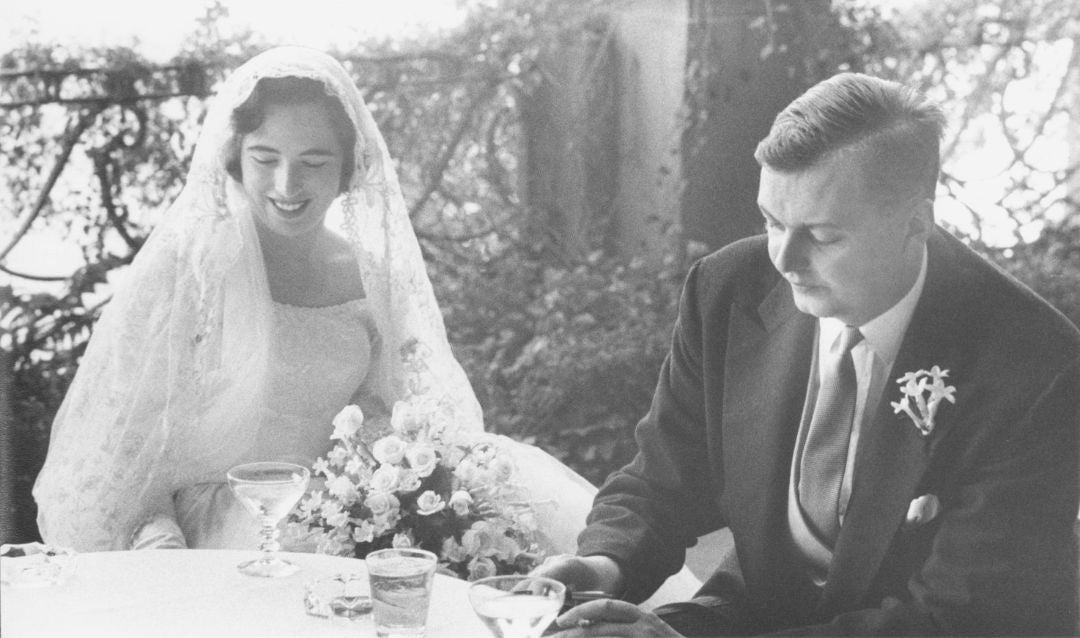
Mimi and William A.V. Cecil at the reception following their wedding.
In 1957, she married William A.V. Cecil at St. Vincent Ferrer’s Roman Catholic Church in New York City. In 1960, the Cecils moved to Asheville, NC to raise their family and to oversee the management and preservation of Biltmore, which was created by his grandfather George W. Vanderbilt. Upon their return, Biltmore was transformed into a privately owned, profitable, working estate that was named a National Historic Landmark in 1963.
While supporting her family’s endeavors at Biltmore, Mrs. Mary Cecil became a legend in her own right within the community. Known for her relaxed and approachable manner, she was a familiar figure in the world of non-profit leadership, and devoted her life to making a difference in the areas of education, social inequities, the environment, and the arts.
She was a trustee and served 14 years as Chair for North Carolina Environmental Defense. In 1995, in recognition of her devotion and support of the organization, the Board of Trustees and Staff elected her Chair Emeritus, expressing their deep and lasting appreciation, respect, and love for her dedication to the welfare of the organization and her lifelong efforts to insure the overall betterment of North Carolina.
Mrs. Mary Cecil was a founding board member of the Nature Conservancy and Friends of the Smokies, and was recognized for 20 years of stewardship by the National Park Service for her work with Friends of the Smokies. She also served on the Board for the North Carolina Zoological Society.
In 2007, The French Broad River Garden Club and The Garden Club of America presented the Zone Conservation Award to Mrs. Cecil for her inspiring dedication to the conservation of our environment, natural resources, and mountain heritage.
She served as Chairman of the Community Foundation of North Carolina board for a decade, and was Chair of the Warren Wilson College Board of Trustees from 1998–2005.
Mrs. Mary Cecil was a supporter of the Asheville Symphony and Guild, the Asheville Art Museum, the Health Adventure, the United Way, and the National Forest Foundation. She was also active with the Buncombe County Board of Education, Hospitality House, John C. Campbell Folk School, and the National Parks Conservation Association.
She volunteered with the Mission Health System for 20 years and was a long-time member of The Biltmore Company’s Board of Directors.
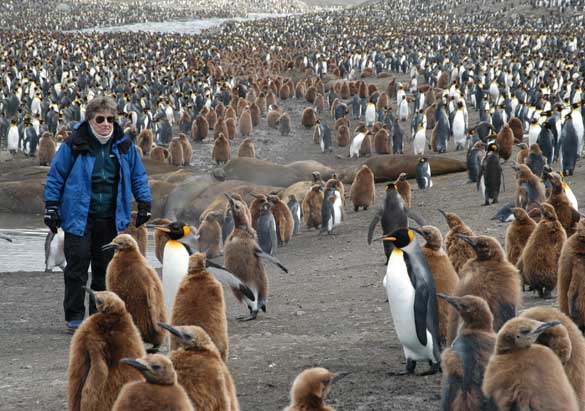
Mrs. Cecil in South Georgia, Antarctica, 2004.
Mrs. Cecil was devoted to her family, sharing her love of travel, especially with her five grandchildren. As each grandchild reached the age of ten, they were able to pick a travel experience to share with her, creating a memorable tradition that spanned generations.
In the book Lady on the Hill, Mr. Cecil (1928–2017) recognized Mimi Cecil for her integral part in Biltmore’s success story and in supporting those efforts for more than 45 years. “She has been a wonderful wife and mother and has offered her considerable gifts, skills, and abilities to our community, our mountains, and our country. I am profoundly in her debt,” he stated.
Mrs. Cecil is survived by her son, William A.V. “Bill” Cecil Jr., and daughter-in-law Virginia “Ginger” Cecil; her daughter, Diana “Dini” Cecil Pickering and son-in-law George “Chuck” Pickering II, brother John J. Ryan III, and sister-in-law Jacqueline Ryan; five grandchildren; and two great-grandchildren.
It’s always fun to add new holiday decorations to your overall design, and this season you can recreate a classic figure with a fresh, new twist. Wine Cork Reindeer made from corks and twigs are inexpensive and easy to make. And just like snowflakes, no two are alike.
Materials
(4) 2” Dry twigs
(1) 1” Dry twig
2 Dry twigs that branch off
Raffia
Drill and 5/32 drill bit
Hot glue gun and glue sticks
2 Wine corks
Small red bead
Green sheet moss
Instructions for Wine Cork Reindeer
Drill 4 small holes into one side of a wine cork. These will hold the reindeer’s legs.
Flip the wine cork over, and drill one more hole on the other side near the end of the cork. This will hold the reindeer’s neck.
To make the head, take the second cork and drill a small hole near the end of it. Then flip it over, and drill two more holes on the other side.
Add a dab of hot glue and then push a 2” dry twigs into each of the four holes in your first wine cork to make the reindeer’s legs.
Add hot glue and a 1” dry twig in your second wine cork.
Then attach the two corks together, creating the reindeer’s body.
Next, add your reindeer’s antlers. Put hot glue in the top two holes of the head, and add the twigs that branch off.
To really give your reindeer personality, add a small red bead for his nose, then tie a charm or bell on the raffia and hang it around the neck.
Create a small holiday herd of Wine Cork Reindeer and place them in a bed of moss, or hang several in your tree. These fun, festive reindeer are sure to add holiday cheer to any room in your home. Want to continue the fun? Our Frosted Lanterns make a beautiful backdrop glow for your reindeer herd.
Frosted Lanterns are a classic way to brighten up your holiday decorating, but buying them in bulk can get pricey. You can get this same look using glass jars and simple crafting materials for cents on the dollar. The process is easy and in the end you’ll be left with a treasure to share for many Christmas’s to come.
Materials
Glass jars
Self-adhesive stickers
Painter’s tape
Frosted glass spray paint
Double sided tape
22 Gauge wire (about 32 inches per jar)
Needle nose pliers
Tweezers
Protective gloves
Battery operated candles
Instructions for Frosted Lanterns
Create a pattern on the jar using painter’s tape and stickers.
Spray the jar lightly and evenly with frosted glass spray paint. Be sure to wear gloves and work outside in a well-ventilated area.
When the spray is dry, use tweezers to carefully peel off the tape and stickers. Try not to touch or scrap the frosted area. Let the jar sit for an hour, then add the handle.
Use needle nose pliers to cut a piece of 22 gauge wire. Wrap it around the neck of the jar once and twist it thoroughly into place. Take the excess wire and create a loop, twisting the end securely to the other side of the jar, creating the handle.
Put a small square of double sided mounting tape on the bottom of a tea light and place on the bottom of your lantern. Use battery operated candles if you plan to place your lanterns near greenery or children and pets.
These sweet, simple frosted lanterns will light your entry way, brighten your home, and provide a warm welcome for holiday visitors. Want to keep the fun going? Take a look at our Christmas Wine Cork Reindeer walkthrough! Reindeer made from wine corks and twigs are inexpensive and easy to make.

.jpg)


 A vision for the future
 The success of Olmsted’s protégées is also directly attributable to his mentorship, from Biltmore’s first forest manager Gifford Pinchot’s who went on to serve as the first chief of the U.S. Department of Agriculture Forest Service to Chauncey Beadle, Biltmore’s estate supervisor who managed and nurtured Olmsted’s designs for more than 50 years.
 Plan your visit now